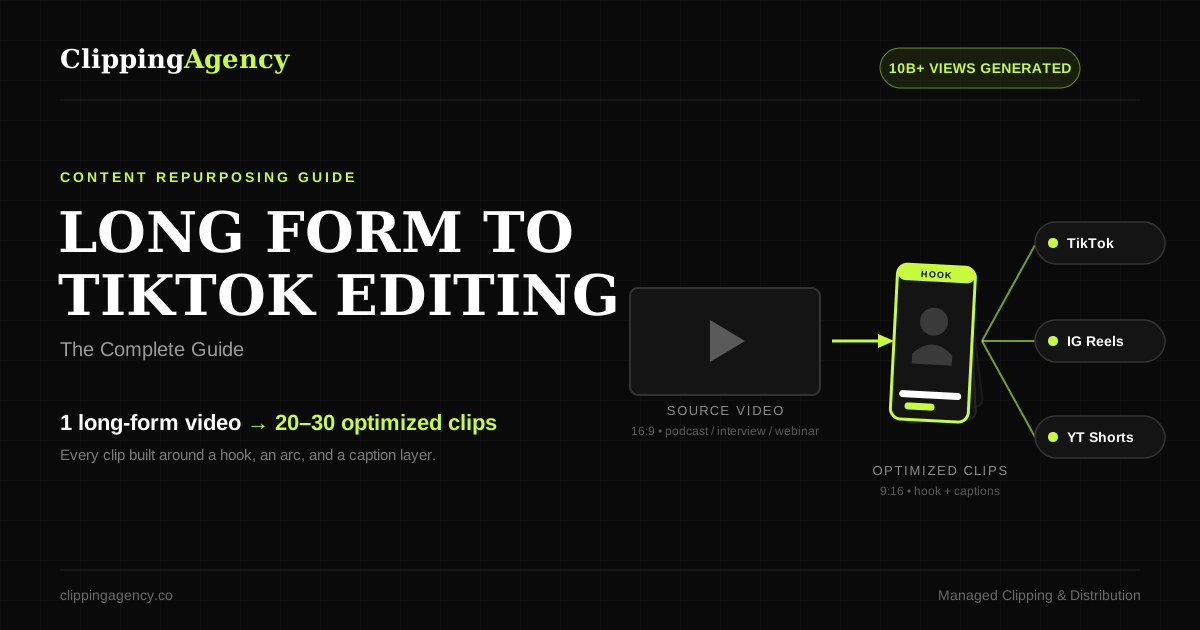

QUICK ANSWER Vertical video repurposing is the process of extracting high-retention moments from long-form video content, reformatting them into 9:16 aspect ratio clips, and distributing those clips across short-form platforms like TikTok, Instagram Reels, and YouTube Shorts. A single one-hour recording can produce 20 to 60 standalone vertical clips, each formatted with platform-native captions, optimised hooks, and correct dimensions for maximum algorithmic reach.
Vertical Video Repurposing: The Complete Strategy Guide
What Is Vertical Video Repurposing?
Vertical video repurposing is a content production and distribution strategy that converts existing long-form video recordings into short, vertical-format clips built for short-form platform feeds.
The term covers two distinct operations that must happen together:
Reformatting refers to the technical conversion of a horizontal or square video into a 9:16 portrait orientation, along with adjustments to captions, pacing, hook structure, and clip length to match the consumption behaviour on each specific platform.
Repurposing refers to the editorial process of identifying which moments from a long recording carry enough standalone value to work as an independent short-form video. Not every minute is clippable. The best moments are opinions, revelations, emotional peaks, one-liner insights, and demonstrable results.
When both operations run as a repeatable system, one recording becomes a content library. One podcast episode becomes 20 clips. One YouTube video becomes a month of distribution. One livestream that most creators let expire in the VOD archive becomes 30 pieces of searchable, shareable, algorithm-friendly vertical content across three platforms simultaneously.
Why Vertical Video Is Now the Default Format for Reach
Short-form vertical content has not just grown. It has restructured how audiences discover content entirely.
| Platform | Monthly Active Users | Avg. Daily Time Spent | Primary Format |
| TikTok | 1.8 billion | 95 minutes | 9:16 vertical |
| Instagram (Reels) | 2 billion | 53 minutes | 9:16 vertical |
| YouTube Shorts | 2.5 billion | 48 minutes | 9:16 vertical |
People now spend more time in vertical short-form feeds than on any other content format online. The implication for creators and brands is direct: if your content does not exist in vertical format, it effectively does not exist for most of the discoverable web.
The average horizontal YouTube video reaches the subscribers who already follow that channel. A vertical clip distributed across hundreds of accounts on TikTok, Reels, and Shorts reaches people who have never heard of you, on a feed that is algorithmically built to surface content to users who will find it relevant. That is the structural reason vertical video repurposing outperforms almost every other form of organic reach generation available to creators and brands in 2026.
The Vertical Video Repurposing Process: How It Actually Works
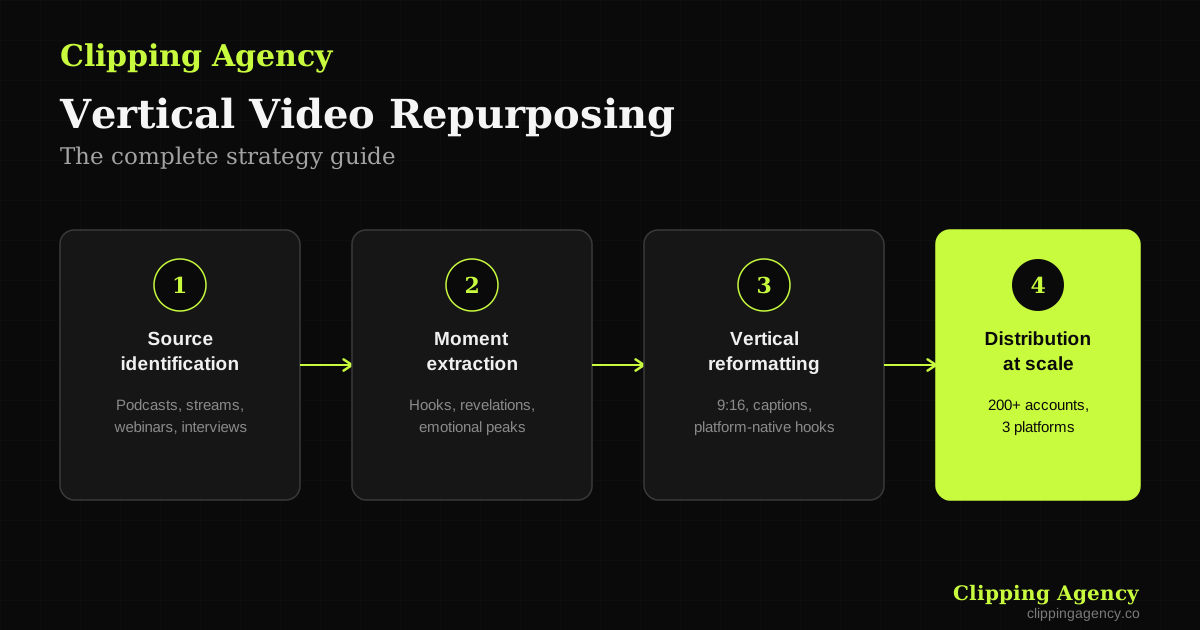
A well-run vertical video repurposing operation follows five stages. Understanding all five is what separates brands that see compounding growth from those who produce clips and see nothing happen.
Stage 1: Source Identification
Every repurposing workflow starts with the master recording. The best source content for vertical repurposing includes long-form YouTube videos, podcast episodes, livestream VODs, webinars, interviews, product demos, and founder talks. The longer and more insight-dense the original recording, the more clips it yields.
A 60-minute podcast episode is not one piece of content. It is a library of 20 to 40 potential standalone moments, each capable of independent distribution, independent discovery, and independent audience acquisition.
Stage 2: Moment Extraction and Clip Selection
The editorial layer of vertical repurposing is where most DIY attempts fall short. Identifying which moments will perform as standalone vertical clips is a skill developed through understanding platform behaviour, retention mechanics, and hook psychology.
The highest-performing clip moments share these characteristics:
- They open mid-thought or mid-tension, not with context-setting
- They contain a single, clear argument or revelation
- They resolve within 30 to 90 seconds
- They do not require prior knowledge of the creator or brand to be understood
This is why clip selection cannot be fully automated. AI tools can transcribe and segment, but they cannot reliably identify which segment will stop a scroll and hold attention through to the end.
Stage 3: Vertical Reformatting
This is the technical stage, and it involves more than changing an aspect ratio.
Aspect Ratio: All three major short-form platforms require 9:16 (1080×1920 pixels) for full-screen vertical display. Content that is letterboxed, pillarboxed, or centre-cropped from a 16:9 source without dynamic reframing loses significant screen real estate and signals to the algorithm that the content was not created natively for the platform.
Caption Strategy: Captions are not accessibility features in vertical video. They are retention tools. Research consistently shows that viewers watch vertical clips with sound off at significant rates, particularly on TikTok and Instagram. Captions should be styled in large, centred, single-line bursts that match the rhythm of the spoken word rather than full-sentence blocks.
Hook Writing: The first two to three seconds of a vertical clip determine whether the viewer keeps watching or swipes. The hook is not the beginning of the original recording. It is a reconstructed opening that surfaces the most compelling element of the clip immediately. Strong hooks name a specific outcome, contradict a common belief, or pose an unresolved question.
Clip Length: Platform-by-platform, optimal clip length varies. TikTok clips between 21 and 34 seconds consistently show strong completion rates. Instagram Reels performs well at 15 to 30 seconds for discovery-focused content and up to 90 seconds for educational content with strong retention curves. YouTube Shorts has shown strong performance at the 45 to 60-second range, where average view duration becomes a weighted ranking signal.
Stage 4: Platform-Native Formatting
Each platform has distinct formatting norms that affect how content is indexed, surfaced, and recommended.
TikTok rewards novelty and hook strength above all else. The algorithm is not heavily weighted toward follower count, which makes it the most accessible distribution channel for new or unfamiliar content.
Instagram Reels gives initial reach advantage to accounts with engagement history, but Reels from external accounts or new posts can still achieve broad reach through the Explore and Reels tabs when content triggers strong early engagement signals.
YouTube Shorts weights average view duration more heavily than the other two platforms. A clip that holds 80% of viewers to completion on Shorts will outperform a clip with higher initial plays but poor retention.
These behavioural differences mean a clip cannot simply be uploaded identically to all three platforms and expected to perform well on each. True vertical video repurposing accounts for these differences at the formatting and caption level.
Stage 5: Distribution at Volume
This is the stage that most solo creators and internal marketing teams cannot execute at the scale that produces compounding results.
Posting one vertical clip to one account once is not repurposing strategy. It is a single data point. The structural advantage of vertical video repurposing as a growth system comes from volume: multiple clips, posted across multiple accounts, on multiple platforms, simultaneously and consistently.
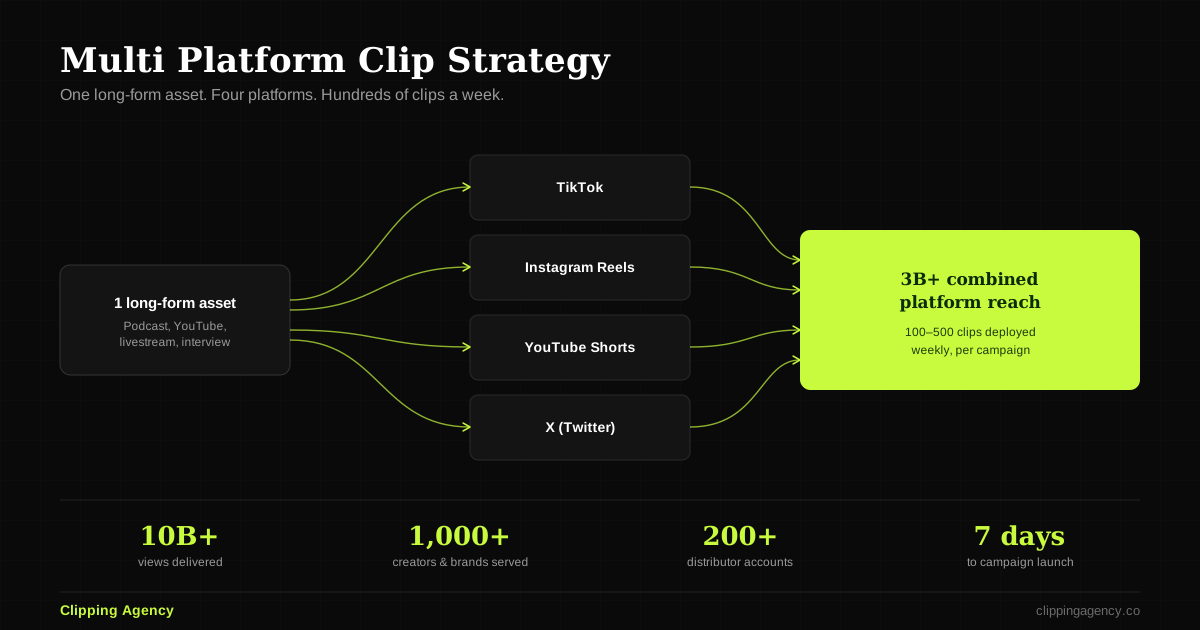
This is the model that Clipping Agency was built around. Where a single creator might manage three to five posts per week across one or two accounts, a managed clipping campaign deploys clips across hundreds of accounts simultaneously, turning one piece of long-form content into a mass distribution event rather than a single post.
Vertical Video Repurposing by Content Type
Different source content types require different clip extraction strategies. Here is how the approach shifts by format:
| Source Format | Avg. Clips Generated | Top Clip Type | Primary Platform |
| Podcast episode (60 min) | 20 to 40 clips | Opinion moments, hot takes | TikTok, Reels |
| YouTube video (30 min) | 10 to 20 clips | Tutorial highlights, results | Shorts, TikTok |
| Livestream / stream (2 hrs) | 30 to 60 clips | Reactions, moments, gameplay | TikTok, Reels |
| Webinar (60 min) | 15 to 25 clips | Stats, insights, frameworks | Reels, Shorts |
| Interview (45 min) | 15 to 30 clips | Quotable answers, debate | TikTok, Shorts |
The content type also determines the hook format. A podcast clip hooks with a provocative opinion. A tutorial clip hooks with a stated outcome. A livestream clip hooks with a moment already in progress. Matching hook style to content type is one of the more overlooked optimisation variables in vertical video repurposing.
What Vertical Video Repurposing Is Not
Auto-captioning is not repurposing. Adding captions to an unedited recording and uploading it vertically does not constitute a repurposing strategy. Without clip selection, hook engineering, and platform-native formatting, a captioned full recording performs no better than an uncaptioned one.
AI clip tools are not a distribution system. AI-powered highlight extractors can accelerate the editing workflow. They do not replace editorial judgment in moment selection, and they do not solve the distribution problem. A clip that sits on one account reaches one account’s audience. The leverage in vertical video repurposing comes from where and how many places a clip gets distributed, not just from how quickly it was cut.
Reformatting is not the same as reframing. Cropping a 16:9 video to a 9:16 frame by cutting off the sides is not vertical reformatting. It is aspect ratio cropping. True reformatting involves dynamic reframing that keeps the subject in focus, adjusts for the vertical viewing experience, and treats the phone screen as the native canvas rather than as a cropped version of a wider frame.
Our recent breakdown of clipping agency vs AI clipping tools covers this distinction in depth if you want to understand where automated tools stop and managed strategy begins.
The Compounding Effect: Why Volume Produces Non-Linear Results
One of the most important and least discussed dynamics in vertical video repurposing is that its value does not scale linearly with clip volume.
A single clip posted to a single account has a finite reach ceiling determined by that account’s existing audience size and the algorithm’s willingness to push it beyond followers. But 40 clips posted across 200 accounts over four weeks creates 8,000 distribution events, each drawing from a different audience segment, each building independent discovery paths back to the original creator or brand.
The reach is not additive. It compounds. Each clip that performs drives the algorithm to surface similar content from the same network. Each new follower acquired through a clip becomes a future viewer for subsequent clips. Each piece of external traffic generated by a short-form clip feeds the platform’s interest graph for the original creator’s profile.
This is why brands and creators who implement vertical video repurposing at scale consistently report non-linear growth curves. The first month sees a views increase. The second month sees the follower and inbound inquiry effect. By the third month, organic reach from short-form clips consistently outperforms equivalent spend on paid social for most content categories.
Clipping Agency clients have generated over 10B+ views using this exact compounding distribution model, built on top of short-form clipping services that handle clip production and multi-account distribution as a fully managed system.
Common Mistakes in Vertical Video Repurposing
Starting with the wrong clip length. Many brands default to 60 seconds because it feels like a safe middle ground. In reality, the right clip length is determined by the retention curve of the specific content, not by a platform average. A 22-second clip with 95% average view duration outperforms a 60-second clip with 40% retention on every short-form platform.
Ignoring platform-specific caption styling. A caption format that works on TikTok (large, bold, centred, word-by-word) can feel jarring on YouTube Shorts, where viewers tolerate slightly more text on screen. Applying one caption template across all three platforms is a missed optimisation opportunity that shows up directly in retention data.
Treating repurposing as a one-time project. Vertical video repurposing is not a campaign. It is an infrastructure. Brands that run it as a one-time sprint, producing 20 clips from one recording and stopping there, never reach the distribution volume required to trigger compounding. The system needs to be always-on and fed with new source material regularly to maintain algorithmic momentum.
Using hooks pulled directly from the middle of the original video. The opening of a long-form video is almost never the right hook for a vertical clip. Long-form openings are designed for viewers who have already chosen to watch. Vertical hooks are designed for viewers who are mid-scroll and have not committed to anything yet. Clips that begin with ‘So as I was saying earlier…’ stop performing before the algorithm ever decides to push them.
Vertical Video Repurposing vs. Short-Form Video Production
A question that comes up frequently from both creators and brand marketing teams is whether vertical video repurposing is the same as short-form video production.
| Vertical Video Repurposing | Short-Form Video Production | |
| Source material | Existing long-form recordings | Net-new content created for short-form |
| Cost per clip | Lower (existing asset) | Higher (requires production) |
| Volume potential | High (20 to 60 clips per recording) | Low (1 video per production session) |
| Editorial effort | Moment selection and reformatting | Full script, shoot, and edit |
| Time to publish | Days from existing footage | Weeks from concept |
| Distribution scale | Multi-account network | Typically single account |
The two approaches are not mutually exclusive. The most effective content strategies layer both, using original short-form content for brand-building and repurposed clips from long-form recordings for volume distribution. But for creators and brands with an existing library of long-form content, vertical video repurposing is the faster, more scalable path to short-form presence.
For a deeper look at how we handle the distribution layer, see how our clipping marketing system turns short-form clips into a full acquisition channel.
FAQs: Vertical Video Repurposing
What is vertical video repurposing?
Vertical video repurposing is the process of converting long-form video recordings into short, 9:16 formatted clips optimised for TikTok, Instagram Reels, and YouTube Shorts. It includes moment selection, aspect ratio reformatting, caption styling, hook writing, and platform-native distribution.
What aspect ratio is used in vertical video repurposing?
The standard aspect ratio for vertical video repurposing is 9:16, which corresponds to a 1080×1920 pixel frame. This fills a full phone screen without letterboxing or pillarboxing, and is the native format required for full-screen display on TikTok, Instagram Reels, and YouTube Shorts.
How many clips can be repurposed from one video?
The number of clips varies by source content length and density. A 30-minute YouTube video typically yields 10 to 20 clips. A 60-minute podcast episode typically produces 20 to 40 clips. A two-hour livestream can generate 30 to 60 clips when processed by an experienced clipper.
What is the ideal clip length for vertical video repurposing?
Ideal clip length depends on the platform and content type. TikTok performs well at 21 to 34 seconds for discovery content. Instagram Reels works across 15 to 90 seconds. YouTube Shorts performs best at 45 to 60 seconds, where average view duration is a significant ranking factor.
Does vertical video repurposing work for brands or only creators?
Vertical video repurposing works effectively for both. Creators use it to expand audience reach from existing content without producing more. Brands use it to distribute product demos, founder interviews, webinars, and campaign footage across short-form feeds without building a dedicated short-form production team.
What makes a vertical clip perform well algorithmically?
A high-performing vertical clip has a hook that creates tension or curiosity in the first two to three seconds, maintains high average view duration through a single focused argument or moment, uses captions that match the spoken rhythm, and is formatted natively for the target platform’s aspect ratio and pacing norms.
Can AI tools replace a vertical video repurposing service?
AI tools can accelerate clip extraction and caption generation but cannot replace editorial judgment in moment selection, hook writing, or platform-specific formatting. They also do not solve the distribution problem. A managed service combines editorial expertise with a clipper network that distributes clips across hundreds of accounts simultaneously.
How long does it take to see results from vertical video repurposing?
Most creators and brands see measurable increases in short-form content output and view counts within the first 30 days of a managed repurposing system. Follower growth and inbound inquiry effects typically become visible in months two and three as the compounding distribution model builds algorithmic momentum.
The Bottom Line: Why Hire Clipping Agency for Vertical Video Repurposing
Most creators and brands who try to run vertical video repurposing in-house hit the same ceiling. They can produce clips. They cannot produce clips at the volume and distribution scale that makes the strategy actually work.
Clipping Agency is not a tool. It is not a freelancer. It is not an AI highlight reel generator. It is a fully managed content distribution engine built specifically to run vertical video repurposing at the scale where compounding results become inevitable.
Here is what that looks like in practice. You send your long-form recordings. Our team identifies the highest-retention clip moments, engineers hooks for each platform, reformats every clip to 9:16 with platform-native captions and pacing, and then deploys those clips across a network of hundreds of accounts on TikTok, Reels, and Shorts simultaneously. You do not hire editors. You do not manage clipper payouts. You do not chase quality control. You receive views, followers, and inbound reach.
We have generated over 10B+ views for creators and brands using this exact system, and we have done it without a single dollar of paid media. Every view comes from clipping campaigns that turn your existing content into a mass distribution network.
The brands and creators growing fastest right now are not producing more content. They are getting more out of the content they already have. Vertical video repurposing is how that happens. And Clipping Agency is how it happens at scale.
Every Day You Wait, A Competitor Gets the View
We recruit, train, and manage a clipping army that distributes your content across 50–500 accounts on TikTok, Reels, and Shorts simultaneously. One upload becomes hundreds of posts. Every single day.
Trusted by 1,000+ creators · 10 Billion+ views generated