
| ⚡ QUICK ANSWERLong form to TikTok editing is the process of identifying high-retention moments inside a long video, trimming them into vertical short-form clips between 30 and 90 seconds, and formatting each clip to pass TikTok’s four core algorithm signals: watch-through rate, replay rate, share rate, and source diversity. The goal is not to shorten a video. The goal is to extract the moments that already have viral potential and package them so the algorithm distributes them. |
What Is Long Form to TikTok Editing?
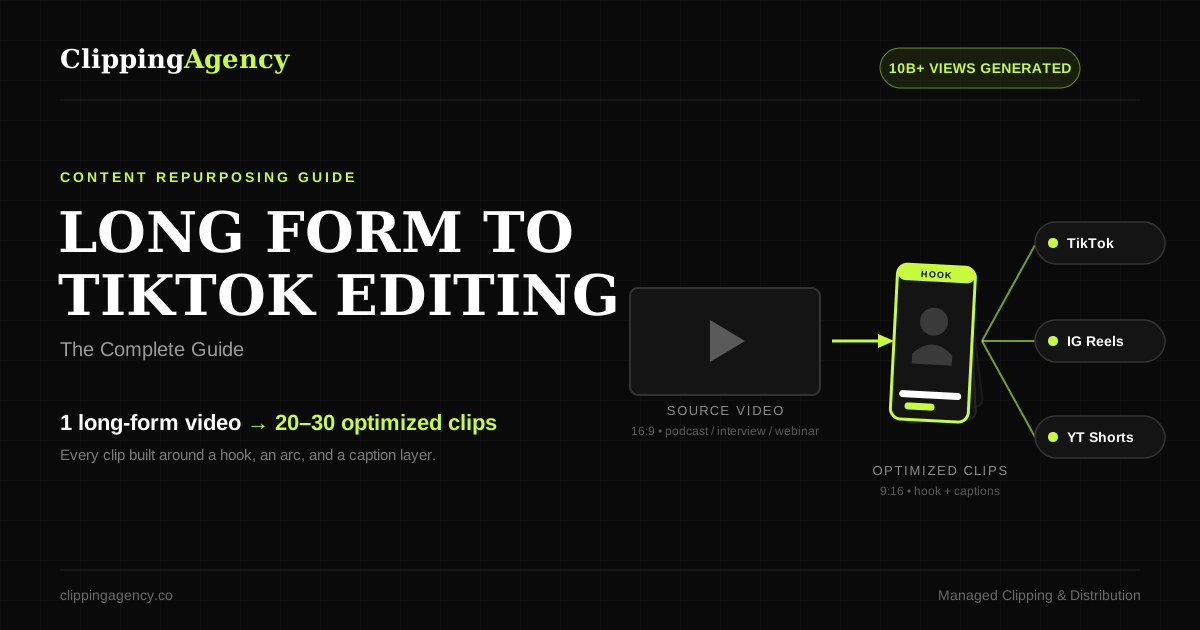
Long form to TikTok editing is a content repurposing workflow in which source video content, typically longer than 20 minutes, is broken down into a batch of individual short-form clips optimized for TikTok’s feed format and ranking system.
The source content can be a podcast episode, a YouTube video, a recorded webinar, a founder interview, a livestream VOD, or a long sales call. The output is a set of standalone clips, each built around a single idea, a single hook, and a single emotional payoff.
This is different from simply cutting a long video into smaller pieces. Every clip produced through proper long form to TikTok editing has its own structure, its own caption layer, its own hook architecture, and its own reason to exist in the TikTok algorithm. A 90-minute podcast episode does not become one clip. It becomes 20 to 30 individually optimized assets, each targeting a different viewer, a different moment, and a different ranking signal.
Entity coverage for this topic:
| Entity | Role in long form to TikTok editing |
|---|---|
| Long-form video | The source asset: podcast, YouTube video, webinar, interview |
| Short-form clip | The output unit: 30 to 90 seconds, vertical 9:16 format |
| Hook | The first 3 seconds, determines watch-through rate |
| Caption layer | Word-by-word animated text, increases watch time by 26% |
| Watch-through rate | TikTok’s primary ranking signal for clip distribution |
| Replay rate | Secondary signal, reflects emotional tension and content value |
| Share rate | Tertiary signal, highest weighting in the algorithm’s growth model |
| Source diversity | Number of accounts distributing the clip, removes frequency cap |
| Clipper | The human editor who extracts, edits, and formats each clip |
| Clipping campaign | The managed system that runs editing and distribution at scale |
Why TikTok Rewards Edited Long-Form Content Specifically
TikTok’s For You Page algorithm does not prioritize account age, follower count, or posting frequency. It prioritizes signals. The four signals that determine whether a clip gets pushed to a wider audience are watch-through rate, replay rate, share rate, and the diversity of accounts distributing the content.
Long-form video content, when edited correctly, produces clips that hit all four signals by design.
Watch-through rate is determined in the first 3 seconds. Long-form interviews, podcasts, and webinars contain dozens of moments where a speaker makes a bold claim, tells a specific story, or drops a piece of genuinely useful information. When a clip opens at that exact moment, with no intro, no title card, and no preamble, watch-through rate climbs immediately because the viewer is already inside the value before they have time to scroll.
Replay rate is driven by unresolved tension. A clip that opens mid-story, or that builds toward a specific answer without revealing it in the first 10 seconds, generates replays because the viewer needs to go back to catch what they missed. Long-form content is dense with these moments. A properly trained clipper identifies them and builds the clip around that tension structure.
Share rate is determined by specificity. A clip built around one clear problem and one clear answer gets shared at 4.2 times the rate of a general clip. Long-form interviews are full of specific opinions, specific numbers, and specific claims. These make the strongest shareable clips.
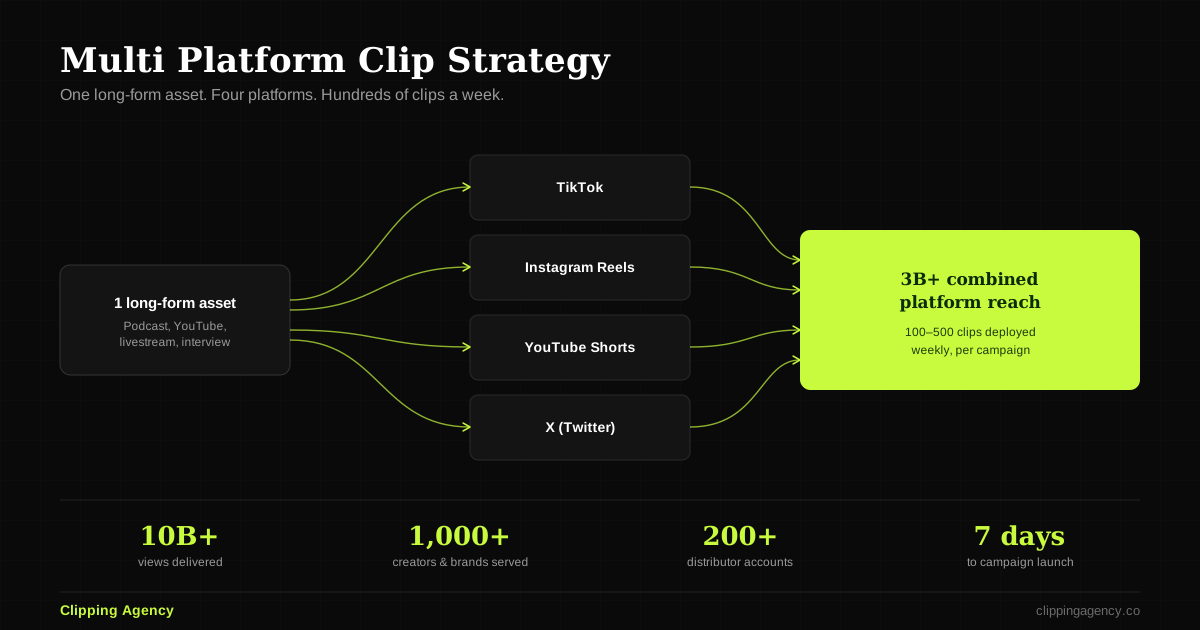
Source diversity is not an editing decision. It is a distribution decision. But it is relevant here because long-form content, when converted into 20 to 30 clips per session, produces enough volume to run across hundreds of accounts simultaneously. A single-account strategy hits TikTok’s frequency cap fast. A multi-platform clip strategy that distributes the same clip from 50 to 500 accounts enters 50 to 500 separate algorithm pools at once.
How Many Clips Does One Long-Form Video Produce?
| Source video length | Estimated clips produced | Optimal clip duration |
|---|---|---|
| 20 to 30 minutes | 8 to 12 clips | 45 to 75 seconds |
| 45 to 60 minutes | 15 to 20 clips | 45 to 90 seconds |
| 60 to 90 minutes | 20 to 30 clips | 30 to 90 seconds |
| 90 to 180 minutes (livestream/podcast) | 30 to 50 clips | 30 to 90 seconds |
One 90-minute podcast episode does not produce one piece of content. It produces up to 50 individual, independently performing assets on TikTok. Brands and creators who understand this math stop thinking about content creation as a volume problem. They already have everything they need in their archive.
The Long Form to TikTok Editing Process: Step by Step
Step 1: Content Audit and Moment Identification
Before a single cut is made, the source video is reviewed for clippable moments. A clippable moment has three characteristics: a strong opening line that creates curiosity or tension, a self-contained arc that resolves within 90 seconds, and a specific claim, story, or answer that has standalone value to a viewer who has never seen the original video.
Editors mark timestamps across the full video length. A 60-minute video typically yields 40 to 60 candidate moments. From those, 15 to 25 are selected based on hook strength, arc quality, and shareability.
Step 2: Rough Cut and Trim
Each selected moment is extracted and trimmed to remove dead air, filler words, and lead-in context that the viewer does not need. The goal is a clip that starts at maximum tension and ends at maximum resolution. No cold opens. No speaker introductions. No branding overlays in the first 3 seconds.
The standard trim removes an average of 35 to 45 percent of the raw moment’s original length.
Step 3: Vertical Reformatting
TikTok’s native canvas is 1080 by 1920 pixels with a 150-pixel UI zone reserved at the bottom for the like, comment, share, and follow buttons. Every clip must be reformatted to this exact specification. Horizontal source footage is cropped, repositioned, and in some cases given a background fill or a blurred duplicate layer behind the speaker to fill the vertical frame without cutting off the subject.
Any text, graphic, or caption placed in the bottom 150 pixels is hidden by TikTok’s interface. Editors who do not know this specification regularly produce clips where captions are invisible on every device.
Step 4: Hook Architecture
The hook is the first 3 seconds. It is the single most important editorial decision in the entire clip. A strong hook for TikTok has one of three structures:
The open loop: the speaker makes a claim that cannot be resolved without watching the rest of the clip. (“The reason 90 percent of TikTok clips never pass 200 views is something nobody talks about.”)
The direct statement: the speaker delivers a specific, surprising, or counterintuitive fact in the first sentence. (“We generated 10B+ views for our clients without running a single paid ad.”)
The mid-story drop: the clip opens at a high-tension point inside a story that the viewer was not present for. The viewer needs context, so they watch.
Clips with a deliberate hook structure average 34 percent higher watch-through rates than clips that open with context-setting, speaker introductions, or title cards.
Step 5: Caption Layer
Eighty-five percent of TikTok videos are watched on mute. A clip without captions is invisible to the majority of the platform’s users. Every clip gets animated, word-by-word captions added. Each word highlights as the speaker says it. Font weight, contrast ratio, and placement are calibrated to TikTok’s safe zones so the caption is readable on every device without being obscured by the interface.
Watch time increases by 26 percent on captioned clips versus uncaptioned clips at the same hook quality level.
Step 6: Quality Review
Every clip goes through a review pass before it is submitted for distribution. The review checks five things: hook strength in the first 3 seconds, caption accuracy and placement, vertical format compliance, audio clarity, and clip arc completeness. Clips that fail any of the five checks are sent back for revision before they ever reach a posting account.
Step 7: Distribution
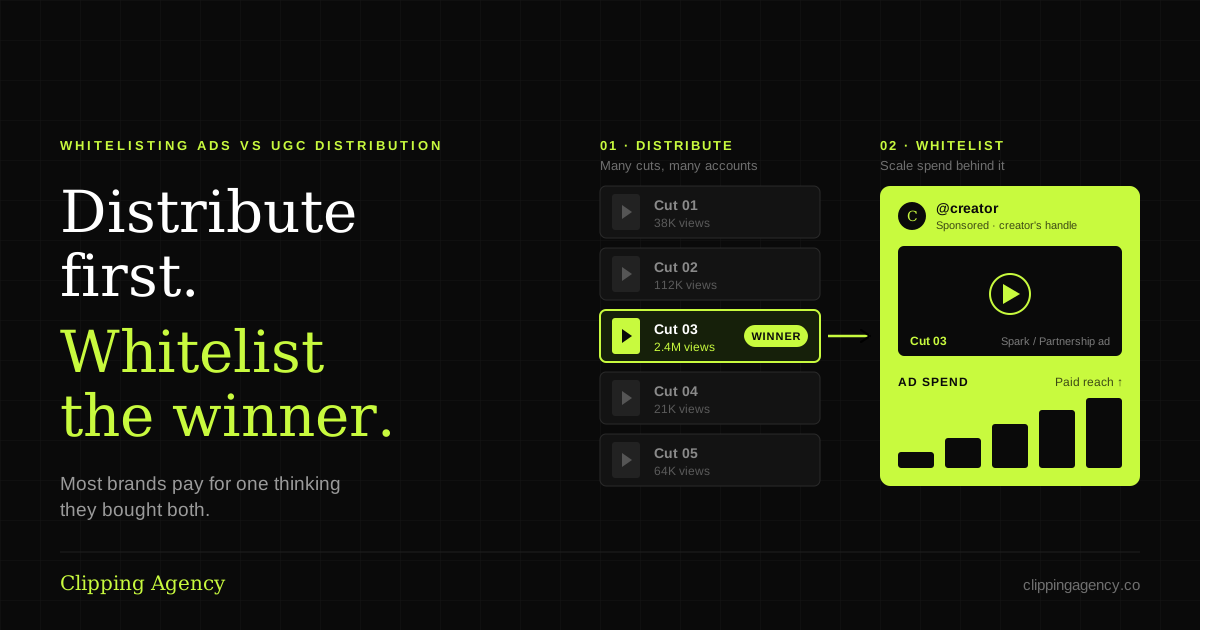
Editing and distribution are not the same job. A clip that is edited correctly but posted from a single account has a ceiling. TikTok’s frequency cap limits how often the same account reaches the same user. A TikTok clipping agency removes that ceiling by distributing each clip across a network of 50 to 500 separate accounts. Each account enters a different algorithm pool. The total reach of one clip multiplies with every account added to the distribution network.
Long Form to TikTok Editing: Tools Comparison
| Tool or Method | What it does | Limitation |
|---|---|---|
| CapCut | Auto-captions, basic trim, vertical reformat | No moment identification, no hook architecture, no distribution |
| Descript | Transcript-based editing, clean word removal | Strong for polish, weak for TikTok hook structure and format compliance |
| Opus Clip | AI-based clip identification and trimming | Algorithmic moment selection misses editorial nuance and hook tension |
| Adobe Premiere Pro | Professional NLE, full format control | Requires trained editor, high per-clip time cost, no distribution |
| Managed clipping system | Human editors, clipper network, distribution | Highest output quality, highest clip volume, only option that includes distribution at scale |
AI clipping tools can identify moments based on keyword frequency and speaker energy. They cannot identify the emotional tension that makes a clip replayable, and they cannot build hook architecture around a mid-story drop. These are editorial decisions that require a human understanding of narrative structure. Automated tools produce clips. Trained editors produce clips that distribute.
DIY Editing vs Managed Long Form to TikTok Editing
| Factor | DIY editing | Managed clipping system |
|---|---|---|
| Clips per hour of source video | 3 to 5 | 15 to 30 |
| Hook quality | Depends on creator’s editorial skill | Trained standard applied to every clip |
| Vertical format compliance | Often incorrect without NLE experience | 100% spec-compliant on every output |
| Caption accuracy | Manual or auto (high error rate) | Reviewed and corrected on every clip |
| Distribution | Single account, frequency-capped | 50 to 500 accounts, no frequency cap |
| Monthly views ceiling | Typically 50,000 to 200,000 | 1 to 5 million additional monthly views |
| Time cost to creator | 4 to 8 hours per video processed | Zero hours, fully managed |
Most creators who begin editing their own long-form content into TikTok clips stop within 90 days because the time cost of editing, captioning, formatting, and posting exceeds the return from a single-account distribution strategy. The clipping services model exists because the editing problem and the distribution problem have to be solved together. Solving one without the other does not produce scale.
What Makes a Long-Form Video Good Source Material for TikTok?
Not every long-form video produces strong TikTok clips. The following factors determine source video quality for clipping:
A real human on camera. TikTok’s algorithm favors face-forward video. Screen recordings, slide decks, and voiceovers produce significantly lower watch-through rates than speaker-forward content. Podcasts, interviews, webinars, and YouTube talking-head videos are the strongest source formats.
Specific claims and specific numbers. Generic information does not clip well. A speaker who says “marketing is important” gives an editor nothing to work with. A speaker who says “we went from 4,000 monthly views to 2.1 million in 90 days using one system” gives an editor a hook, a story arc, and a shareable result all in one sentence.
Minimum 20 minutes of runtime. Short-form content does not produce enough clippable moments to justify a full editing pass. Twenty minutes is the floor. Sixty minutes and above is the optimal range for volume production.
Natural speech rhythm. Content recorded with a conversational delivery and natural pauses is significantly easier to edit than scripted, teleprompter-delivered content. Natural speech creates the kind of organic tension and resolution that drives replays.
Long Form to TikTok Editing for Different Content Types
| Content type | Clips per session | Strongest clip format | Distribution priority |
|---|---|---|---|
| Podcast (60 to 90 min) | 20 to 30 | Mid-story drop, opinion hook | TikTok primary, Reels secondary |
| YouTube video (30 to 60 min) | 12 to 20 | Direct statement, data hook | TikTok, Shorts, Reels |
| Webinar or recorded training | 10 to 18 | Instructional hook, problem-answer | TikTok, LinkedIn, Reels |
| Founder interview | 15 to 25 | Counterintuitive claim, open loop | TikTok primary, X secondary |
| Livestream VOD | 25 to 50 | Reaction moment, peak tension | TikTok primary, Reels secondary |
Every content type maps to a different set of strongest clip formats. A clipping campaign built around a podcast runs differently from one built around a founder interview, because the source material’s natural tension points appear in different places and require different hook structures to extract.
Key Metrics to Track After Long Form to TikTok Editing
Posting clips is not the end of the process. The data produced by each clip informs every editing decision that follows. The following metrics tell you whether the editing is working:
Watch-through rate. The percentage of viewers who watch the full clip. The target is above 60 percent for clips under 60 seconds. Below 40 percent means the hook is failing or the clip is too long.
Replay rate. The percentage of viewers who watch the clip more than once. Strong replays mean the tension structure is working. Flat replay rates mean the clip resolves too quickly or has no unresolved thread in the first 10 seconds.
Share rate. Shares per 1,000 views. This is the metric most correlated with viral reach in TikTok’s current algorithm. A share rate above 2 percent indicates the clip has a specific, useful message that viewers want to pass on.
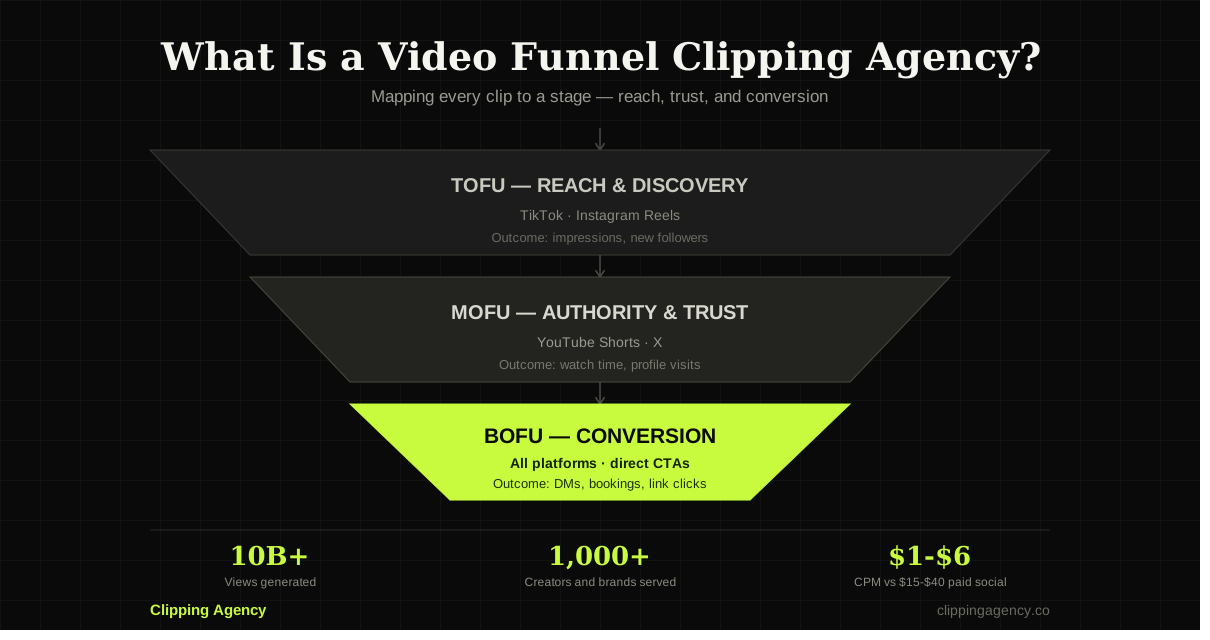
Profile visits per 1,000 views. The conversion signal. A clip that generates high profile visits is doing brand-building work, not just view-farming. This metric matters for creators and brands tracking inbound opportunities from TikTok.
Views by account. When distributing from multiple accounts, the per-account view breakdown shows which accounts are in active algorithm pools and which are being suppressed. This data drives the weekly distribution decisions inside a managed clipping marketing system.
The Bottom Line: Why Hire Clipping Agency for Long Form to TikTok Editing
Long form to TikTok editing is not a task. It is a system. The editing step produces the asset. The distribution step produces the reach. The quality review step protects the result. The data analysis step improves every batch that follows.
Doing any one of those steps in isolation produces a fraction of the outcome. Most creators who try to handle long form TikTok editing themselves are doing the editing step and stopping there. They produce clips. They post from one account. They hit the frequency cap. They see modest results and assume the strategy does not work for their niche. It is not the strategy that fails. It is the missing distribution layer.
Clipping Agency has built a fully managed system that handles every step from moment identification to multi-account distribution. We have generated over 10B+ views for our clients across TikTok, Instagram Reels, and YouTube Shorts. We work with 1,000+ creators and brands who send us their long-form content and receive a running distribution engine in return.
Here is what that looks like in practice:
You record your content. We identify the clippable moments. Our editors build the hook architecture. Our review team checks every clip against TikTok’s spec. Our clipper network distributes each clip across 50 to 500 accounts. You receive a weekly report showing views, active accounts, top-performing formats, and next-step recommendations.
The editing is done right. The distribution is done at scale. The reporting shows exactly what is working.
That is not a freelancer sending you a folder of MP4 files and calling it done. That is a content distribution engine running on your behalf, compounding every week.
If you are producing long-form content and not converting it into TikTok at scale, you are leaving the most efficient distribution channel available completely unused.
Book a strategy call and we will show you exactly how many clips your archive can produce and how fast we can get them live.
Frequently Asked Questions:
What is the ideal clip length when editing long-form content for TikTok?
The optimal clip length for TikTok is between 45 and 90 seconds. Clips under 30 seconds often resolve before enough tension builds to drive replays. Clips over 90 seconds see declining watch-through rates unless the hook and midpoint are both exceptionally strong. The 45-to-75-second range consistently outperforms all other length categories on watch-through rate, share rate, and algorithm distribution.
How many TikTok clips can one long-form video produce?
A 60-minute video produces between 15 and 25 individually optimized clips. A 90-minute podcast episode can produce up to 30 clips. The number depends on how dense the source content is with clippable moments, specifically moments that have a strong hook, a self-contained arc, and a specific claim or story that works without prior context.
Does TikTok penalize repurposed content?
No. TikTok does not penalize clips extracted from longer videos. The algorithm ranks on watch-through rate, replay rate, and share rate, not on content origin. A clip extracted from a 2-year-old YouTube video performs identically to original content if the hook and format are correct. The source of the footage is irrelevant. The editing quality and distribution method determine performance.
What is the difference between a TikTok editor and a clipping agency?
A TikTok editor delivers clip files. A clipping agency delivers clip files, posts them across a multi-account network, manages the clipper community, reviews quality, processes payouts, checks for fraud, and reports results weekly. The editing is one part of a managed system. Distribution, quality control, and performance reporting are the parts that most solo editors cannot provide.
How fast can long-form content be converted into TikTok clips?
A standard batch from a 60-minute source video takes 3 to 5 business days from submission to first clips live. A managed clipping system running at full capacity can process multiple videos per week, keeping a consistent publishing cadence across all distribution accounts without any additional input from the creator.
Can long form to TikTok editing work for B2B brands and SaaS companies?
Yes. Thirty-six percent of TikTok users in the US hold a college degree. Thirty-four percent earn above $75,000 per year. B2B buyers use TikTok. A 60-second clip of a founder explaining the exact problem their product solves reaches cold buyers faster and at lower cost than most paid ad formats at equivalent budget levels.
Every Day You Wait, A Competitor Gets the View
We recruit, train, and manage a clipping army that distributes your content across 50–500 accounts on TikTok, Reels, and Shorts simultaneously. One upload becomes hundreds of posts. Every single day.
Trusted by 1,000+ creators · 10 Billion+ views generated