
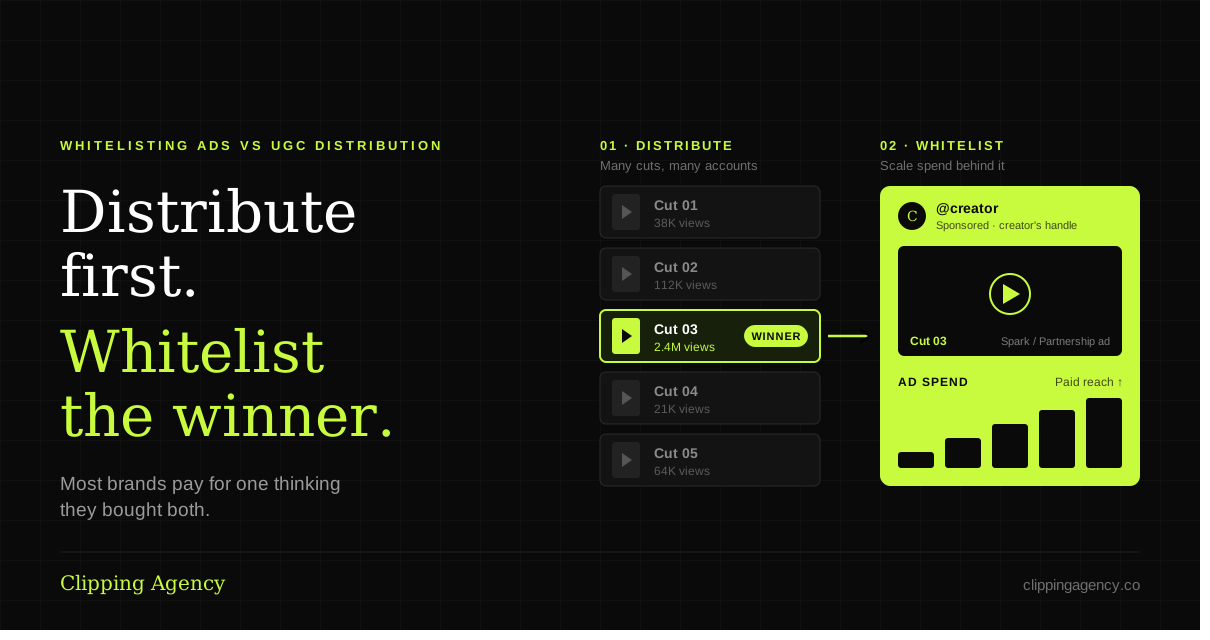
One scales spend behind a post that already worked. The other finds which post deserves it.
Most brands pay for one thinking they bought both.
| 10B+Views Delivered | 1,000+Creators Managed | 30 DaysAvg. to First Viral Clip |
| QUICK ANSWERWhitelisting ads are paid promotions that run from a creator’s own handle, scaling ad spend behind a single proven post. UGC distribution sends distinct cuts of your content across many creator or clipper accounts natively, paid per verified view. Distribute first to find the winner. Whitelist the winner to scale it. |
What Are Whitelisting Ads?
Whitelisting ads (also written as allowlisting or creator licensing) are paid advertisements that run from a creator’s own social account rather than from your brand page. The viewer sees a person’s name and face at the top of the ad, not a logo. The creator grants your ad account permission to promote the post, and you control the spend and targeting.
Neither TikTok nor Meta use the term “whitelisting” officially. On TikTok the feature is called Spark Ads. On Instagram and Facebook it is called Partnership Ads, previously known as branded content ads. The difference between whitelisting and simply buying paid usage rights is whose account the ad runs from: paid usage rights put the creative inside your brand account; whitelisting puts it inside theirs.
The appeal is authenticity at scale. Ads that appear to come from a real creator outperform brand-page ads on engagement and click-through, because the viewer trusts a person over a logo. But that trust only compounds when the content already earned it organically, which is where clipping campaigns become essential.
| Route | Whose handle runs the ad | What you need from the creator | Platform name |
| Paid usage rights | Your brand account | The video file plus a licence covering paid use | N/A |
| Spark Ads | The creator’s TikTok account | A video code from the post’s ad settings (7, 30, 60 or 365 days) | TikTok |
| Partnership Ads | Creator’s handle, brand’s handle, or both | A partnership ad code per post, or account-level permission (revocable any time) | Meta (Instagram / Facebook) |
What Is UGC Distribution, and Why It Is Not the Same Thing?
UGC distribution is getting one piece of content posted natively by many creator or clipper accounts simultaneously, each with its own unique cut, paid per verified view rather than per ad impression. There is no ad auction, no targeting decision you make, and no single handle the reach depends on. Each post lands in its own account’s feed, and the platform’s recommendation engine decides how far it travels.
The critical phrase is its own cut. TikTok’s algorithm does not recommend duplicated content. Instagram makes Reels that have already been posted on Instagram less visible. Pushing one file through thirty accounts does not generate thirty separate attempts at reach. It generates one reach event, repeated badly. Real distribution requires distinct edits, distinct openings, distinct captions, each posted by a different account to a different existing audience.
This is what clipping services solve at the structural level. A trained clipper network does not repost your original file. It produces individual cuts, each one a genuine editorial version of your long-form content, and distributes them simultaneously across platforms. That is what creates real distribution surface.
| 10B+Total views generated through clipping campaigns | 10xAvg. short-form output increase in 30 days | 1 to 5MAdditional monthly views on TikTok and Reels |
Whitelisting Ads vs UGC Distribution: The Core Difference
Both are paid. Both involve creators. Both put your content in front of people who do not follow you yet. But the job each one does is entirely different. Confusing them means spending budget on whitelisting a post nobody tested, or distributing content at such low volume it never finds a winner.
| Signal | Whitelisting Ads | UGC Distribution |
| What it scales | Spend behind one proven post | The number of attempts and audiences reached |
| Who picks the viewer | Your targeting in the ad auction | Each account’s existing audience and platform recommendations |
| Content duplication risk | None (one post per handle) | None when each account uses a distinct cut |
| Requires ad spend | Yes, plus creator licensing fee | No, paid per verified view |
| Best entry point | After a winner is identified | Before you know which cut wins |
| FTC disclosure required | Yes | Yes, payment counts as a connection to disclose |
When Should You Use Whitelisting? When Should You Distribute?
Use whitelisting when a specific post has already earned it organically. TikTok’s own Spark Ads documentation recommends choosing posts that already have an established number of organic likes and views, because content that performs organically tends to outperform when used as an ad. Whitelisting multiplies what is already working. It cannot tell you what works.
Use UGC distribution when you have a library of content but no proven winner. You want many distinct cuts in front of many different audiences simultaneously. You want to find the hook, the opening second, the caption format that holds watch time before committing ad spend to any of them. Distribution is the research phase. Whitelisting is the scale phase.
The brands wasting the most budget on whitelisting are the ones who skip the distribution phase entirely. They pay a creator to authorize a post, load ad spend behind it, and discover after four weeks that the post was never the problem. The audience was fine. The cut was wrong. A structured clipping marketing approach avoids this by running distribution at volume before a single dollar of ad spend is committed.
| Situation | Right move |
| You have a viral organic post with strong watch time and shares | Whitelist it |
| You have a folder of UGC but no standout performer yet | Distribute first |
| You need conversions tracked inside an ads manager | Whitelist it |
| You want reach across audiences no single account already owns | Distribute |
| You want to test multiple hooks and openings simultaneously | Distribute |
| You want to scale an audience you defined with targeting | Whitelist it |
How Whitelisting and UGC Distribution Work Together
The strongest strategy runs them in sequence. Distribution is phase one. Whitelisting is phase two. The two tools are not competitors. They solve consecutive problems in the same content marketing cycle.
Research from Motion’s 2026 Creative Benchmarks, which analysed over 578,000 Meta ad creatives across 6,000 advertiser accounts, found that roughly 5% of creatives qualify as winners. That means 95 out of every 100 pieces of creative do not reach their potential. The number of distinct attempts at finding a winner is the most controllable variable in the whole system. Distribution increases that number dramatically before you spend on whitelisting a single post.
| 1 | Cut the source into distinct versionsDifferent hooks, different first seconds, different captions and edits of the same source content. Each cut must be a genuine new version, not a repasted copy, or the platform’s duplicate filter removes the distribution advantage entirely. |
| 2 | Distribute the cuts across many accounts nativelyA managed clipper network posts each cut from a separate account on TikTok, Reels, and Shorts. Native posting bypasses the repost suppression both platforms apply to content pushed from brand accounts. Each post is disclosed as paid where required. |
| 3 | Read the signal, not the noiseCompare watch time, share rate, and the proportion of views coming from non-followers. A cut that holds attention consistently across multiple accounts and audiences is a genuine winner. A single lucky day is not. Look for the pattern, not the outlier. |
| 4 | Secure the authorization for the winnerAsk the account that posted the winning cut for a Spark Ads code or Meta Partnership Ad permission. Agree the term, the fee, and what happens if permission is withdrawn, in writing, before the budget goes in. A TikTok code lasts 7, 30, 60, or 365 days. |
| 5 | Run the winner while testing the next oneKeep new cuts going out through distribution while the winning post runs as a whitelisted ad. Budget behind one post is not a growth plan. The next winner is already in your content library. Distribution finds it while whitelisting monetizes the current one. |
What a Clipping Campaign Actually Does in This System
A clipping campaign is a fully managed distribution infrastructure. It is the operational layer that makes UGC distribution work at real volume. Rather than sourcing individual creators to post one or two videos, a clipping campaign recruits, vets, and pays a structured network of clippers, each one making their own edit and posting it from their own account across TikTok, Instagram Reels, and YouTube Shorts simultaneously.
The output is not impressions on a single post. It is hundreds of native posts, each unique, each reaching a different existing audience, each generating watch time data that tells you which version of your content actually holds attention. That data is what makes your whitelisting budget intelligent instead of speculative.
Clipping Agency has generated over 10B+ views for clients using this system. The campaigns operate on a CPV model, meaning you pay for verified views on posts that performed, not for impressions on posts that did not. The operational infrastructure, including Whop setup, clipper onboarding, submission review, quality control, payout processing, and performance tracking, is fully managed. You supply the long-form content. The distribution engine does the rest.
The Mistakes That Waste Budget on Both Sides
Most budget waste in both whitelisting and distribution comes from the same root cause: treating content as confirmed before it has been tested. Here are the most common failure patterns and what each one costs.
| Mistake | What it costs | How to avoid it |
| Whitelisting a post nobody has tested organically | Full ad spend behind content that holds no attention | Distribute the cut first. Whitelist only after watch time confirms it |
| Pushing one file through multiple accounts | Duplication suppression removes distribution advantage entirely | Each account needs its own distinct edit of the source |
| Letting the Spark Ads code expire mid-campaign | Campaign goes dark mid-flight, wasting remaining planned spend | Agree the term before the creative is locked. Match it to your flight |
| Skipping FTC disclosure on distributed posts | Platform enforcement risk and audience trust damage | Payment or free product is a connection that must be disclosed |
| Treating distribution as a one-time push | One winning cut found, then the pipeline runs dry | Keep new cuts going out in parallel with any whitelisted winner |
| Leaving the licensing fee and term out of the contract | Creator revokes permission mid-campaign with no recourse | Document the term, the fee, and the revocation clause before spend begins |
Questions People Ask About Whitelisting Ads and UGC Distribution
What is the difference between whitelisting ads and UGC distribution?
Whitelisting ads are paid promotions running from a creator’s own handle. They scale ad spend behind a single post that has already proven itself organically. UGC distribution posts distinct cuts of your content across many creator accounts natively, paid per verified view. Distribution finds the winner. Whitelisting scales it.
Are Spark Ads the same as whitelisting?
Spark Ads are TikTok’s version of whitelisting. A creator authorizes a post through the post’s ad settings, generating a video code that lasts 7, 30, 60, or 365 days. The advertiser adds that code in TikTok Ads Manager and the post runs as an ad from the creator’s account, with views, likes, and follows attributed to the original organic post.
When should I use UGC distribution instead of whitelisting?
Use UGC distribution when you have a library of content but no identified winner yet. Distribution gives many distinct cuts many separate attempts at organic reach simultaneously. Once one cut consistently outperforms on watch time and share rate across multiple accounts and audiences, that is the cut worth whitelisting with paid spend behind it.
Can whitelisting and UGC distribution work together?
Yes, and the best campaigns run them in sequence. Distribute first at volume, identify the cut that holds attention, whitelist that winner to scale it with targeting, and keep distributing new cuts in parallel to find the next one. Running both simultaneously prevents the pipeline from running dry after a single whitelisted post.
What is a clipping campaign and how does it relate to UGC distribution?
A clipping campaign is a fully managed distribution system where an agency builds and operates a network of clippers who each post their own distinct cut of your content across TikTok, Reels, and Shorts simultaneously. It is the operational infrastructure that makes UGC distribution work at real scale, generating the watch time data needed to identify which content deserves whitelisting budget.
How much does whitelisting cost compared to UGC distribution?
Whitelisting costs a creator licensing fee plus the ad spend behind the post. UGC distribution is priced per verified view with no ad auction cost required. Brands that distribute first spend their whitelisting budget on posts already proven to hold attention, which significantly reduces wasted spend on creative that was never right for its audience.
Do distributed posts need an FTC disclosure?
Yes. The FTC considers payment or free product a material connection that must be disclosed regardless of which distribution route carries the content. Both whitelisting ads and natively distributed posts require disclosure across TikTok, Instagram Reels, and YouTube Shorts.
THE BOTTOM LINE
Why Clipping Agency Is the Right Partner for Both
You do not have to choose between finding the winner and scaling it. We run both phases for you: mass distribution to identify what holds attention, then the infrastructure to keep your content engine producing new winners every month.
| 10B+ Views Delivered | Our clipper network has generated over 10 billion views for creators and brands across TikTok, Instagram Reels, and YouTube Shorts. We know what holds attention because we track it at scale. |
| Built for Distribution Volume | Whitelisting one post is not a growth strategy. Our clipping campaigns run hundreds of distinct native posts simultaneously, generating the real-world data that makes your whitelisting spend defensible. |
| Fully Managed Operations | Clipper recruitment, Whop setup, submission review, quality control, payout processing, and performance tracking are all handled end-to-end. You create long-form content. We do everything else. |
| 1,000+ Creators. One System. | We work with over 1,000 vetted creators who know how to cut and post your content in ways that native algorithms reward. No duplication. No suppression. Real reach on real accounts. |
| You Own the Winners | Every cut that performs through distribution is yours to whitelist. We find the proof-of-concept. You decide where to put the budget. There is no guesswork in your ad spend when the watch time data already tells you the answer. |
| Results in 30 Days or Less | Most clients see a 10x increase in short-form content output and 1 to 5 million additional monthly views within the first 30 days. The system is built to move fast because attention does not wait. |
Book a Free Strategy Call at clippingagency.co
About Clipping Agency
Clipping Agency is the leading managed clipping and short-form content distribution agency for creators, podcasters, and brands. We have generated over 10B+ views for clients by building structured clipper networks that turn long-form content into mass-distributed short-form campaigns across TikTok, Instagram Reels, and YouTube Shorts.
Follow us on YouTube for clipping strategy, campaign case studies, and distribution frameworks.
Every Day You Wait, A Competitor Gets the View
We recruit, train, and manage a clipping army that distributes your content across 50–500 accounts on TikTok, Reels, and Shorts simultaneously. One upload becomes hundreds of posts. Every single day.
Trusted by 1,000+ creators · 10 Billion+ views generated