

Quick Answer: A music clipping campaign takes your existing content — studio sessions, interviews, live performances, music videos — and turns it into dozens of short-form clips distributed across TikTok, Instagram Reels, and YouTube Shorts simultaneously through a managed network of editors. Artists and labels using this model are generating millions of views per release without a single dollar in ad spend.
The music industry has a distribution problem and it is not the kind streaming platforms solve.
You can have a track on Spotify, Apple Music, and every DSP on the planet. You can run pre-save campaigns, pitch playlists, and hire a PR firm. And still, the song gets 3,000 streams and fades out before anyone outside your existing fanbase hears it.
The artists breaking through right now are not doing it by spending more on ads or chasing playlist spots. They are doing it by showing up everywhere, simultaneously, every single day — on TikTok For You pages, Instagram Reels feeds, and YouTube Shorts homepages — through a system that multiplies their content across hundreds of accounts at once.
That system is a music clipping campaign. And it is changing how artists and labels build audiences in 2026.
What Is a Music Clipping Campaign?
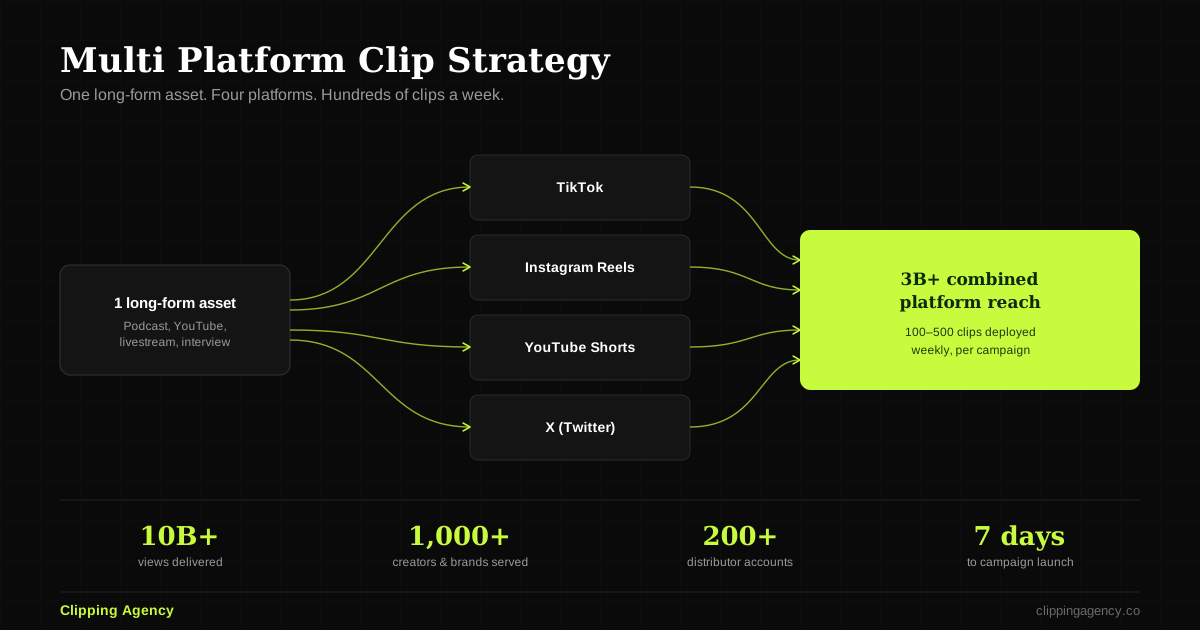
A music clipping campaign is a performance-driven content distribution system where long-form music content studio vlogs, interviews, live sets, music video shoots, podcast appearances, and behind-the-scenes footage is broken down into short-form clips and distributed across TikTok, Instagram Reels, and YouTube Shorts through a managed network of editors and clippers.
The difference between a music clipping campaign and standard social media content strategy is scale and infrastructure. A typical artist account posts once or twice a day. A clipping campaign deploys 50 to 500 independent accounts posting your content simultaneously, creating the volume and velocity that triggers algorithmic amplification.
One music video shoot. Thirty clips. Five hundred distribution points. That is not posting — that is a campaign.
The core entities involved in a music clipping campaign include:
- Content source: long-form music content (interviews, sessions, live footage, vlogs)
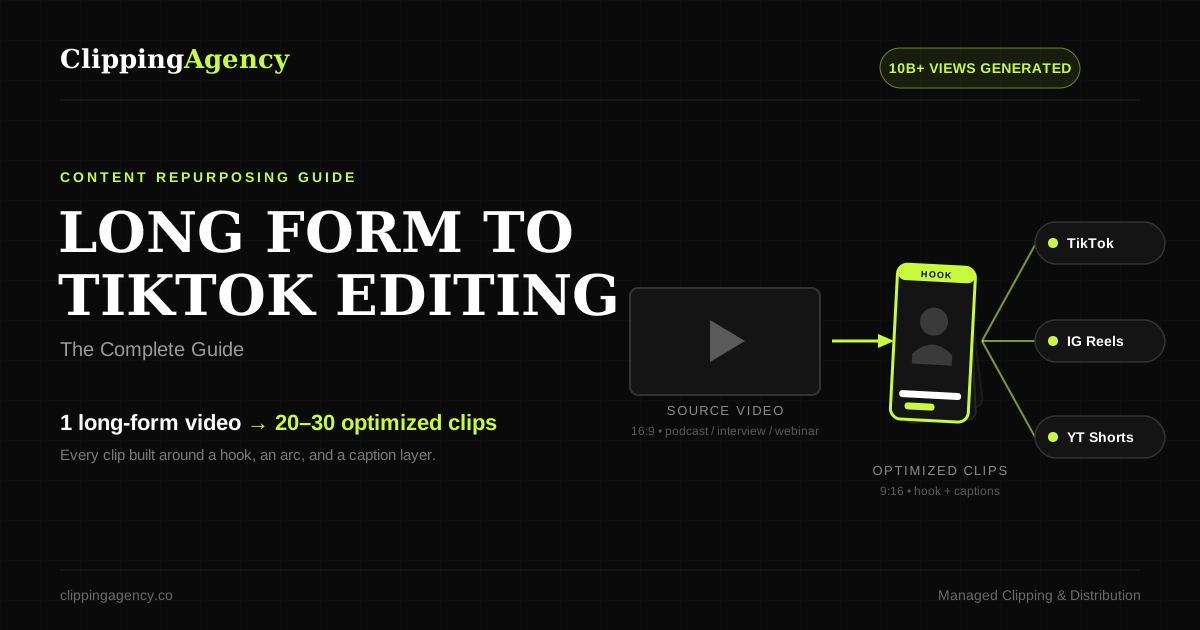
- Short-form clips: 15 to 90-second vertical videos extracted from source material
- Clipper network: a vetted community of editors who distribute clips across their own accounts
- Platform distribution: TikTok, Instagram Reels, YouTube Shorts — simultaneously
- Performance tracking: CPV (cost per view), reach, engagement rate, clip approval rate
- Payout infrastructure: clippers earn based on view performance, not flat fees
Why Music Artists and Labels Need a Clipping Campaign in 2026
The Algorithm Rewards Volume, Not Talent
Short-form platform algorithms do not care how good your song is on the first upload. They care about volume, velocity, and watch-time signals. A single account posting once a day has a fraction of the distribution surface area of a campaign running across hundreds of accounts simultaneously.
This is why artists with objectively great music stay invisible while songs with aggressive short-form presence dominate discovery feeds. The content is not the differentiator — the distribution infrastructure is.
Music Content Is Uniquely Clip-Ready
Most content categories require heavy editing to produce compelling short-form clips. Music content is different. A 30-second moment from a studio session, a 45-second live performance clip, a raw reaction when an artist hears their final mix — these are already built for viral short-form formats. They require minimal editing and deliver immediate emotional impact.
A 2-hour studio vlog contains 20 to 40 individually clippable moments. A 60-minute artist interview contains 15 to 30. A single music video shoot produces enough raw footage for an entire month of short-form content.
Streaming Growth Follows Short-Form Visibility
The relationship between TikTok visibility and Spotify stream velocity is well-documented. When a clip from a track or an artist’s content goes wide on short-form platforms, streaming numbers follow within 24 to 72 hours. A music clipping campaign creates the conditions for this to happen repeatedly, not just once per release cycle.
Music Content Distribution: Clipping Campaign vs. Other Channels
How a managed music clipping campaign compares to standard promotion methods:
| Distribution Method | Avg. Monthly Views | Ad Spend Required | Audience Targeting | Compounding Effect |
|---|---|---|---|---|
| Paid Social Ads (Meta/TikTok) | 500K–2M | $5,000–$20,000/mo | Yes (paid) | No — stops with budget |
| Spotify Playlist Pitching | Streams only | $0–$2,000/mo | Algorithm-controlled | Minimal |
| Brand Account (1 post/day) | 10K–200K | $0 | Organic only | Slow |
| Music Clipping Campaign | 1M–10M+ | $0 ad spend | Organic + multi-platform | Yes — compounds monthly |
| PR / Press Outreach | Variable | $3,000–$15,000/mo | Audience-dependent | Minimal |
What Content Works Best in a Music Clipping Campaign?
Not all music content clips equally well. The formats that consistently generate the highest view velocity in short-form distribution are the ones that deliver an emotional or informational payoff within the first three seconds — before a viewer can scroll past.
1. Studio Sessions and Behind-the-Scenes Footage
Raw studio content performs exceptionally because it is authentic and provides access that fans cannot get anywhere else. A producer showing how a beat was built, an artist reacting to a vocal take, or a candid conversation between collaborators — these moments stop the scroll because they feel unfiltered.
2. Artist Interviews and Long-Form Conversations
Interviews are clipping goldmines. A 60-minute artist interview produces 15 to 30 standalone clips that can be distributed over a 30-day campaign. The best clips are those where the artist says something surprising, vulnerable, contrarian, or deeply personal — moments that create an emotional reaction in the first two seconds.
3. Live Performance Footage
Live performance clips carry inherent energy that is difficult to replicate in studio environments. The combination of crowd reaction, artist performance, and ambient sound creates clips that perform well on all three platforms particularly YouTube Shorts, where music-adjacent content is heavily favored by the algorithm.
4. Reaction Moments and Milestones
Artists hearing their song for the first time on the radio. Seeing their first gold or platinum plaque. Reacting to a fan-made cover. These milestone moments are among the highest-performing clip types in music campaigns because they combine authenticity, emotion, and a clear narrative arc all within 30 to 60 seconds.
5. Music Video Shoot Footage
Behind-the-scenes content from music video shoots generates consistent engagement because it creates a preview narrative — viewers want to see the final product after watching the process. This content also pairs naturally with release day campaigns, where a coordinated clip surge coincides with the official video drop.
Platform Breakdown: Where Music Clips Perform Best
| Platform | Best Music Content Type | Ideal Clip Length | Key Algorithm Signal | Avg. CPV |
|---|---|---|---|---|
| TikTok | Artist moments, raw reactions, studio clips | 15–45 seconds | Watch completion + shares | $0.002–$0.004 |
| Instagram Reels | Polished clips, aesthetic sessions, collabs | 30–60 seconds | Saves + shares | $0.003–$0.005 |
| YouTube Shorts | Live clips, performances, music video BTS | 45–90 seconds | Watch time + subscriptions | $0.002–$0.006 |
How a Music Clipping Campaign Works: The Full Process
A properly run music clipping campaign is not a one-off content push. It is a continuous distribution engine that runs alongside every release, tour, or content milestone. Here is how Clipping Agency structures it from start to first clip live.
Phase 1: Content Audit and Campaign Architecture
Before a single clip is cut, the campaign infrastructure is designed around your content library. This includes identifying your highest-value long-form assets, mapping out clip types by platform (TikTok hooks differ from Reels formats differ from Shorts pacing), and defining campaign performance benchmarks CPV targets, view goals, and approval thresholds.
Phase 2: Clipper Network Recruitment and Onboarding
A music clipping campaign depends on a network of editors and fans who distribute clips across their own accounts. Clipping Agency recruits, vets, and onboards this network specifically for your content ensuring the accounts posting your clips have real audiences, active posting histories, and platform credibility that protects organic reach.
Phase 3: Clip Production and Format Optimization
Content is edited into platform-specific short-form clips. Every clip receives a hook in the first three seconds, platform-native captions, vertical formatting, and audio levels optimized for mobile playback. Music content often requires additional consideration around audio quality: a clip from a live performance, for example, is mixed differently than a studio session clip.
Phase 4: Campaign Launch and Coordinated Distribution
Clips are deployed across the clipper network simultaneously. For release-day campaigns, this surge posting creates the appearance of organic momentum multiple accounts, on multiple platforms, posting related content within the same 24 to 48-hour window. This is the volume and velocity pattern that algorithmic amplification responds to.
Phase 5: Performance Monitoring, Payouts, and Iteration
Campaign performance is tracked across every clip view, watch time, shares, saves, and CPV. Clippers receive payouts based on view performance. Top-performing clip formats are identified and scaled. Underperforming formats are adjusted. The campaign improves with each cycle because the data tells you exactly what is working.
Music Clipping Campaign vs. Paid Music Promotion: A Direct Comparison
Music artists and labels typically choose between three primary promotion channels for a new release: paid social advertising, PR and playlist pitching, or organic content strategy. A clipping campaign sits in a different category from all three.
Paid ads stop the moment your budget does. A clipping campaign builds compounding organic reach that keeps growing after the campaign ends.
| Factor | Paid Music Ads | PR / Playlist Pitching | Music Clipping Campaign |
|---|---|---|---|
| Upfront Cost | High ($5K–$20K+) | Medium ($3K–$10K) | Fraction of paid ads |
| View Quality | Paid impressions | Listener-dependent | Organic — high intent |
| Audience Authenticity | Low (algorithmic) | Medium | High — fan-driven |
| Release Window Timing | Fixed budget window | Slow (2–8 weeks lead) | Live within days |
| Compounding Effect | None | Minimal | Yes — builds monthly |
| Platform Coverage | 1–2 platforms | Streaming only | TikTok + Reels + Shorts |
Music and Short-Form Video: Key Facts and Figures
The numbers behind why music clipping campaigns work are not speculative. They reflect platform realities that artists and labels can build strategy around.
| Stat | Figure | Source / Context |
|---|---|---|
| TikTok monthly active users | 1.7 billion+ | Platform report, 2025 |
| YouTube Shorts daily views | 70 billion+ | Google, 2024 |
| % of TikTok users who discover new music on the platform | 75% | MusicWatch, 2024 |
| Avg. cost per view — clipping campaign | $0.002–$0.005 | Clipping Agency client data |
| Avg. cost per view — TikTok paid ads | $0.01–$0.03 | Industry benchmark |
| Views generated by Clipping Agency for clients | 10 Billion+ | Clipping Agency |
| Avg. clips per 60-min music interview | 15–30 clips | Clipping Agency production data |
| % of short-form videos that never break 1,000 views | 96% | Short-form platform analysis |
Who Should Run a Music Clipping Campaign?
A music clipping campaign is not right for every artist at every stage. But it is the right move for a specific set of situations where distribution scale produces results that no other channel can match.
Independent Artists with Existing Long-Form Content
If you have been recording studio sessions, doing interviews, or capturing performance footage and that content is sitting on a hard drive or a YouTube channel with limited reach. A clipping campaign turns that archive into an active distribution asset. You do not need to create anything new. You need your existing content working harder.
Labels Managing Multi-Artist Rosters
For labels managing multiple artists, a clipping campaign provides scalable short-form infrastructure without requiring a separate social team for each act. The same campaign architecture — clipper network, distribution system, performance tracking — runs across your full roster, with content customized per artist.
Artists Preparing for a Release
A release-day clipping campaign is designed to surge post across platforms on the day a single, album, or video drops. The coordinated volume creates the appearance of organic momentum which is exactly what streaming platform algorithms and social recommendation systems respond to.
Artists Who Have Plateaued on a Single Platform
If you are growing on YouTube but invisible on TikTok, or have Reels traction but no Shorts presence, a music clipping campaign provides cross-platform distribution from a single content source. One interview gets formatted for all three platforms simultaneously.
How Music Clipping Campaigns Connect to a Broader Content Distribution System
A music clipping campaign does not exist in isolation. It is one part of a broader content distribution engine that compounds over time as your clip library grows, your clipper network expands, and the algorithm learns to associate your content with high-retention signals.
Artists who get the most from clipping campaigns treat their short-form presence as a clipping marketing channel — not a one-time campaign. Each release adds to an ecosystem of clips that continue generating views long after the campaign ends. A studio session clip posted six months ago still circulates through recommendation feeds if it resonates.
For artists who also host podcasts or interview shows, the system works identically. Our podcast clipping agency infrastructure handles the full pipeline from episode to viral clip — the same system that powers music content campaigns, adapted for audio-first formats.
And for artists wanting to understand what makes a clip perform before committing to a full campaign, our short-form video agency overview explains how editing, hooks, and distribution interact to produce viral reach.
Why Hire Clipping Agency for Your Music Clipping Campaign?
Most music artists have tried the standard playbook. Paid ads that stop the moment the budget runs out. PR firms that take six weeks to get coverage that generates 800 streams. A social media manager posting twice a day to an account with limited reach. None of it solves the core problem: your content is not reaching people who do not already know you exist.
We built Clipping Agency specifically for this problem. Not a generic content agency that learned about clipping. A team that has built the infrastructure, the clipper networks, the quality control systems, and the payout architecture that turns long-form music content into millions of organic views — consistently, campaign after campaign.
We have generated over 10 billion views for artists, labels, creators, and brands using this exact system. Not through ad spend. Not through paid placements. Through scale, volume, and distribution infrastructure that works like a multiplier on content you have already created.
Here is what makes us different from every other option in the market:
- We manage everything — system setup, clipper recruitment, quality review, payout processing, campaign reporting. Your only job is to send us your content.
- We have built the clipper network that other agencies do not have. Real editors, real accounts, real audiences — not bots or recycled networks.
- We launch fast. A music clipping campaign can go live within days of your strategy call — not weeks.
- We optimize continuously. Every campaign generates data. We use that data to improve clip formats, hook strategies, and platform targeting every single week.
- We are trusted by artists and labels because we show our results in numbers — views, CPV, clips approved, accounts active — not in vague promises about ‘growing your presence.’
If your music deserves to be heard by more people — and it does — the question is not whether a clipping campaign works. The question is whether you want to keep waiting for the algorithm to find you, or build the infrastructure that puts you everywhere at once.
Book a free strategy call at clippingagency.co. We will audit your content, map out your campaign, and show you exactly how many views your existing footage can generate.
Frequently Asked Questions — Music Clipping Campaign
What is a music clipping campaign?
A music clipping campaign is a managed content distribution system where an artist’s or label’s long-form content — interviews, studio sessions, live footage, and music video material — is edited into short-form clips and distributed across TikTok, Instagram Reels, and YouTube Shorts simultaneously through a network of editors. The goal is organic view velocity without paid advertising.
How many views can a music clipping campaign generate?
Results vary by content volume and quality, but most campaigns generate between 1 million and 10 million views per month when running at full distribution capacity. Clipping Agency has generated over 10 billion views across its client base using this model.
Does a music artist need to create new content for a clipping campaign?
No. A music clipping campaign works from existing long-form content — footage you have already recorded but may not have fully distributed. Studio sessions, old interviews, live recordings, and music video shoot footage all qualify as source material for a campaign.
How is a music clipping campaign different from running paid music ads?
Paid music ads require ongoing budget and stop generating views the moment the campaign budget is exhausted. A music clipping campaign generates organic views through community-powered distribution — and the reach compounds over time as your clip library grows. Average CPV through clipping is $0.002 to $0.005 versus $0.01 to $0.03 for paid social advertising.
Which platforms does a music clipping campaign cover?
Clipping Agency runs music campaigns across TikTok, Instagram Reels, and YouTube Shorts simultaneously. Each platform receives clips formatted natively for its algorithm, aspect ratio, caption style, and pacing preferences.
How quickly can a music clipping campaign launch?
Clipping Agency can move a music campaign from strategy call to first clips live within days. For release-day campaigns tied to a specific drop date, the infrastructure is built and ready in advance so distribution can surge exactly when it matters most.
Do labels and managers need to manage the campaign themselves?
No. Clipping Agency handles the full operation — clipper recruitment, clip production, quality review, platform distribution, payout processing, and performance reporting. Labels and artist teams receive weekly reports with full campaign data and spend zero time on operations.
What type of music content generates the most views in a clipping campaign?
Raw, authentic moments consistently outperform polished content on short-form platforms. Studio sessions, candid artist reactions, live performance clips, and milestone moments — such as hearing a song on the radio for the first time — generate the highest watch completion rates and shares. Music video behind-the-scenes footage also performs strongly, particularly on YouTube Shorts.
Every Day You Wait, A Competitor Gets the View
We recruit, train, and manage a clipping army that distributes your content across 50–500 accounts on TikTok, Reels, and Shorts simultaneously. One upload becomes hundreds of posts. Every single day.
Trusted by 1,000+ creators · 10 Billion+ views generated