
⚡ QUICK ANSWER A content clip strategy is a structured system for extracting, editing, and distributing short-form video clips from long-form content — such as podcasts, YouTube videos, interviews, and livestreams — across platforms like TikTok, Instagram Reels, and YouTube Shorts. Instead of creating new content from scratch, a content clip strategy turns what you’ve already recorded into a high-volume distribution engine that compounds reach over time.
| 10B+Views generated for clients | 1,000+Creators & brands using clipping | 5–7×Lower CPV vs. paid ads | 10–30Clips per hour of content |
What Is a Content Clip Strategy?
A content clip strategy is the deliberate, repeatable process of turning existing long-form video into short-form clips — and distributing those clips across multiple platforms and accounts at volume. The word strategy is key here. Randomly cutting clips and posting them is not a strategy. A true content clip strategy has four components:
- Source identification — knowing which long-form content produces the highest-retention clips
- Clip selection criteria — a defined framework for choosing which moments to extract (hooks, value density, emotion)
- Platform-native formatting — editing clips to the specific ratios, captions, and pacing each platform rewards
- Distribution infrastructure — a system or clipper network that pushes clips across multiple accounts simultaneously
Without all four elements, you have content repurposing. With all four, you have a growth machine.
The term sits at the intersection of several established marketing concepts: content repurposing, short-form video distribution, social media clipping, and content atomization. What makes it distinct is the emphasis on systematic output at scale rather than one-off clip creation.
Why a Content Clip Strategy Matters in 2026
Short-form video now accounts for the majority of time spent on social platforms. TikTok alone crossed 2 billion monthly active users. Instagram Reels and YouTube Shorts have fundamentally reshaped how audiences discover new creators and brands. The algorithm no longer rewards the creator who posts the most — it rewards the creator whose content earns the highest engagement per view.
Clips — specifically well-selected, well-formatted clips from existing content — perform disproportionately well because they carry authentic moments from long-form sources. They feel native. They don’t look like ads. And because they’re extracted from content you’ve already produced, the cost of creating them is a fraction of producing original short-form content.
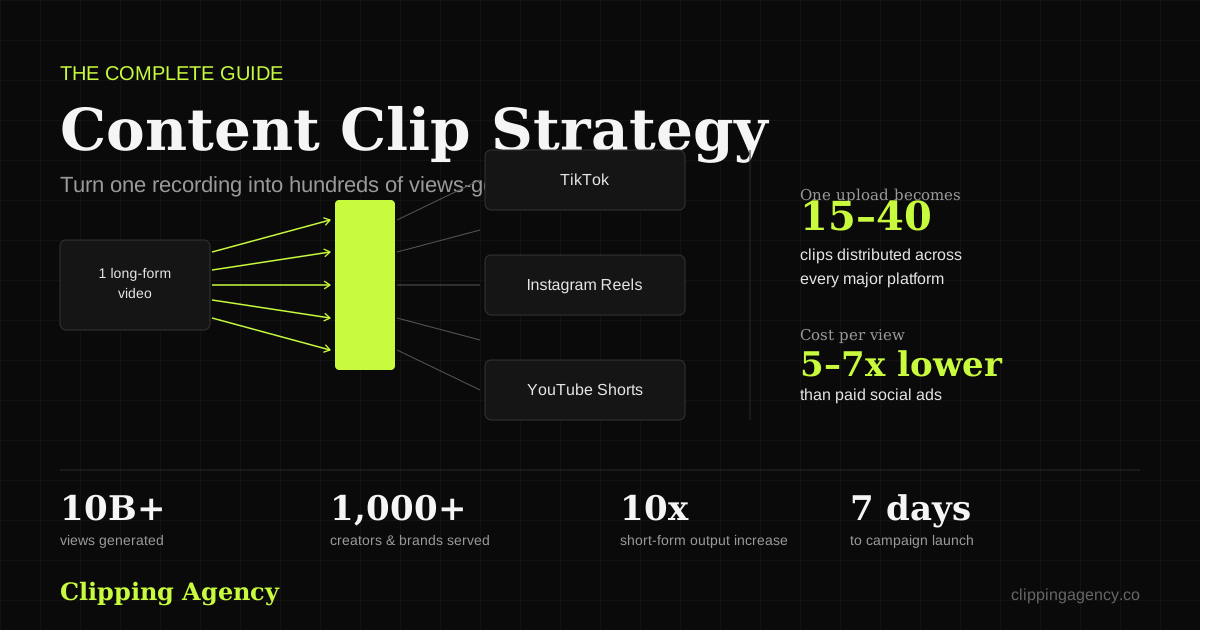
Industry reality check: Most creators publish one piece of long-form content and promote it once. A proper content clip strategy turns that same piece into 15–40 short clips distributed across multiple platforms over weeks — dramatically increasing the ROI on every minute you spend recording.
The brands and creators generating the most organic reach in 2026 are not the ones spending more time in front of a camera. They’re the ones who’ve built clipping services infrastructure that multiplies the value of what already exists in their content library.
Core Entities in a Content Clip Strategy
To understand how a content clip strategy functions, it helps to know the key entities involved — the people, tools, platforms, and concepts that make the system work:
The Content Creator or Brand (Source)
The entity producing long-form content — whether that’s a podcaster, YouTuber, brand founder, coach, or media company. The content creator owns the raw material that the entire clip strategy is built on.
Long-Form Source Content
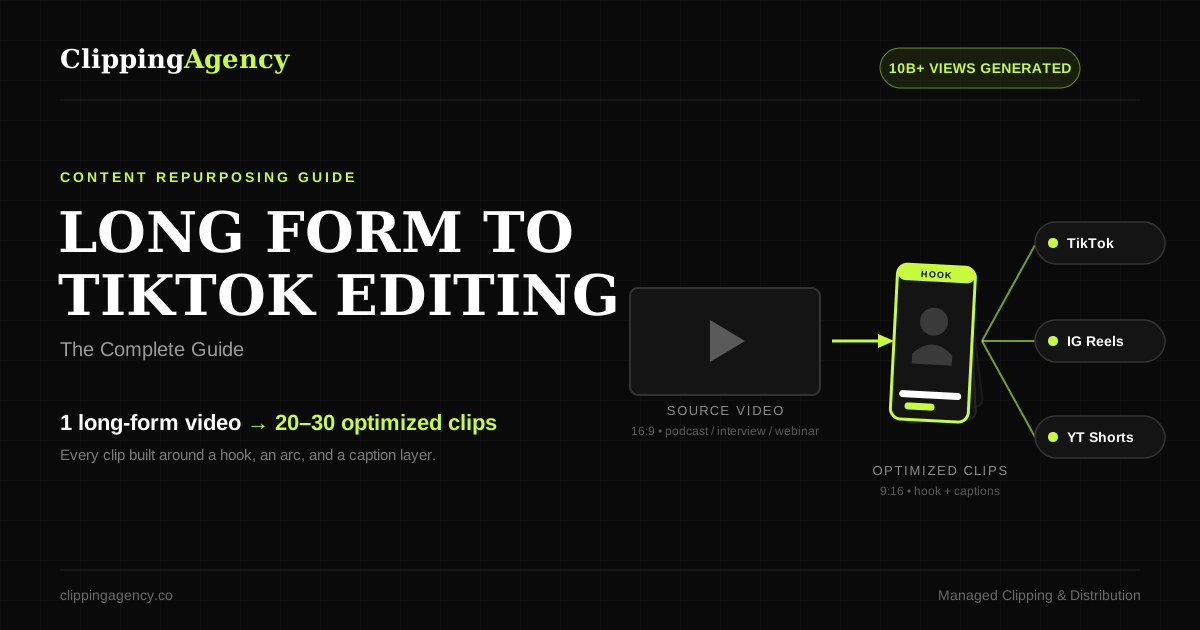
Podcasts, YouTube videos, livestreams, webinars, interviews, conference keynotes, and brand documentaries. The denser and more conversation-rich the source, the more extractable clip moments it contains. A one-hour podcast episode can realistically produce 20–30 high-performing clips.
Clippers (Editors / Distributors)
Clippers are independent editors who extract, format, and post clips on their own social accounts. In an organized clipping campaign, clippers earn performance-based payouts tied to verified views. This turns distribution into a community-powered system rather than a single-team bottleneck.
Short-Form Platforms
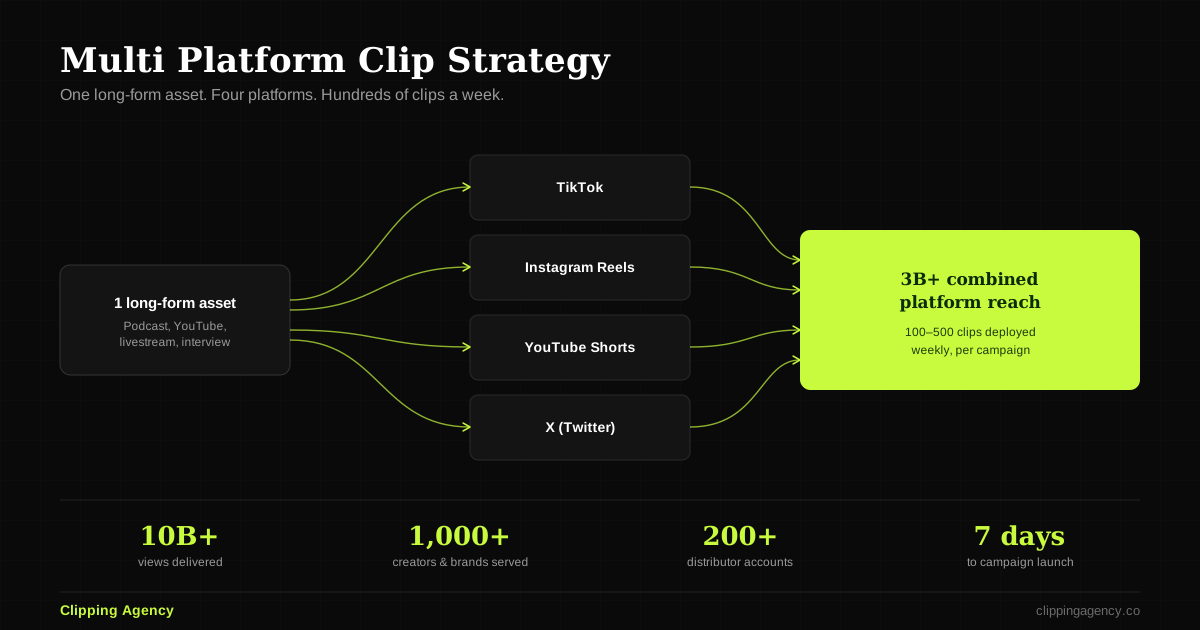
TikTok, Instagram Reels, and YouTube Shorts are the three primary distribution channels. Each has distinct algorithm behavior, optimal clip length, and audience demographics. A strong content clip strategy accounts for platform-native differences rather than posting identical clips everywhere.
Clip Selection Framework
The criteria used to decide which moments from long-form content become clips. Strong clip selection prioritizes: pattern interrupts, high-emotion moments, standalone insights, controversial statements, storytelling peaks, and value-dense one-liners.
Distribution Architecture
The system through which clips are published — from a single editor posting to one account, up to a managed clipper network distributing across hundreds of accounts simultaneously. This separation is what differentiates casual clipping from a true content clip strategy.
Performance Tracking & CPV
Cost Per View (CPV) is the primary efficiency metric. A well-run content clip strategy consistently delivers CPV at 5–7× lower than paid advertising, with the added benefit that organic clips drive audience retention rather than passive impressions.
How to Build a Content Clip Strategy: Phase by Phase
Building a content clip strategy is not a single decision it’s a sequential infrastructure build. Here’s how a professional system comes together:
Phase 1 Content Audit: Identify Your Clip-Ready Library
Before clipping anything, audit your existing long-form content. Prioritize episodes or videos with strong dialogue, clear insights, emotional peaks, or quotable moments. Not all long-form content is equally clip-worthy. High-density conversations perform better than produced, scripted content.
Phase 2 Define Your Clip Selection Criteria
Create a documented standard for what makes a clip worth extracting. Your criteria should include: hook quality (does it grab attention in 0–3 seconds?), standalone value (does it make sense without context?), emotional charge (does it trigger curiosity, laughter, or disagreement?), and optimal length (45–90 seconds performs best across all three platforms).
Phase 3 Format for Platform-Native Distribution
Each platform has non-negotiable formatting requirements. TikTok rewards fast pacing and native-feeling content. Instagram Reels favors high-production visual hooks. YouTube Shorts responds to keyword-optimized titles and thumbnail-style opening frames. Platform-native captions (burned in, not platform-generated) consistently outperform non-captioned clips across all three.
Phase 4 Build or Activate a Distribution Network
A single account posting your clips is not a strategy it’s a bottleneck. Real scale comes from distributing across multiple accounts simultaneously. This means recruiting a clipper community through Whop, or partnering with a managed Clipping Agency that already has the infrastructure in place.
Phase 5 Implement Performance Tracking
Every clip in a properly run system is tracked against views, engagement rate, follower conversion, and inbound traffic. Use this data to refine your clip selection criteria over time doubling down on formats that perform and retiring those that don’t.
Phase 6 Scale Through Compounding Distribution
The compounding effect is what separates content clip strategy from one-time repurposing. As your clipper network grows and your library deepens, the volume of clips in circulation increases exponentially without requiring more content production from you.
Content Clip Strategy vs. Other Distribution Methods
| Approach | Content Source | Scale | Cost Efficiency | Authenticity | Compounds? |
|---|---|---|---|---|---|
| Content Clip Strategy | Repurposed | ✔ Very High | ✔ Very High | ✔ High | ✔ Yes |
| Paid Social Ads | Purpose-built | Medium | ✘ Low | ✘ Low | ✘ No |
| Original Short-Form | New daily | Medium | Medium | ✔ High | Partial |
| Influencer Sponsorship | Brand-integrated | Medium | ✘ Low–Med | Variable | ✘ No |
| Email Newsletter | Written | ✘ Low | ✔ High | ✔ High | Partial |
| Clipping Campaign (Managed) | Repurposed + dist. | ✔ Highest | ✔ Highest | ✔ Highest | ✔ Exponential |
Who Benefits Most from a Content Clip Strategy?
Almost any entity that produces long-form video content can benefit from a systematic content clip strategy. That said, certain profiles see the fastest and most dramatic results:
Podcasters
Podcasters have the richest clip libraries of any content type hours of conversation, insight, and storytelling per episode. A podcast with 50 back-catalogue episodes contains thousands of extractable clip moments. With a structured podcast clipping agency model, each episode becomes 10–30 distributed clips generating ongoing views long after the episode drops.
YouTubers and Streamers
Long-form YouTube content and Twitch or Kick streams are ideal source material. High-emotion gaming moments, product reviews, commentary, and tutorial content all clip exceptionally well. Streamers who activate a clipper community through their audience turn their most engaged fans into a distribution army.
Founders and Executives
Founders who appear on podcasts, do interviews, or run webinars are sitting on a goldmine of clip-ready content. A single 45-minute interview appearance can produce a month of short-form content distributed across platforms — building personal brand authority without any additional time investment.
Brands and Marketing Teams
Product demos, customer testimonials, behind-the-scenes videos, and brand documentaries are all viable clip sources. Clipping marketing turns these into organic reach channels that outperform paid media on engagement, authenticity, and long-term brand recall.
Coaches, Educators, and Course Creators
Coaches running group calls, webinars, or masterclasses produce some of the most value-dense content available. Clipping the highest-insight moments positions the creator as an authority in their niche — driving inbound enquiries and course enrolments without additional content creation.
The 5 Most Common Content Clip Strategy Mistakes
Most creators and brands that attempt a content clip strategy fail not because the model doesn’t work, but because they skip critical components of the system:
- Clipping without selection criteria. Cutting clips randomly produces random results. Every clip needs to pass a hook test, a standalone-value test, and a platform-fit test before distribution.
- Posting to a single account. One account limits reach to one audience. The compounding power of a content clip strategy comes from multi-account distribution across dozens or hundreds of accounts simultaneously.
- Ignoring platform-native formatting. A clip formatted for Reels posted natively to TikTok will underperform a clip edited specifically for TikTok’s algorithm. Platform-native production is non-negotiable at scale.
- Treating it as a one-time activity. Content clip strategy is not a campaign — it’s an infrastructure. It requires ongoing clip extraction, formatting, distribution, and performance review as a continuous cycle.
- Not tracking CPV and conversion. Without cost-per-view data, you can’t identify which content types and clip formats are generating real audience growth versus vanity views.
Content Clip Strategy as a Content Multiplier System
The most powerful framing for a content clip strategy is as a content multiplier service — a system that dramatically increases the output and reach of every piece of long-form content you produce, without requiring you to produce more.
Consider the maths: a creator who produces one one-hour podcast per week is producing 52 hours of content per year. Without a clip strategy, that content reaches their existing audience once, then disappears from the feed. With a content clip strategy running at even conservative output levels, that same 52 hours of content generates:
- 780–1,560 short-form clips annually (15–30 clips per episode)
- Distribution across TikTok, Reels, and Shorts simultaneously
- Compounding catalogue views as older clips continue circulating
- Inbound discovery from audiences who have never heard the long-form episode
This is why the video clipping workflow is not a content creation decision — it’s a distribution infrastructure decision. You’re not making more content. You’re making the content you already have work exponentially harder.
Real output example: Clipping Agency clients generating 1–5 million additional monthly views are not recording more content. They’ve activated a clipper network that distributes existing content across 500+ accounts — turning one upload into thousands of touchpoints across the algorithm.
Should You Build Your Content Clip Strategy In-House or Outsource It?
This is one of the most common questions from creators and brands who understand the value of a clip strategy but are unsure where to start. The honest answer depends on two variables: your available operational bandwidth and the scale of distribution you want to achieve.
| Factor | In-House Build | Outsource to Managed Agency |
|---|---|---|
| Time to launch | 4–12 weeks (recruitment, tooling, testing) | ✔ 5–7 days (pre-built infrastructure) |
| Clip volume | Low (1 editor = 5–10 clips/week) | ✔ High (clipper network = 100s/week) |
| Management overhead | ✘ High (hiring, QC, payouts, reviews) | ✔ Minimal (fully managed) |
| Distribution reach | 1–3 accounts | ✔ 100–500+ accounts simultaneously |
| Cost per view | Variable (internal team costs) | ✔ 5–7× lower than paid ads |
| Scalability | Slowly (linear headcount growth) | ✔ Immediately (network scales on demand) |
If you’re serious about building a content clip strategy that generates millions of views without managing editors and payouts yourself — outsourcing video clipping to a managed agency is the fastest and most scalable path. The infrastructure already exists. You just plug in.
Content Clip Strategy vs. Social Media Clip Campaign: What’s the Difference?
These two terms are related but distinct — and confusing them leads to underperforming results.
A content clip strategy is your long-term framework: the documented system, criteria, workflows, and infrastructure that governs how all your content gets clipped and distributed on an ongoing basis. Think of it as the operating manual.
A social media clip campaign is a time-bound, goal-specific execution within that strategy — for example, a 30-day push to promote a product launch, build awareness in a new niche, or accelerate growth ahead of a fundraise.
The best-performing creators and brands have both: a permanent content clip strategy running as their baseline distribution engine, and campaign-specific activations layered on top when they need to accelerate results for a particular goal.
Frequently Asked Questions: Content Clip Strategy
What is a content clip strategy in simple terms?
A content clip strategy is a system for turning your existing long-form videos — podcasts, YouTube videos, interviews, webinars — into short clips and distributing those clips across TikTok, Instagram Reels, and YouTube Shorts at volume. Instead of creating new content from scratch, you extract the best moments from what you’ve already recorded and push them through multiple channels simultaneously.
How many clips can you get from one piece of long-form content?
A professional content clip strategy typically produces 10–30 clips from a single hour of long-form content. The exact number depends on how conversation-dense and value-rich the source material is. Podcasts and long-form interviews tend to yield the highest clip counts because they contain varied topics, emotional moments, and standalone insights throughout.
What type of content works best for a clip strategy?
Long-form conversations, podcasts, founder interviews, educational webinars, product demonstrations, coaching sessions, and livestreams all work exceptionally well. The common factor is density of value — content that contains a lot of distinct insights, emotional peaks, or memorable moments within each hour of recording.
How long does it take to see results from a content clip strategy?
Most creators and brands working with a managed clip strategy see a 10× increase in short-form content output and 1–5 million additional monthly views within the first 30 days. The compounding effect builds from month two onward as the clip library in circulation grows and the algorithm responds to sustained volume.
Do I need to create new content for a clip strategy to work?
No. A content clip strategy is explicitly built on existing content. You do not need to create anything new. If you have a catalogue of podcasts, YouTube videos, or recorded interviews, you already have everything needed to launch a high-volume clip strategy.
What’s the difference between clipping and content repurposing?
Content repurposing is the broad concept of reusing existing content in new formats. Clipping is a specific, high-volume execution that focuses on short-form video extraction and multi-account distribution at scale — generating hundreds of clips from the same source material through a managed network of editors.
Can a content clip strategy work for small creators with a limited back catalogue?
Yes. Even a library of 10–20 long-form episodes or videos contains enough material to run a meaningful clip strategy. Clipping Agency works with emerging creators and established brands alike. For smaller catalogues, the strategy maximises clips per episode and publishing frequency rather than sheer library volume.
Is a content clip strategy the same as a clipping campaign?
Not exactly. A content clip strategy is your permanent framework — the ongoing infrastructure that governs how all your content gets clipped and distributed over time. A clipping campaign is a time-bound, goal-specific activation within that strategy for a launch, growth push, or brand awareness objective. The strategy is the engine; the campaign is a specific gear you engage.
THE BOTTOM LINE — WHY HIRE CLIPPING AGENCY?
Every creator and brand reading this guide has something in common: they’re already making content. The problem has never been the content. The problem is that content sits in one place, reaches one audience once, and disappears from the feed in 48 hours.
A content clip strategy fixes that. But here’s the honest reality: building the infrastructure yourself — recruiting clippers, managing submissions, reviewing quality, processing payouts, tracking CPV — is a full-time operation. Most creators don’t have the bandwidth. Most brands don’t have the team.
That’s exactly why Clipping Agency exists. We’ve already built the infrastructure. We’ve already generated over 10B+ views for 1,000+ creators and brands using the exact system described in this guide. We set up your Whop dashboard, recruit and vet your clipper network, manage all operations end to end, and deliver a daily clip distribution engine that runs while you focus on creating.
If you’re producing long-form content and your short-form presence doesn’t reflect the quality of what you’re recording, you’re leaving millions of views — and the inbound opportunities that come with them — on the table every single month.
That stops the day you book a call.
Ready to Build Your Content Clip Strategy?
Book a free strategy call. We’ll audit your content library, map out your clip potential, and show you exactly what a managed clip strategy looks like for your niche — before you commit to anything.
➔ Book a Strategy Call — Free | go.clippingagency.co/booking-website/
Every Day You Wait, A Competitor Gets the View
We recruit, train, and manage a clipping army that distributes your content across 50–500 accounts on TikTok, Reels, and Shorts simultaneously. One upload becomes hundreds of posts. Every single day.
Trusted by 1,000+ creators · 10 Billion+ views generated