
Quick Answer
A short form video hook is the opening moment of a vertical clip, typically the first 1 to 3 seconds, designed to interrupt a viewer’s scroll and create a reason to keep watching. A hook operates as a psychological trigger. It does not introduce the content. It earns the permission to deliver the content. Without a strong hook, the algorithm never distributes the clip far enough for the content to matter.
What Is a Short Form Video Hook?
A short form video hook is a structured opening device used at the start of a TikTok, Instagram Reel, or YouTube Short to stop passive scrolling behavior and convert a viewer into an active watcher.
The word “hook” comes from the same mechanics used in copywriting and radio broadcasting, where the first line of a message must arrest attention before the main message is communicated. In short-form video, the hook functions across two simultaneous channels: the spoken word (or audio) and the on-screen text overlay.
Both channels carry part of the hook’s weight. When they work together with complementary information rather than identical information, viewer retention in the first three seconds increases significantly.
Entity Context This Page Covers
| Entity | Role in Short Form Video |
|---|---|
| Hook | Opening device that earns watch time |
| Retention Rate | The percentage metric hooks directly influence |
| Pattern Interrupt | A visual or auditory device that breaks scroll behavior |
| Curiosity Gap | The psychological space between what is shown and what is withheld |
| Text Overlay | The on-screen caption layer that carries hook copy independently of audio |
| Clip | The short-form video unit produced from long-form source footage |
| Algorithm | The platform system that uses retention data to decide distribution reach |
| CTR (Click-Through Rate) | Influenced directly by hook effectiveness in organic feeds |
Why the First 3 Seconds Determine Everything
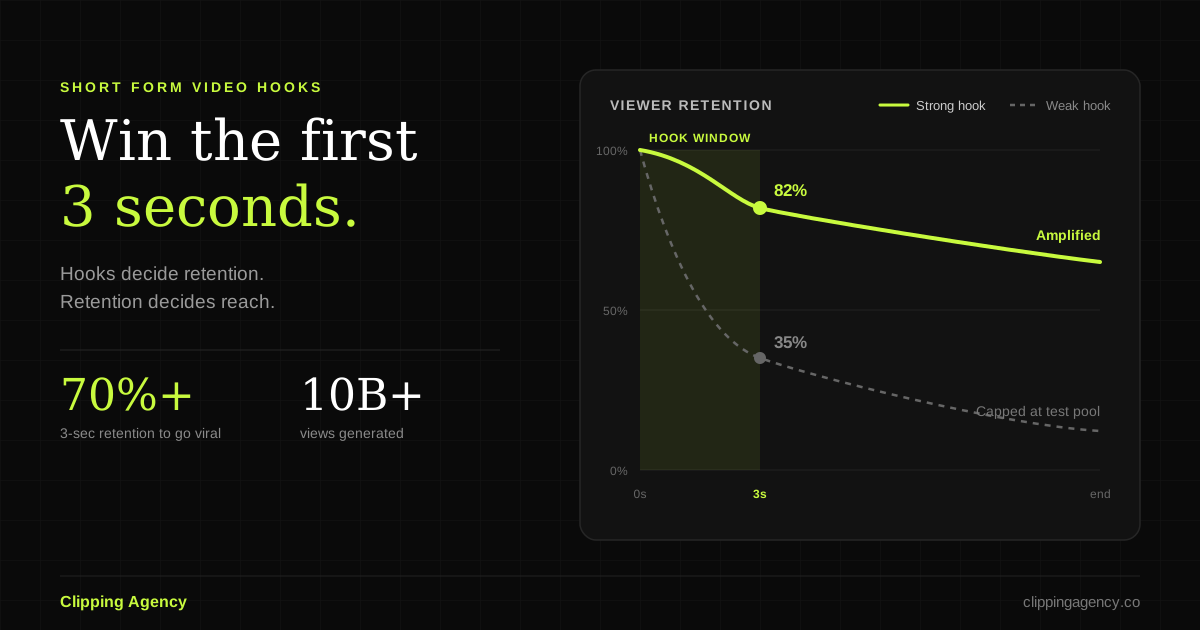
Platform algorithms on TikTok, Instagram, and YouTube Shorts use early retention as the primary signal for distribution. A clip that loses 60% of its audience in the first two seconds gets pushed to a small test pool and never leaves it. A clip that retains 80% of viewers through the first three seconds gets amplified to a broader audience tier automatically.
This means the hook is not a creative preference. It is a distribution variable.
Key Data Points on Short-Form Hook Performance
| Metric | What Happens Without a Strong Hook |
|---|---|
| Average view duration | Drops below 3 seconds on weak openings |
| Algorithm distribution | Clip is capped at the initial test audience |
| Engagement rate | Lower because lower-retention clips attract lower-intent viewers |
| CPV (Cost Per View) | Rises for paid promotion when organic hook performance is poor |
| Virality threshold | Rarely crossed without 70%+ three-second retention |
A 2025 analysis of 46,605 TikTok hooks found that emotionally resonant hooks generated proportionally higher comments and shares compared to neutral openings, even when the content quality of the video body was equivalent.
The hook is the single highest-leverage edit decision in short-form content distribution.
The 7 Core Types of Short Form Video Hooks
Every high-performing hook falls into one of these functional categories. These are not stylistic preferences. They are psychological mechanisms with documented viewer behavior patterns.
1. The Curiosity Gap Hook Presents a partial piece of information that creates an unresolved tension. The viewer stays because the brain seeks closure.
Example structure: “Most creators never find out why their clips plateau at 10,000 views.”
2. The Pattern Interrupt Hook Uses an unexpected visual, sound, or statement at the very opening to break the habitual scroll pattern. The viewer pauses not out of interest but out of mild confusion, which creates the window for the content to earn the watch.
3. The Direct Address Hook Speaks to a specific identity or situation the target viewer recognizes immediately. The hook functions as an audience filter as much as an attention grab.
Example structure: “If you run a podcast and you’re not clipping your episodes, this is for you.”
4. The Bold Claim Hook Opens with a statement that challenges a common belief or presents a counterintuitive outcome. The viewer stays to validate or disprove the claim.
5. The Transformation Hook Shows the end state before explaining the process. Before-and-after visual structures use this mechanism. The gap between the current state and the shown outcome creates watch motivation.
6. The Question Hook Poses a specific, targeted question the viewer has already been asking themselves. When the question matches an active concern, retention is high through the opening. Generic questions produce no effect.
7. The Social Proof Hook Opens with a result or outcome attributed to a real campaign or person. Credibility anchors the attention before the claim needs to be substantiated.
Hook Formulas That Work Across TikTok, Reels, and Shorts
Below are proven structural formulas used in high-retention clipping campaigns across multiple niches and content formats.
Formula 1: The Identity Filter “If you are [specific person], this will change how you [action].”
Formula 2: The Counterintuitive Result “[Common behavior] is why [unexpected negative outcome].”
Formula 3: The Number Anchor “[Specific number] [type of person] made the same mistake last month.”
Formula 4: The Suppressed Information Frame “Nobody talks about [specific topic] because [reason it stays hidden].”
Formula 5: The Stakes Escalation “In the next [time frame], [high-value action] will either work or cost you [loss].”
These formulas are not scripts. They are structural frames. The hook’s effectiveness comes from the specificity of the information placed inside the frame, not from the frame itself.
Hook Format by Delivery Type
| Hook Format | Ideal Word Count | Primary Platform |
|---|---|---|
| Text overlay only | 5 to 9 words | TikTok, Reels |
| Spoken hook (verbal) | 10 to 15 words max | YouTube Shorts, Reels |
| Combined (text and audio) | Complementary, not identical | All platforms |
| Visual only (pattern interrupt) | No text needed in first frame | TikTok |
The Relationship Between Hooks and Clip Selection
The best hook is not written. It is found.
Inside long-form video content, whether a podcast episode, a YouTube livestream, or a recorded webinar, the most powerful hook moments are already present. The job of the clipping process is to identify those moments and structure the clip so the hook moment is the opening frame, not a moment buried five seconds into the clip after context-setting.
This is one of the most common technical errors in short-form editing. A creator records a great insight. The clipper selects the right moment. But the clip opens with a setup line rather than the insight itself. The hook lands at second seven. The viewer left at second two.
Clip structure determines whether the hook is experienced at all.
Why Podcast Creators Lose 80% of Their Hook Potential
Podcast episodes produce between 10 and 30 strong hook moments per hour of recording. Most podcasters distribute one or two clips per episode, usually from the opening or closing sections.
The opening of a podcast episode is structurally the weakest source of hooks. It contains introductions, context-setting, and pleasantries. The strongest hooks tend to appear in the 15 to 40 minute range of a typical episode.
A podcast clipping agency builds a systematic review process that scans the full episode for hook-quality moments rather than clipping by convention or time position. The result is a volume of clips from a single episode that increases short-form output by 10 times or more, each with a structurally sound hook placed at the correct opening position.
How Hook Quality Connects to Distribution Volume
A single strong hook on a single clip is a one-time result.
The distribution model that produces sustained reach is built on volume: multiple clips from the same source content, each with a different hook type, targeting different audience segments, distributed simultaneously across a network of clipper accounts. This is what clipping marketing achieves at scale.
Distribution Volume Comparison
| Approach | Clips Per Episode | Hook Variations Tested | Monthly Views Potential |
|---|---|---|---|
| Single-account posting | 1 to 2 | 1 | Low (algorithm-capped) |
| Managed clipper network | 10 to 30 | 5 to 10 | 1M to 5M additional monthly views |
| Full campaign infrastructure | 30+ | 15+ | Viral threshold regularly crossed |
Frequently Asked Questions
What makes a short form video hook effective?
An effective short form video hook is specific, creates an unresolved tension or question in the first two seconds, and targets an identity or concern the intended viewer already holds. Generic openings produce low early retention regardless of content quality. The combination of a precise text overlay and a complementary spoken hook outperforms either element used alone.
How long should a short form video hook be?
A short form video hook should land its core mechanism within the first one to three seconds of the clip. For spoken hooks, ten to fifteen words is the functional maximum before viewer attention drops. For on-screen text overlays, five to nine words is the standard working range.
What is the difference between a hook and a title?
A title describes the content. A hook creates a psychological reason to consume the content. A title is a label. A hook is a mechanism. In short-form video, the hook is delivered in the first frame, not in the title field of the platform’s publishing interface.
Why do most brand clips fail at the hook stage?
Most brand clips open with a brand logo, a context-setting statement, or a product introduction. All three of these structures delay the hook. By the time the actual content value is communicated, the viewer has already scrolled past. Brand clips perform best when the opening frame leads with the viewer’s problem or interest, not the brand’s identity.
Does hook quality affect algorithm performance?
Yes. Short-form video platform algorithms use early retention rate, measured in the first one to three seconds, as a primary signal for content distribution. A clip with a strong hook that retains 70 to 80 percent of its initial audience in the first three seconds is distributed to progressively larger audience tiers automatically.
How many hook types should be tested per campaign?
In a managed clipping campaign, testing five to ten different hook types across simultaneous distributions from the same source content is standard practice. This generates performance data on which hook structures resonate with the specific audience segment and informs ongoing content production decisions.
The Bottom Line: Why Clipping Agency Is Your Best Partner for Short Form Video Hooks
Knowing what a great short form video hook looks like and consistently producing them at scale across a full distribution system are two entirely different problems.
Most brands understand hook theory. They read the frameworks. They know the formulas. The result is still the same: one or two clips per week, minimal reach, and no systematic understanding of which hook types actually convert with their audience.
Clipping Agency solves both sides of this problem. Our clipper network has helped generate 10B+ views across creator and brand content because every clip that leaves our system is reviewed for hook placement and hook type before it reaches a single account.
We do not post content and hope for the best. We run structured clipping campaigns that test multiple hook variations simultaneously across a network of accounts, then use the performance data to sharpen every subsequent clip. Your content becomes a distribution engine, not a publishing calendar.
If you produce long-form content and you are not extracting and distributing ten to thirty short-form clips from each recording, with tested hooks at every opening frame, you are leaving the largest share of your potential reach untouched every single day.
Book a strategy call and we will show you exactly what your content library can produce.
About Clipping Agency
Clipping Agency is the leading managed short-form video clipping and distribution service for creators and brands. Trusted by 1,000+ creators, our clipper network has driven over 10B+ views through high-volume content distribution across TikTok, Instagram Reels, and YouTube Shorts. We handle everything from clip selection and hook writing to campaign management and clipper payouts. Follow us on YouTube to see the system in action.
Every Day You Wait, A Competitor Gets the View
We recruit, train, and manage a clipping army that distributes your content across 50–500 accounts on TikTok, Reels, and Shorts simultaneously. One upload becomes hundreds of posts. Every single day.
Trusted by 1,000+ creators · 10 Billion+ views generated