
Let’s Be Honest About What’s Actually Happening Here
You upload your long-form video into an AI tool. It spits out twelve clips. You post three of them, feel pretty good about yourself, and then check your analytics a week later and see… not much. Maybe a few hundred views. Maybe a couple of likes from people who already follow you.
And you sit there wondering: is this just how it goes? Or is something missing?
Something is missing. And it’s not your content quality. Your content is probably fine — maybe even great. What’s missing is distribution. Real distribution. The kind that doesn’t depend on your one account, your existing followers, or whether the algorithm decided to be generous that Tuesday.
That’s what this article is actually about. Not a debate over which AI tool is coolest, or whether robots are coming for video editors’ jobs. It’s about understanding what you’re actually buying when you use an AI clip generator — and what you’re getting when you work with a real clipping agency. Because those two things are solving completely different problems. And mixing them up is costing creators months of growth.
What Is an AI Clip Generator, Really?
At its core, an AI clip generator is software that watches your video and tries to guess which moments people will care about. Then it cuts those moments in/to short clips, adds captions, reformats for vertical viewing, and exports them. That’s the loop. Upload, process, download.
The three tools you’ll hear about most right now are Opus Clip, Vidyo.ai, and Munch. They’re all doing roughly the same thing with slightly different angles on it.
Opus Clip built its reputation on what it calls a “virality score” — basically, an algorithm that predicts which parts of your video are most likely to blow up on TikTok or Reels. It reframes your footage automatically to keep the speaker centered, handles captions, and lets you batch export. If speed is the goal and you’ve got a ninety-minute interview you need clipped by tomorrow morning, Opus Clip genuinely delivers.
Vidyo.ai leans more toward structured content — webinars, podcast episodes, recorded meetings. It’s particularly good at identifying chapter breaks and pulling out quotable moments. The caption accuracy is solid for spoken word, and it connects directly to YouTube and Zoom so you don’t have to manually upload anything. For someone with a podcast who just wants to get clips out consistently, it’s a reasonable tool to have.
Munch takes a slightly different approach. It tries to match your clips to trending topics — essentially telling you “this moment maps to this trending conversation” — and it includes scheduling so you can push content out without jumping between apps. There’s something appealing about that pipeline, especially for smaller teams trying to stay consistent without spending hours on it.
Here’s the thing though: all three of these tools produce clips. That’s their job. They do it well, within the limits of what software can reasonably do. They save you time. They make the editing step faster and more accessible.
But editing is not growth. Editing is just one step in a much longer chain — and it’s not even the most important one.
What AI Tools Actually Can’t Do
This is where the conversation needs to get real. Because the limitations of AI clip generators aren’t bugs or temporary gaps waiting to be patched in the next update. They’re structural. They reflect what software fundamentally is and isn’t built to do.
Generating a clip and distributing it are not the same thing
When Opus Clip finishes processing your video, it hands you files. Nice, formatted, captioned files. And then you’re on your own. You still need to post them. You need accounts to post them on. You need to figure out when to post, how often, what captions to write, which platforms to prioritize and then you actually need to go do all of that, consistently, week after week.
Think about that for a second. You used the AI tool to save time on editing. But you’re still spending hours every week on distribution. And all of that distribution is happening through one account yours which means you’re fighting for algorithmic favor alongside every other creator doing the exact same thing.
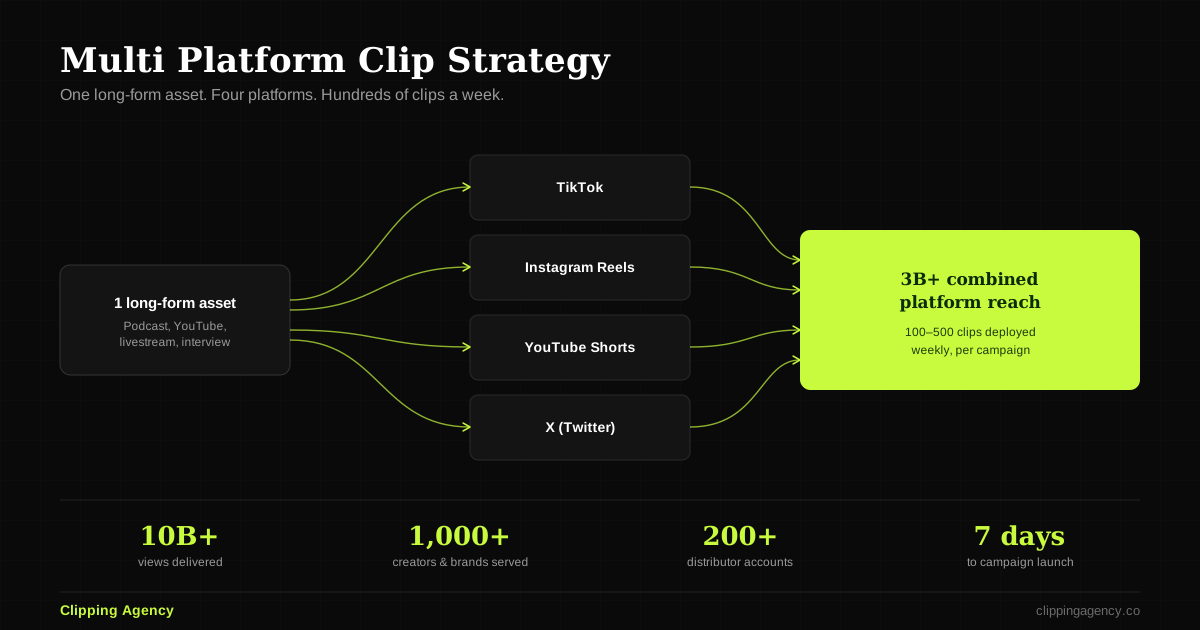
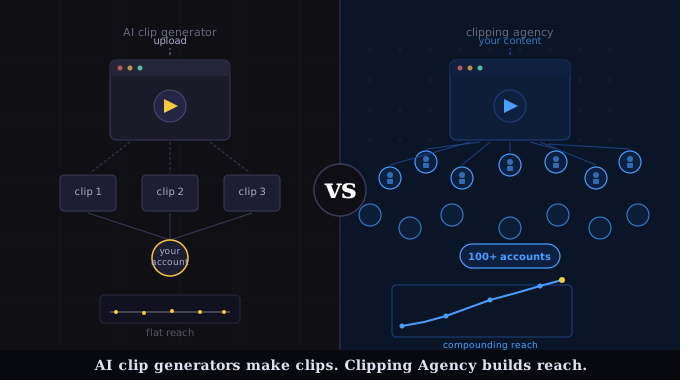
Compare that to what happens when a coordinated network of 50, 100, or 200 accounts is pushing your content simultaneously. The math isn’t even close. One account posting ten clips a week is not comparable in any universe to a hundred accounts posting your content across TikTok, Reels, and Shorts at the same time.
Our clipping campaigns are built entirely around that distribution-first principle. The clip is just the starting point. Where it goes and how many places it goes simultaneously is the actual lever.
An algorithm doesn’t know what makes your brand worth following
AI tools are trained on data. Historical patterns of what went viral. Engagement signals from millions of videos. That’s useful, up to a point. But it doesn’t know your audience. It doesn’t know that your community responds to the moments where you get a little frustrated, or that your most-shared clips tend to come from the first ten minutes of your episodes, or that a certain kind of storytelling in your voice connects with people in a way that generic viral metrics would never surface.
Human editors do. Editors who’ve spent time with your content, who understand what you’re building, and who make choices based on brand fit not just on what scored well for someone else’s content last month.
That’s the kind of judgment that turns clips into audience growth. And it’s the kind of judgment that a short-form video agency with real human editors brings to the table.
AI-generated clips look like AI-generated clips
People can tell. Not always consciously, but the auto-caption font, the mechanical reframe, the slightly-too-polished-but-somehow-also-soulless aesthetic — it’s become recognizable. It blends in with everything else rather than standing out. And blending in is the one thing you cannot afford when you’re trying to build a brand.
Generic content fills feeds. It doesn’t build identity. There’s a real difference between being seen and being remembered, and AI tools tend to produce the former far more reliably than the latter.
More clips is not the same as more reach
This one trips people up constantly. They figure that if they automate clip production and get more content out, the views will follow. More content, more shots on goal, more chances for something to hit.
But that math only works if distribution scales with output. If you’re still posting everything through one account, the extra clips mostly compete with each other for the same pool of followers. You’re not expanding your reach you’re just filling your own feed faster.
The real multiplier isn’t volume. It’s distribution width. Getting thirty well-chosen clips in front of audiences who don’t follow you yet — through a network of accounts built specifically to carry your content — beats producing a hundred clips that only your existing followers ever see.
That’s the engine behind our clipping services. Not just making more clips. Building the infrastructure to put them in front of new people, at scale, every single day.
There’s no strategy. No accountability. No one steering.
AI tools process. That’s genuinely all they do. They don’t think about where you want your brand to be in six months. They don’t notice when a particular style of clip is outperforming others and adjust accordingly. They don’t care if your content is getting better or worse traction because they have no stake in your outcome.
A clipping agency does. A real one has something to show for — and lose — based on whether your content actually grows.
So What Does a Clipping Agency Actually Do?
The term “clipping agency” gets used loosely, so let’s be specific about what it means when it’s done properly.
It doesn’t mean hiring someone to edit clips for you. An editor produces content. An agency builds infrastructure.
At Clipping Agency, the work starts before the first clip is ever made. The first thing that gets built is the system — the full distribution architecture, including how clippers are onboarded, how submissions are reviewed, how quality is controlled, how payouts work, and how performance gets tracked. Think of it as building the machine before loading it with content.
Then comes the community. A curated network of clippers real people, real accounts, real audiences gets recruited, vetted, and brought into your distribution ecosystem. These aren’t bots. They’re editors and content creators who are motivated to share your content because there’s something in it for them. When they post your clips on their TikTok accounts, their Instagram Reels, their YouTube Shorts your content reaches their followers. Audiences who’ve never heard of you. Audiences who might actually love what you do, if they ever saw it.
Then the operation runs. Submissions come in. Quality gets reviewed. Clips that meet the standard go out. Clips that don’t get sent back. Payouts get processed. Analytics get tracked. You see the numbers go up.
You don’t manage any of it. You keep making your long-form content. The engine handles everything else.
Our podcast clipping agency service shows what this looks like in practice for podcast creators — turning each episode into ten to thirty clips that get distributed across the network, so the reach of every episode compounds over time instead of peaking on launch day and fading.
And for brands and creators who want to think about this at the strategy level, our clipping marketing service treats distribution as a full marketing channel not an afterthought, not a nice-to-have, but the actual engine driving audience growth and brand awareness.
The Honest Comparison
| What You’re Evaluating | AI Clip Generator | Clipping Agency |
|---|---|---|
| How fast clips get made | Very fast — automated | Reviewed by humans, brand-matched |
| Editorial quality | Based on viral pattern data | Based on your specific brand and audience |
| Distribution reach | One account — yours | Hundreds of accounts simultaneously |
| How much time you spend | More than you think (you still post everything) | Almost none — fully managed |
| Platform strategy | Basic scheduling at best | TikTok, Reels, Shorts, X — all covered |
| Monthly view potential | Depends entirely on your account’s reach | 1–5M+ additional views |
| Brand consistency | Template-based, generic feel | Tailored to your voice and niche |
| Campaign accountability | Zero | End-to-end tracking and optimization |
| What happens after 90 days | You’ve got a lot of clips, similar growth | Your distribution network compounds |
Who Actually Benefits From an AI Clip Generator?
Not everyone needs a fully managed clipping agency and it’s worth saying that clearly. AI tools do serve a genuine purpose for certain creators at certain stages.
If you’re early in your content journey and you’re still figuring out what resonates with your audience, running everything yourself through an AI tool is fine. It’s fast, cheap, and low-commitment. You can move quick, test a lot of formats, and learn without burning through budget. That’s a reasonable use of these tools.
If you’re producing low-volume content say, a webinar once a month or one interview every few weeks the math probably doesn’t justify bringing in a full managed system yet. An AI tool can cover you.
But if you’re a podcaster dropping episodes every week and wondering why your audience isn’t growing the way your content quality deserves… if you’re a YouTuber with a real library of long-form content that’s sitting mostly unwatched… if you’re a brand or a founder trying to build omnipresence and you don’t have time to manage a content machine yourself — then you’ve honestly outgrown what AI generators are capable of doing for you.
The bottleneck isn’t how many clips you can produce. It’s how many people are actually seeing them.
Who Gets the Most Out of a Clipping Agency?
The clients who work best with a managed clipping service tend to have a few things in common.
They’re producing long-form content consistently podcasts, YouTube videos, live streams, interviews and they know it’s good. They’re frustrated that more people aren’t finding it. They’ve tried posting consistently, they’ve tried posting “at the right times,” they’ve maybe even tried paid ads. And the returns haven’t matched the effort.
They also understand or quickly come to understand that creating content and distributing content are completely different skills. You can be excellent at one and terrible at the other. Most creators are. Because most creators got into this to make things, not to manage logistics.
Clipping Agency serves creators, podcasters, YouTubers, streamers, founders, brands, and agencies. What they all share is this: they have more content than they have reach. And they’re ready to fix that with a system instead of guesswork.
The numbers tend to follow quickly. A 10× increase in short-form content output within thirty days. Between one and five million additional monthly views across TikTok and Reels. All of it without adding more to your plate.
The Real Issue Isn’t AI vs Humans
Step back from the comparison for a second. The actual question here isn’t which side wins — AI tools or a human-run agency. That’s the wrong frame.
The question is: what problem are you trying to solve?
If the problem is “I need clips faster and cheaper,” AI tools are built for that. Use them. They’re good at it.
If the problem is “I need my brand to reach significantly more people, in a way that actually compounds over time, without me personally managing the distribution,” then you need infrastructure not just a faster way to produce files.
AI clip generators solve an editing problem. Clipping Agency solves a growth problem.
And those are not the same problem. Treating them as if they are is genuinely one of the most common ways creators end up spinning their wheels for months — producing more and more content, wondering why the numbers aren’t moving.
The Bottom Line — Why Clipping Agency
Let’s not pretend AI tools are going away or that they don’t have a role to play. They’ll keep getting sharper. The clip quality will improve. The virality predictions will get a little more accurate. That’s fine.
But here’s what no AI tool is going to build for you: a living, coordinated network of real people actively distributing your content across hundreds of accounts every single day. That’s not an editing problem. That’s an infrastructure problem. And infrastructure is what we actually do.
We’ve driven over 2 billion views for our clients. Not because we have better software than the AI tools — but because we built something AI tools aren’t designed to build: a scalable, community-powered distribution engine that runs on your behalf without requiring your daily attention.
We set the whole thing up. We recruit and vet the clippers. We review quality. We manage payouts. We track what’s working and make adjustments. You keep making your content. We keep making sure it reaches people who’ve never heard of you — yet.
If you’re serious about growing your brand in 2026, and you’re tired of watching great content underperform because distribution hasn’t caught up with quality, this is where that changes.
No pressure. No hard sell. Just a real conversation about what your content could be doing that it isn’t doing yet.
FAQ
Can I run an AI clip generator alongside a clipping agency at the same time?
You can, and some people do — especially when they want to keep posting to their own accounts while the agency handles the broader network. That said, most clients find that once the distribution system is fully running, the AI tool becomes less necessary. The agency’s editors are making better clip selections anyway, so there isn’t much left for the AI tool to uniquely add.
How is Clipping Agency different from just hiring a video editor?
A video editor makes clips. That’s a production service. What Clipping Agency builds is a distribution system — which includes the editorial layer, yes, but also the clipper network, the submission and review process, the payout infrastructure, and the performance tracking. It’s closer to building a marketing channel than hiring a contractor.
Which platforms do you distribute content across?
TikTok, Instagram Reels, YouTube Shorts, and X are the core platforms. As things shift — and they always do — distribution can expand to match where your audience is actually spending time.
Do I need a big existing audience for this to work?
No, and this is one of the most common misconceptions. Because distribution is happening across a network of accounts rather than just your own, the system generates reach independently of your starting audience size. It’s one of the reasons it works for emerging creators, not just established ones.
How quickly do results show up?
Most clients start seeing meaningful movement — more content output, more platform visibility, more monthly views — within the first thirty days. The compounding effect becomes more pronounced over time as the network gets tuned to your content.
What kind of long-form content works best?
Anything with substance: podcast episodes, long YouTube videos, live streams, interviews, keynotes, recorded webinars. The more your content has strong audio, real insight, or compelling storytelling, the better the clips perform. If you’re a podcaster specifically, our podcast clipping agency service is built specifically around your format.
Do I have to manage anything once the system is live?
No. That’s the point. Once the clipping engine is set up, you are not responsible for managing editors, reviewing clips, handling payouts, or tracking performance. It runs. You create. We distribute.
How do clipping campaigns stack up against paid ads?
The data is pretty clear on this. Clipping campaigns consistently outperform paid advertising on engagement, audience authenticity, and cost-per-acquisition. Paid ads stop the moment you stop paying. A clipping campaign builds compounding organic reach that keeps working after the campaign ends.
Every Day You Wait, A Competitor Gets the View
We recruit, train, and manage a clipping army that distributes your content across 50–500 accounts on TikTok, Reels, and Shorts simultaneously. One upload becomes hundreds of posts. Every single day.
Trusted by 1,000+ creators · 10 Billion+ views generated