
Let’s start with something that a lot of agencies won’t say to your face: paid ads are not a growth strategy. They’re a renting strategy.
Every dollar you put into TikTok Ads, Meta Ads, or YouTube pre-rolls is buying you borrowed attention. The moment your budget runs out, the views stop. The reach disappears. The algorithm forgets you. You don’t own anything you built — you just leased eyeballs for a while and handed them back.
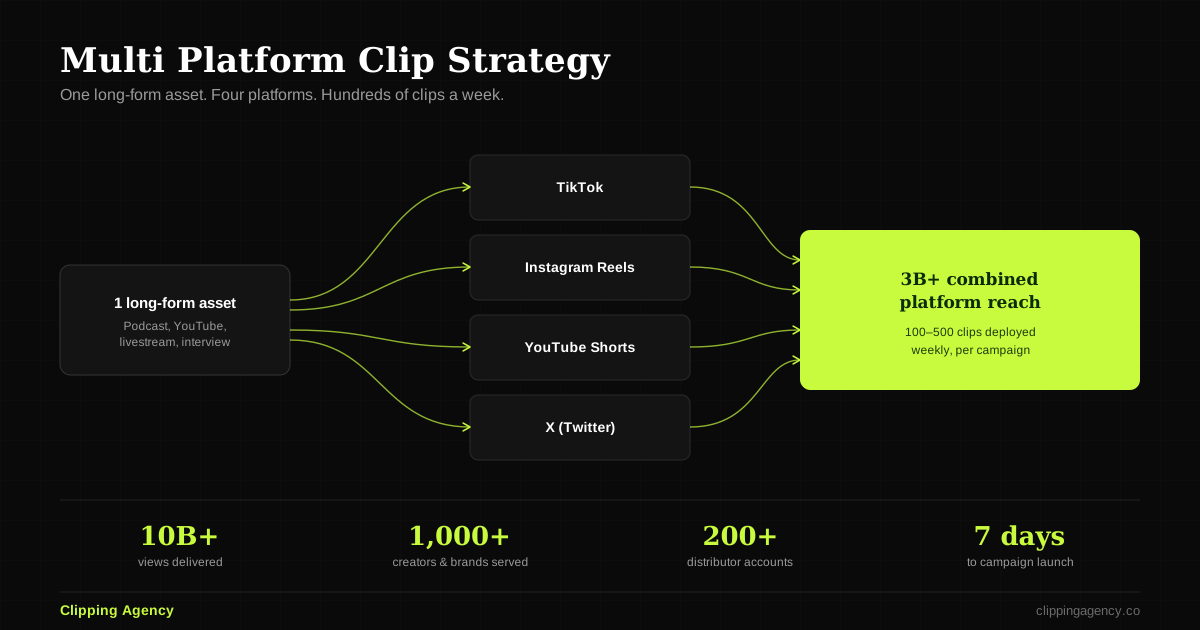
Clipping campaigns work completely differently. Instead of paying platforms for access to audiences, you build a system where your content reaches those audiences organically — through a community of clippers who distribute your content across hundreds of accounts simultaneously, on TikTok, Instagram Reels, YouTube Shorts, LinkedIn, and X.
The result is reach that compounds. Views that don’t stop when a budget runs out. An audience that actually remembers you because they found you naturally — not because an algorithm forced your ad into their feed at 2am.
This isn’t a theory. It’s a model that’s generated over 2 billion views for creators and brands across every niche imaginable. And in this piece, we’re going to break down exactly why clipping campaigns beat paid ads — head to head, category by category, no fluff.
First — What Actually Is a Clipping Campaign?
Before we get into the comparison, it’s worth making sure we’re on the same page about what a clipping campaign actually is — because a lot of people confuse it with just “editing some short clips.”
A clipping campaign is a fully managed content distribution system. Here’s how it works:
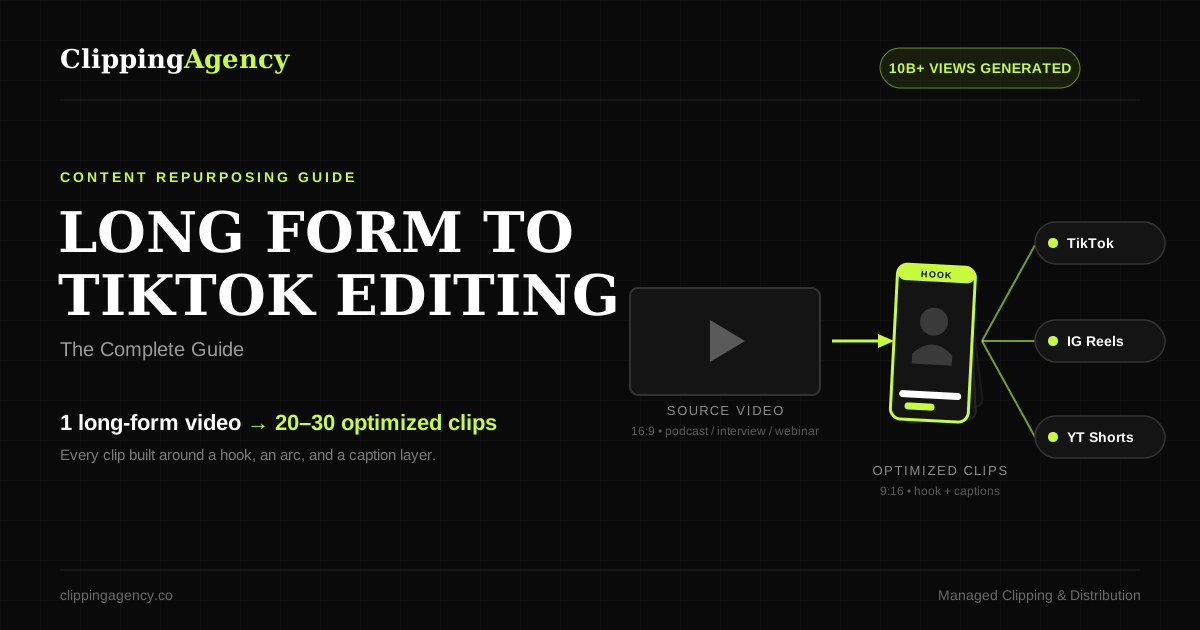
You produce long-form content — a podcast, a YouTube video, a webinar, an interview, a stream. A team of vetted clippers takes that content, cuts it into 10 to 30 high-retention short clips, optimizes each one for the platform it’s going to, and then distributes those clips across hundreds of independent accounts simultaneously.
Every single day. Across TikTok, Instagram Reels, YouTube Shorts, and X.
The result? One piece of content becomes a 30-day distribution event. The algorithm sees sustained volume across multiple accounts. Reach builds. Followers grow. And unlike paid ads, none of it stops when a budget runs out — because it was never dependent on a budget to begin with.
At Clipping Agency, we run the entire operation: clipper recruitment, quality review, platform distribution, performance tracking, and automated payouts. You send the content. We handle everything else.
Now — let’s get into the comparison.
Round 1: Cost Per View — It’s Not Even Close
This is usually where the conversation starts, and it’s the most obvious place where paid ads fall apart.
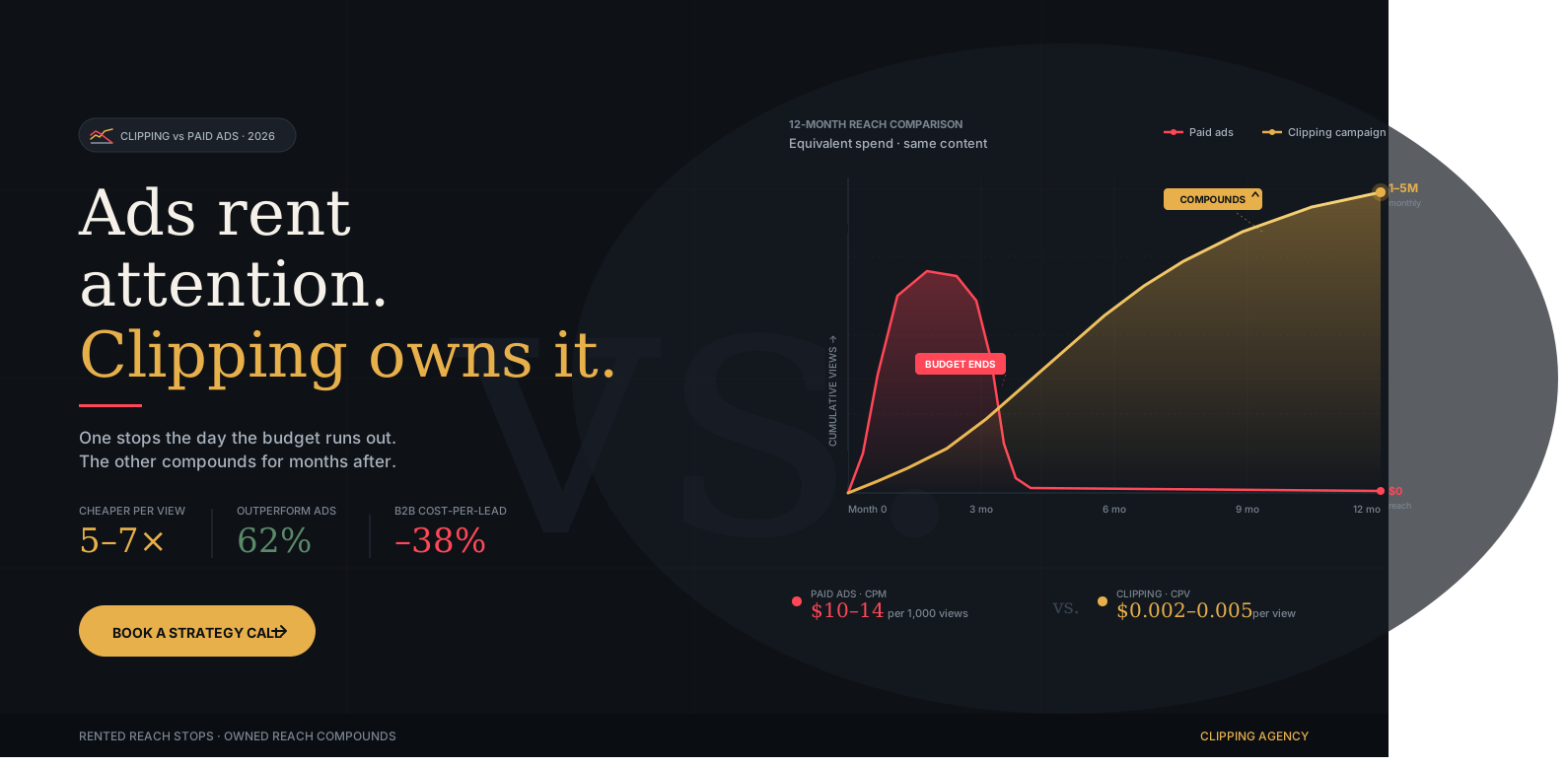
Paid ads on Meta and TikTok typically cost between $10 and $14 per 1,000 views (CPM). That works out to $0.010–$0.014 per view. And that’s before you factor in creative production, testing budgets, agency fees, or the fact that a huge chunk of those “views” are 2-second passive scrolls that barely register.
A properly managed clipping campaign delivers views at $0.002 to $0.005 CPV — that’s 5 to 7 times cheaper per view than paid advertising.
But here’s the part that really matters: the nature of those views is completely different.
When someone sees your paid ad, they know it’s an ad. Their guard is up. Watch time is lower. Engagement is lower. Click-through is lower. And the moment your campaign ends, every single one of those metrics goes to zero.
When someone finds your content through a clipping campaign, they found it organically in their feed — posted by a real account, looking like real content, because it is real content. Watch time is higher. Saves are higher. Follows are higher. Comments are genuine. And that engagement signals to the algorithm that your content is worth pushing further — which means your reach compounds instead of stopping.
62% of clips distributed through Clipping Agency campaigns outperform equivalent paid ads on cost-per-view. That’s not a rounding error. That’s a fundamental difference in how the two models work.
Round 2: What Happens When You Stop Paying
This is the question that most brands never think to ask until it’s too late.
With paid ads, the answer is simple and brutal: everything stops. Your views drop to zero. Your reach disappears. The audience you “built” through ads goes silent because you never actually built an audience — you rented access to one. The moment the invoice goes unpaid, the reach is gone.
With a clipping campaign, something very different happens.
Every clip that went live during your campaign is still out there. Still getting views. Still driving follows. Still building brand recognition. The algorithm has already learned that your content performs — and it keeps surfacing it to new audiences. The followers you gained through clipping are real followers who found you organically and chose to follow you. They don’t disappear.
This is what we mean when we say clipping campaigns compound. Each month of distribution builds on the last. The clipper network grows. The algorithm gets more data. The best-performing clips keep circulating. And your brand presence keeps growing — even in months when you’re not actively running a campaign.
Paid ads don’t do any of that. They rent. Clipping campaigns own.
Round 3: Audience Trust and Content Authenticity
There’s a reason ad-blockers exist. There’s a reason people instinctively scroll past sponsored content without registering it. There’s a reason TikTok’s own research has shown that 67% of users say they feel more engaged with content that doesn’t feel like an ad.
People are exhausted by advertising. They’ve developed genuine psychological resistance to paid placements — especially on social media platforms where the content around the ads is authentic and native.
Clipping campaigns don’t have this problem.
Your clips are posted by real people, on real accounts, as native content in the feed. There’s no “Sponsored” label. No skip button. No pre-roll that interrupts what someone actually wanted to watch. It looks organic because it is organic — and viewers engage with it the way they engage with any content they genuinely came across.
This is why engagement rates on clipping campaign content consistently outperform paid ad placements. People who find your content through a clipper’s account are more likely to watch it to the end, follow the original creator, share it with their own audience, and come back for more. That kind of engagement is worth more than any CPM metric on a paid media report.
Round 4: Scale — What Happens When You Want More Reach
Here’s one of the most important structural differences between paid ads and clipping campaigns, and it’s one that most brands completely overlook.
With paid ads, more reach costs more money. Always.
If you want to double your views, you double your budget. If you want to triple your reach, you triple your spend. The cost scales linearly with the outcome — and there’s a ceiling where rising CPMs start eating into ROI so aggressively that the economics stop making sense.
With clipping campaigns, the relationship between cost and reach doesn’t work that way.
As your clipper network matures, your cost per view stays flat or actually drops. Why? Because experienced clippers get better at identifying what works. The algorithm learns your content and distributes it more efficiently. The network effect kicks in — more clippers posting more content across more accounts means more organic amplification, not more spend.
Our clipping campaigns typically achieve 1–5 million additional monthly views for clients. That kind of scale with paid ads would require a media budget that most brands — even well-funded ones — simply don’t have. With clipping, it’s achieved through community-powered distribution that gets more efficient over time, not more expensive.
Round 5: Algorithm Signals and Long-Term Platform Growth
This is the round that matters most for anyone thinking beyond the next 30 days.
Paid ads generate what are essentially artificial signals. You’re paying the platform to push your content to people, not because the algorithm determined it was worth surfacing, but because you paid for the placement. The engagement you get from paid ads — even genuine clicks and views — carries far less weight as an algorithmic signal than organic engagement does.
Clipping campaigns generate real algorithmic signals.
When hundreds of accounts post your content and that content gets genuine engagement — real watch time, real saves, real follows, real comments — the platform algorithm interprets that as strong social proof. Your content is performing. Your niche audience is engaging. The algorithm responds by distributing the content further, pushing it to new audiences who haven’t seen it yet, and increasing your overall content discoverability.
This is why clipping campaign clients often see their main channel grow during a campaign — not just their short-form clips. The algorithm learns that your content resonates, and that learning carries forward into every piece of content you publish going forward. Paid ads can’t do that. They generate impressions, not signals.
Round 6: Audience Fatigue — The Problem Paid Advertisers Never Solve
If you’ve run paid ads for any length of time, you know the pattern. A new creative performs well in week one. By week two, performance is dropping. By week four, your CPM has spiked because your audience has been saturated and your click-through rate has collapsed. You need new creatives. More budget. More testing. More spend just to maintain the same reach.
This is audience fatigue. It’s the fundamental limitation of paid advertising at scale, and there is no clean solution to it. The only answers are more budget, more creatives, or smaller target audiences — none of which fix the underlying problem.
Clipping campaigns don’t experience audience fatigue in the same way. Because your content is distributed across hundreds of different accounts to hundreds of different audience segments simultaneously, no single audience group gets overexposed. Each clipper’s audience sees your content as fresh, organic content posted by someone they already follow. The distribution is naturally diversified across the network — which means the reach stays healthy even as volume increases.
The Numbers Side by Side
Let’s make this concrete. Here’s what the math actually looks like comparing a typical paid ad campaign against a managed clipping campaign:
Paid Ad Campaign — $5,000/month budget:
- Platform CPM (Meta/TikTok): $10–$14 per 1,000 views
- Estimated views: 357,000–500,000
- Nature of views: Passive, interruptive, ad-flagged
- Engagement rate: Typically 0.5–2%
- What remains after month ends: Zero organic reach, no lasting algorithm signals
- Audience built: Minimal — ad audiences don’t follow you, they scroll past you
Managed Clipping Campaign — equivalent investment:
- CPV: $0.002–$0.005
- Estimated views: 1–5 million additional monthly views
- Nature of views: Organic, native, algorithm-favoured
- Engagement rate: Consistently higher than paid placements
- What remains after campaign ends: Followers, algorithm signals, brand recognition, circulating clips
- Audience built: Real followers who found you organically and chose to stay
The numbers aren’t close. And the qualitative difference — in the type of audience built, the trust established, and the long-term platform growth generated — makes the gap even wider.
Who Should Be Running Clipping Campaigns Instead of Paid Ads
Honestly? Most people currently spending money on paid ads.
But more specifically, clipping campaigns are especially powerful for:
Creators and personal brands who are spending on TikTok or Meta ads to grow their following — and finding that the followers they get through ads don’t engage the way organic followers do. Clipping builds a real audience that actually cares about what you do.
B2B brands and SaaS companies who are paying for LinkedIn or Google Ads and watching their cost-per-lead creep up every quarter. Our data from active SaaS clients shows 38% lower cost-per-lead versus paid search and 3.2x more inbound demo requests by months 2–3 of an active clipping campaign.
Podcasters and YouTubers who have tried boosting posts or running ads to grow their audience and found that paid views don’t translate into loyal listeners or subscribers. Clipping drives people to your content because they found it organically — and organic discovery converts into real audience members at a rate paid ads simply can’t match.
E-commerce brands running product awareness campaigns on Meta who are fighting rising CPMs and shrinking ROAS. Clipping distributes your product content natively across platforms without the ad label, the skip button, or the audience fatigue that kills paid campaigns after a few weeks.
Agencies and marketing teams who are managing ad spend for clients and watching the returns get thinner every year. Adding a clipping campaign to your service offering means delivering better results at lower cost — which is a very strong conversation to have with a client who’s used to paying $14 CPM.
What About Running Both? Here’s the Honest Answer
Some brands ask whether they should run clipping campaigns alongside paid ads rather than replacing them entirely.
The honest answer: if you have the budget and you’re using paid ads for specific direct-response goals — retargeting, time-sensitive launches, bottom-of-funnel conversions — there’s a case for running them alongside a clipping campaign.
But for brand awareness, audience growth, reach, and long-term platform presence? Clipping campaigns are not just better than paid ads. They’re in a completely different category. They build something that paid ads structurally cannot — a compounding, organic presence that gets stronger over time and doesn’t require a monthly budget to maintain.
If you’re currently spending on paid ads for awareness and reach, the question isn’t really “should I also do clipping?” The question is “why am I still paying for something that stops the moment I stop paying?”
Our short form video agency has run this comparison across hundreds of clients in dozens of niches. The outcome is consistent every time. Clipping wins.
Frequently Asked Questions
Are clipping campaigns actually cheaper than paid ads? Yes — significantly. Paid ads on Meta and TikTok typically cost $10–14 per 1,000 views. A managed clipping campaign delivers views at $0.002 to $0.005 CPV — that’s 5 to 7 times cheaper per view. And unlike paid ads, those views come with genuine organic engagement and algorithm signals that compound over time rather than stopping when a budget runs out.
Do clipping campaigns work for B2B brands, or just consumer creators? They work extremely well for B2B brands. Our active SaaS and B2B clients see 38% lower cost-per-lead versus paid search and 3.2x more inbound demo requests by months 2–3 of a campaign. LinkedIn and YouTube Shorts in particular are high-performing channels for B2B content through clipping — and far less saturated than most paid ad platforms.
What happens to my reach when a clipping campaign ends? Unlike paid ads, your reach doesn’t drop to zero. Clips that went live during the campaign continue circulating. Followers you gained stay. Algorithm signals you built carry forward into future content. The organic presence you built through clipping is yours — it doesn’t disappear with the invoice.
Can I run clipping campaigns alongside paid ads? Yes — some brands do both. Paid ads can make sense for specific direct-response or retargeting goals. But for brand awareness, audience growth, and platform presence, clipping campaigns deliver better results at lower cost with longer-lasting impact. Most clients who start clipping campaigns significantly reduce their paid ad spend within 2–3 months because the organic results outperform what they were getting from ads.
How quickly do clipping campaigns start producing results? Most clients see measurable view growth within the first 14–30 days. By months 2–3, the compounding effect kicks in — the algorithm has learned your content, the clipper network is at full capacity, and reach builds significantly month over month. This is the opposite of paid ads, which typically see declining performance over time due to audience fatigue.
Is the engagement from clipping campaigns real? Yes. Every clip is posted by a real account to a real audience as organic native content. Viewers engage with it the way they engage with any content in their feed — genuine watch time, genuine saves, genuine follows. This is why engagement rates on clipping campaign content consistently outperform paid ad placements. It’s not ad-flagged, it’s not interruptive, and it’s not passive. It’s content people actually chose to watch.
What kinds of content work best in a clipping campaign? Any long-form content over 20 minutes — podcasts, YouTube videos, webinars, interviews, livestreams, recorded presentations. A single 60-minute episode typically produces 20–40 clips. Our clipping services handle the extraction, formatting, and distribution across all major platforms.
How is Clipping Agency different from just hiring a video editor? A video editor produces clips. Clipping Agency distributes them at scale. A single editor posting to your one channel cannot replicate what a managed network of hundreds of clippers posting simultaneously does for reach and algorithm momentum. Distribution is where the growth actually happens — editing is just the first step. See how our clipping campaigns work →
The Bottom Line: Why Clipping Agency — Not Paid Ads — Is the Smartest Move You Can Make Right Now
Here’s the thing about paid ads that nobody in the performance marketing world wants to say: they’ve gotten dramatically more expensive, dramatically less effective, and dramatically harder to make work over the past three years. CPMs are up across every major platform. Organic-looking ad creative gets flagged and skipped. Audiences are more resistant to paid placements than they’ve ever been. And the moment you stop paying, everything you “built” disappears overnight.
Clipping Agency exists because there’s a fundamentally better way to grow.
Instead of renting attention from platforms, we build you a distribution engine that earns attention — through a community of real clippers posting your content across hundreds of accounts simultaneously, generating organic reach that compounds month after month and builds an audience that’s actually yours to keep.
We’ve generated over 2 billion views for creators and brands who made the switch from paid ads to clipping campaigns. We’ve watched SaaS companies cut their cost-per-lead by 38%. We’ve seen podcasters go from zero short-form presence to 1–5 million additional monthly views within 30 days. We’ve watched founders become omnipresent across TikTok, Reels, Shorts, LinkedIn, and X — without spending a single dollar on ad placements.
The brands winning on short-form video right now aren’t the ones with the biggest ad budgets. They’re the ones who figured out that distribution is a system, not a spend — and built that system before everyone else caught on.
If you’re still putting budget into paid ads for awareness and reach, ask yourself one honest question: what do you actually own after the invoice is paid?
With Clipping Agency, the answer is everything. The reach. The followers. The algorithm signals. The brand recognition. The compounding organic presence that keeps growing long after the campaign ends.
That’s not what paid ads give you. That’s what a real distribution system gives you.
Book a Strategy Call with Clipping Agency →
Ready to replace ad spend with a system that actually compounds? Explore our clipping campaigns, clipping services, podcast clipping, and clipping marketing — or contact us to get started.
Every Day You Wait, A Competitor Gets the View
We recruit, train, and manage a clipping army that distributes your content across 50–500 accounts on TikTok, Reels, and Shorts simultaneously. One upload becomes hundreds of posts. Every single day.
Trusted by 1,000+ creators · 10 Billion+ views generated