
Creating great content is only the first step of the journey. You can spend weeks writing the perfect script or editing a massive project. But if your publishing strategy relies on manual effort, you will inevitably hit a wall.
Imagine you just finished producing a twenty minute faceless documentary on a dark historical mystery. You upload it to YouTube. You hit publish. Now what? If you stop there, you leave massive reach on the table. If you try to manually cut that video for every other platform, you will burn out within a month.
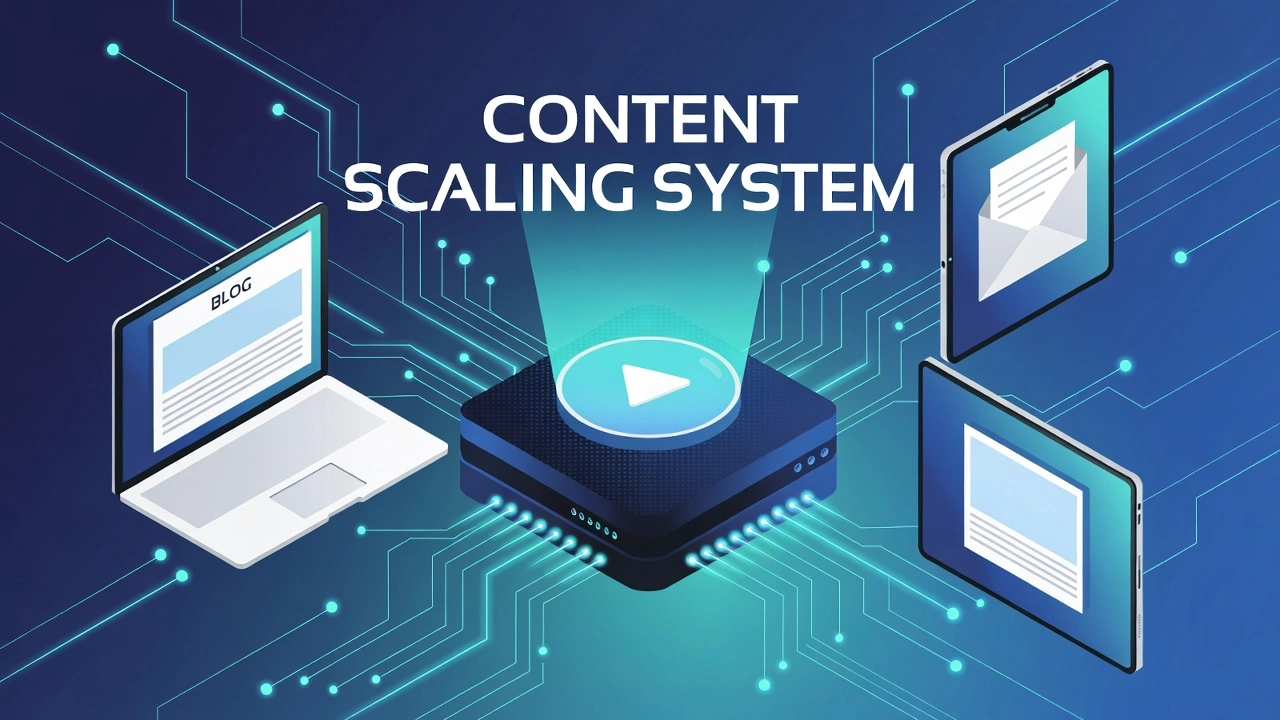
You do not need to work harder. You need a content scaling system. This guide will show you exactly how to build a production engine that turns one strong piece of media into dozens of high performing assets.
What is a Content Scaling System?
A content scaling system is a predictable, step by step pipeline designed to maximize the reach of every piece of media you create. It takes a single core asset and systematically adapts it for different platforms, formats, and audiences.
Most creators treat every single social media post as a brand new project. This is a massive waste of creative energy. A proper scaling engine removes the guesswork. It dictates exactly how an idea moves from a rough draft to a widely distributed campaign.
Here is what your daily operation looks like before and after implementing this infrastructure.
| Metric | The Manual Grind | The Scaling Engine |
| Output Volume | 1 to 2 posts per week. | 15 to 20 highly targeted assets per week. |
| Creative Focus | Drained by formatting and manual uploading. | Focused entirely on storytelling and scripting. |
| Publishing Consistency | Drops immediately when the team gets busy. | Runs automatically through scheduled queues. |
| Asset Lifespan | Content dies 24 hours after publishing. | Content is repurposed and looped for months. |
When you build standard operating procedures for your content, the heavy lifting disappears. Your team stops asking what to post. They simply execute the next step in the pipeline.
Step 1: Build Repeatable Content Workflows
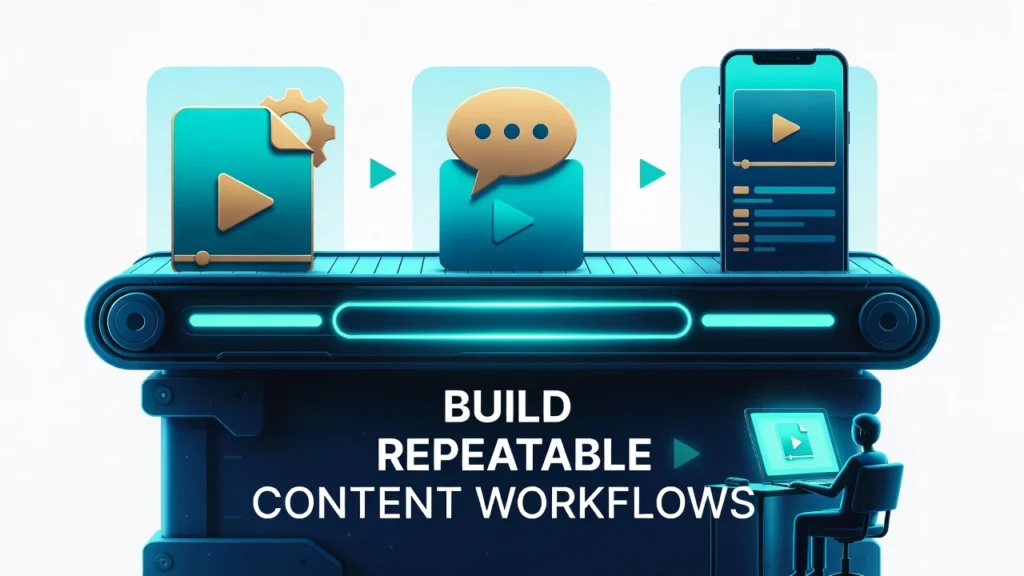
You cannot scale chaos. If your team creates a blog post differently every single time, you will never achieve true volume. You must build repeatable content workflows to establish a baseline of efficiency.
A strong workflow breaks a massive project down into modular, highly specific tasks. Here is a proven pipeline you can copy for your own team.
- The Brainstorming Phase: Log all ideas in a central database. Tag them by topic. Never stare at a blank screen again.
- The Core Asset Creation: Focus all your heavy creative energy on making one incredible, long form piece of content. This could be a comprehensive podcast, a deep dive article, or a long YouTube video.
- The Extraction Phase: Have an editor review the core asset. They must pull out the three best quotes, the two most actionable tips, and the single most controversial opinion.
- The Formatting Phase: Send these extracted pieces to the design team. They will format them into text posts, graphic carousels, and short form clips.
- The Final Review: The lead strategist reviews the batch to ensure brand consistency before anything gets scheduled.
When every team member knows their exact role, friction disappears. The content moves from one station to the next like a factory assembly line.
Step 2: Implement Content Distribution Platforms
You can create the smartest media in the world. If it sits in a hidden folder on your desktop, it is completely useless. You need dedicated software to push your work out into the world.
Content distribution platforms are the backbone of your publishing strategy. They give you a single dashboard to manage your entire internet presence.
Instead of opening five different tabs to post on social media, you upload everything to one central hub. These platforms allow you to tailor the caption, adjust the image tags, and schedule the exact minute the post goes live on each specific network.
Using social media scheduling tools provides several massive advantages.
- Global Reach: You can schedule posts to go live at 3 AM your time to hit the morning commute crowd in London or New York.
- Batch Uploading: You can load an entire month of social media posts into the queue in just two hours.
- Visual Planning: You get a calendar view of your publishing strategy. This ensures you never accidentally post three promotional videos in a row.
Step 3: Master Scalable Content Marketing
Most brands think growth comes from inventing new ideas every single day. That is exhausting and highly inefficient. True scalable content marketing is about transformation. It is the specific skill of taking one deep idea and translating it for different internet cultures.
Repurposing is not just copy and pasting a link. It is reframing the core message.
Let us go back to our example of the historical mystery documentary. Here is exactly how you turn that one core asset into a massive campaign.
| The Platform | The Asset Type | The Formatting Strategy |
| YouTube | Core Asset | The full 20 minute video with a highly clickable thumbnail. |
| TikTok | Short Form Clips | Three fast paced, 60 second videos highlighting the creepiest facts. |
| X (Twitter) | Text Thread | A 10 part thread breaking down the timeline of the mystery. |
| Text Post | A professional post about the psychology behind the historical event. | |
| Email Newsletter | Written Story | A deep dive essay expanding on a specific detail cut from the video. |
You did not have to research five different topics, researched one topic deeply. You simply changed the packaging to fit the platform. That is how you multiply your reach without multiplying your workload.
Step 4: Execute Multi-Channel Content Amplification

Publishing a great video on just one platform is like whispering in a crowded stadium. A few people might hear you, but the masses will miss the message entirely.
Multi-channel content amplification is the process of broadcasting your message across every relevant doorway your audience might walk through. People do not gather in one single place anymore. They scatter across dozens of apps.
Amplification requires you to respect the native language of each platform. You cannot just share a YouTube link on X and expect people to click it. The algorithm will actively suppress external links.
Instead, you must upload the video natively to X. You must upload the graphic natively to LinkedIn. You must write a native post for Facebook. When you natively amplify your message, the platform algorithms reward you with significantly higher organic reach. Small ripples eventually stack up to create massive brand recognition.
Step 5: Leverage AI and Automation Properly

Artificial intelligence is not here to replace your creative voice. It is here to handle the tedious, manual tasks that drain your energy. Inside a high performing content scaling system, AI acts as an administrative assistant.
You must use AI video tools and text processors strategically.
- Transcription: Use AI to instantly transcribe your one hour podcast into a text document.
- Keyword Hunting: Search that text document for specific terms to quickly find the best timestamps for your editing team.
- Drafting Variations: Paste a strong paragraph into an AI tool and ask it to rewrite the text in five different tones for A/B testing on social media.
Automation handles the connective tissue of your workflow. You can set up automated triggers so that whenever a new video is published, a message is instantly sent to your team Slack channel. Automation removes the human error from your daily operations.
Common Mistakes That Kill Your Content Pipeline
Scaling sounds simple in theory. In reality, many brands hit a painful ceiling. They work harder, but their audience stops growing. You must avoid these common traps.
Focusing on Volume Over Value
The biggest mistake is assuming scale means spamming the internet. If you use AI to generate fifty low quality blog posts a day, your audience will immediately lose trust in your brand. Quality must remain the priority. Value drives shares. Shares drive scale.
Ignoring the Customer Journey
You cannot just post random facts and expect your business to grow. Your content must guide the viewer. A viral short form video builds raw awareness. A detailed blog post builds deep trust. An email newsletter drives the final conversion. Map your content to match the psychological stages of your buyer.
Refusing to Document the Process
If your entire production workflow lives exclusively inside your head, you do not have a business. You have a fragile hobby. If you get sick, the publishing stops. You must build clear standard operating procedures for your team. Document exactly how files are named, where they are stored, and who is responsible for final approval.
Scaling Without Hard Data
Publishing blindly is a waste of time. You must review your analytics every single week. If your long form videos are getting incredible watch time, double down on production. If your graphic carousels are getting zero engagement, stop making them. Let the data dictate your creative strategy.
Conclusion
Building a massive audience does not require you to work twenty four hours a day. It requires you to build a smarter machine. A true content scaling system gives every single idea a clear path forward.
It is not about chasing the next viral trend. It is about taking a deep, valuable piece of media and stretching it across the internet. A video becomes a blog post. A blog post becomes an email. An email becomes a dozen social media updates.
When you eliminate the manual tasks, organize your workflows, and utilize powerful distribution software, the friction disappears. You stop feeling overwhelmed by the digital landscape. You gain the ultimate freedom to focus on what actually matters. Moreover, you get to tell incredible stories, build deep connections, and grow your brand consistently.
Every Day You Wait, A Competitor Gets the View
We recruit, train, and manage a clipping army that distributes your content across 50–500 accounts on TikTok, Reels, and Shorts simultaneously. One upload becomes hundreds of posts. Every single day.
Trusted by 1,000+ creators · 10 Billion+ views generated