
Most channels that try YouTube Shorts fail for one reason: they treat Shorts as a content type instead of a distribution system.
They record a vertical video, post it, get 200 views, and conclude Shorts don’t work. The problem is not the platform. It is the approach.
Growing a YouTube channel with Shorts is not about posting more vertical videos. It is about building a repeatable system for getting your best ideas in front of new audiences consistently, without burning out your production schedule. That system is the clipping strategy.
Why Shorts Drive Channel Growth Faster Than Long-Form
Long-form videos are shown primarily to existing subscribers. If your channel is small, your reach is limited by your subscriber count.
Shorts operate on a separate discovery feed. YouTube pushes them to people who have never heard of your channel, testing each video against fresh audiences. This makes Shorts one of the few organic ways a small channel can reach strangers at scale — without paid ads and without an existing audience. YouTube’s CEO confirmed Shorts now averages 200 billion daily views, up from 70 billion in early 2024.
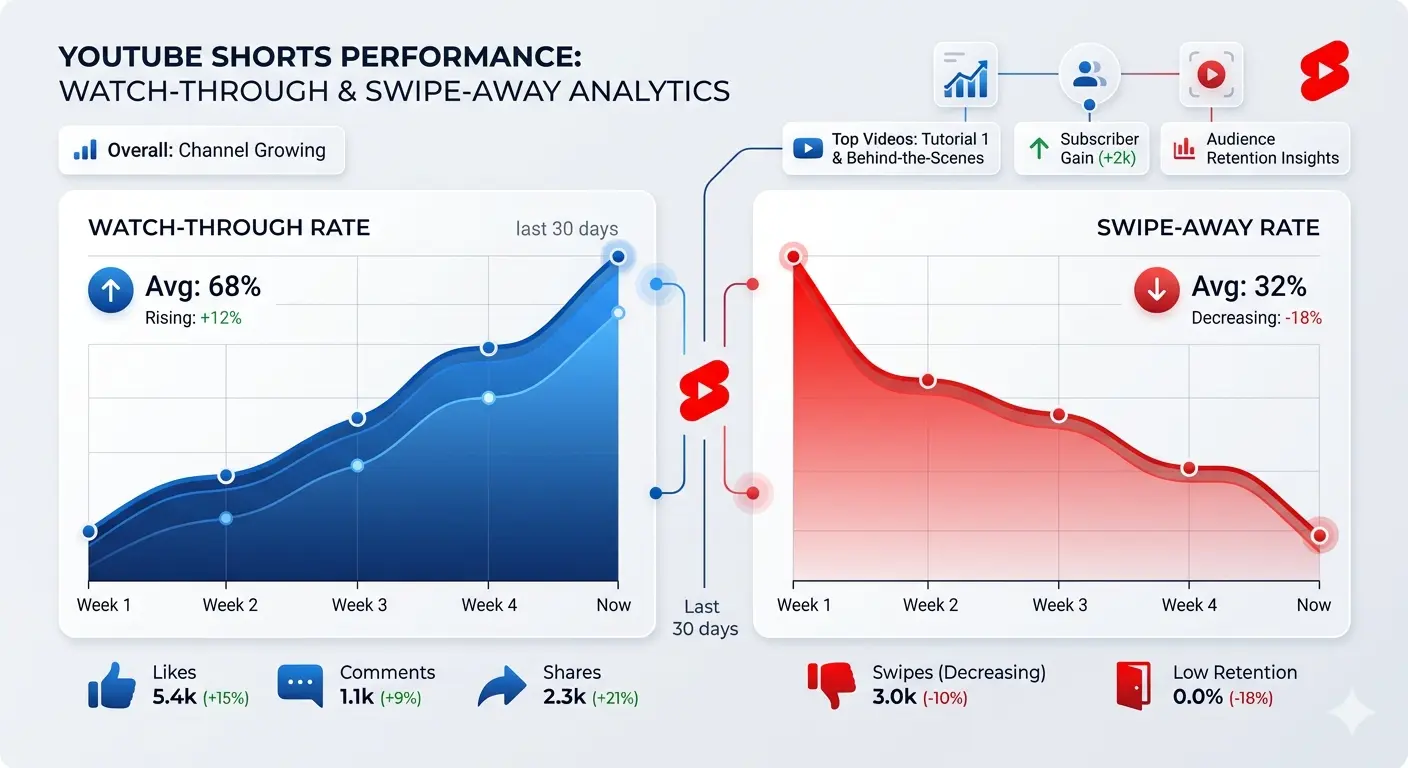
The algorithm also measures Shorts differently. For long-form, total watch time in minutes is the primary signal. For Shorts, it weighs:
- Watch-through rate: what percentage of viewers reach the end
- Swipe-away rate: how quickly viewers exit before 10 seconds
- Average view duration: relative to total video length
- Engagement signals: likes and comments relative to views, not raw numbers
A 50-second Short where 75% of viewers watch to the end signals quality. That triggers wider distribution. Editing decisions matter more here than on almost any other platform, the first three seconds determine whether the algorithm gives the video a real audience.
What Is the Clipping Strategy
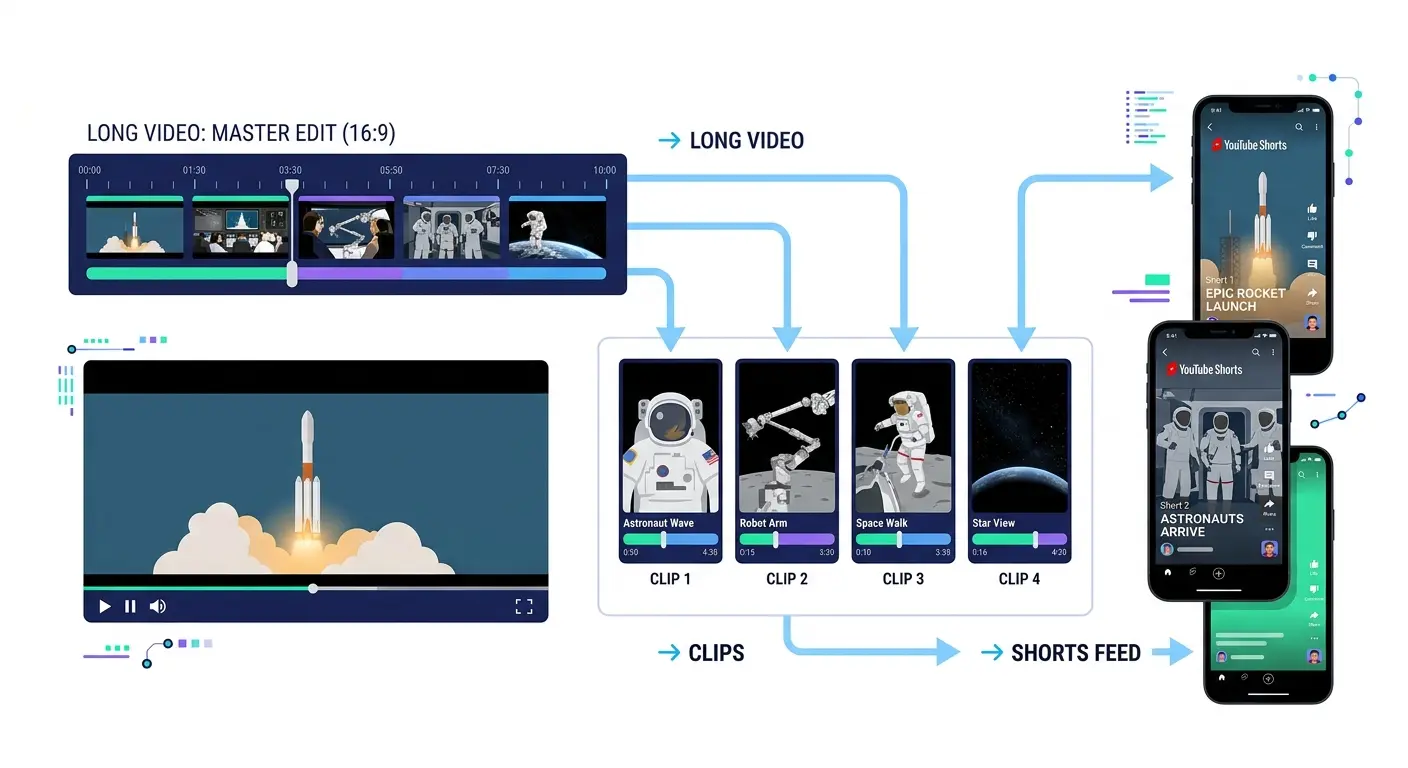
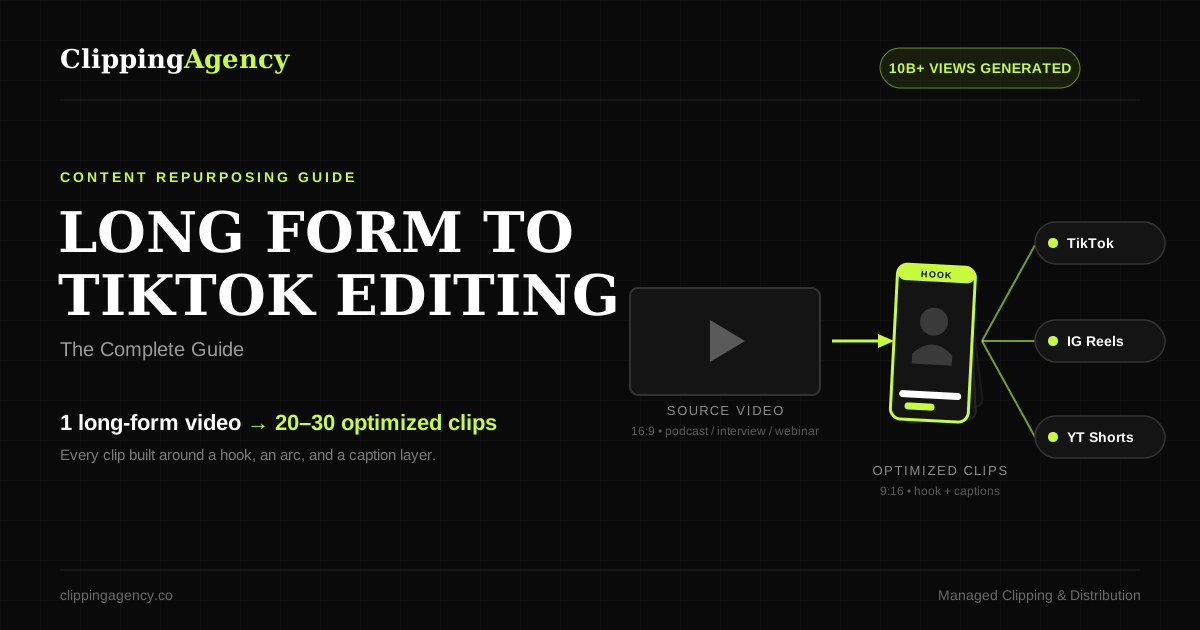
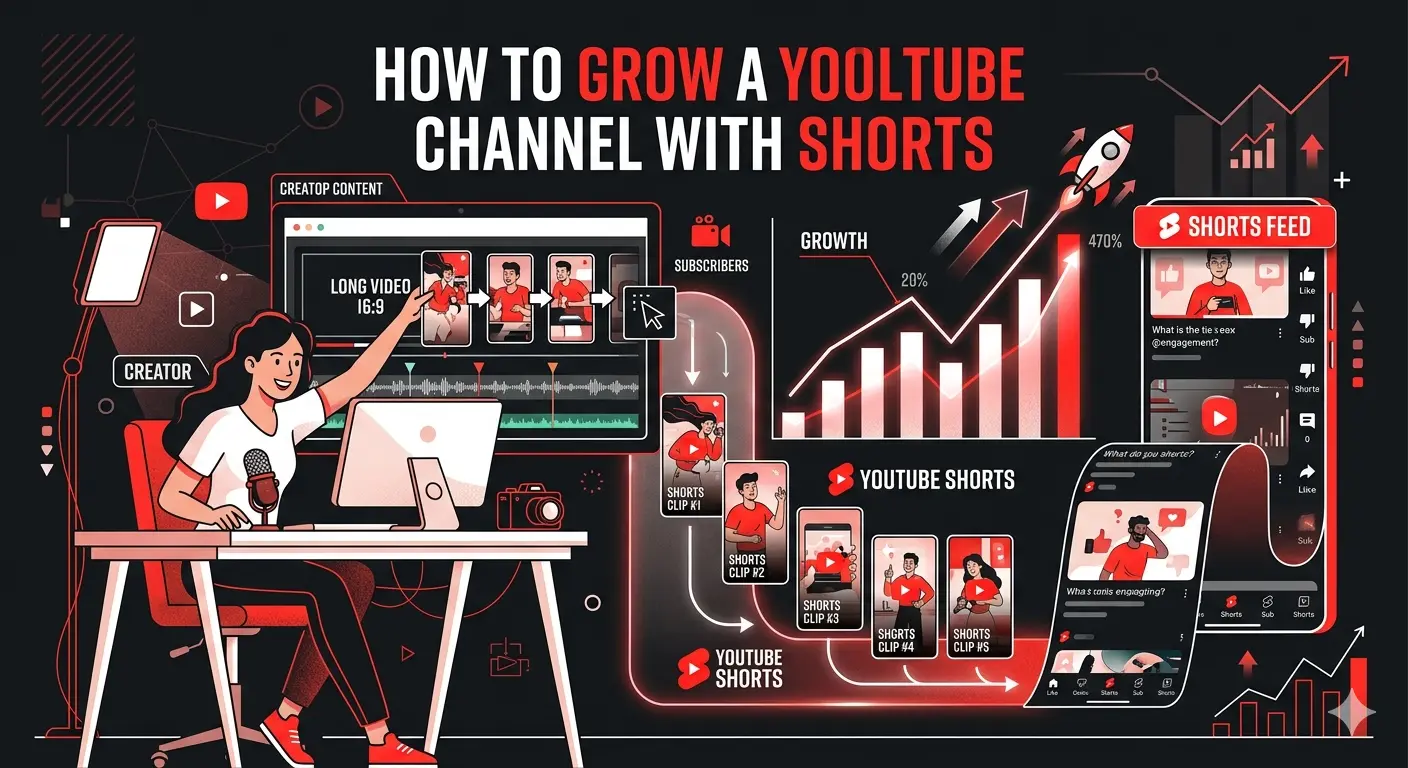
The clipping strategy means turning long-form content into multiple Shorts without creating new material from scratch.
Instead of filming one Short per day, you record or source one long-form piece per week, then extract 8–15 high-value moments from it. Each moment becomes a standalone Short.
One 60-minute interview can generate two to three weeks of daily Shorts. A library of 10 existing videos can produce months of content before you need to record anything new.
Volume matters because each Short is an independent experiment. More Shorts means more data on what your audience responds to, more entry points into the feed, and more chances to hit the watch-through threshold that triggers wider distribution. The clipping strategy solves the volume problem without sacrificing quality — you start with content that has already proven its value, then select only the moments that stand alone as complete ideas.
Observed pattern: Channels posting 3–5 Shorts per day from a content backlog reach growth benchmarks 2–3x faster than channels posting 1–2 per week. The variable is not talent it is volume and consistency.
How to Grow a YouTube Channel with Shorts: The Full System
Step 1: Build Your Content Inventory
List every long-form video you have that is at least 10 minutes long. For each one, estimate how many genuinely strong moments it contains — not interesting moments, strong ones. Moments where the speaker says something surprising, counterintuitive, or specific.
If you are starting from zero, record one long-form video per week for four weeks before posting Shorts. This gives you a backlog and prevents your clipping pace from outrunning your recording pace.
Best source formats, ranked by clip yield:
- Podcast interviews — high clip density, natural conversational energy
- Panel discussions — multiple perspectives, easy to extract opinion clips
- Long tutorials — high yield for educational Shorts
- Solo commentary — lower density, but strong retention when the presenter is sharp
If you run a podcast, a podcast clipping workflow can turn each episode into weeks of Shorts without additional recording.
Step 2: Find High-Retention Moments — Clip by Type, Not Length
Most people clip by time: find something 60 seconds long. This produces average clips because length is not what makes a moment worth watching.
Clip by type instead:
Opinion clips: The speaker takes a clear position some viewers will disagree with. Tension holds attention in a swipe-based feed.
Proof clips: A specific result, number, or before-and-after. Specificity creates credibility.
Reversal clips: Something the viewer assumes is true gets disproved in the first 10 seconds. These have the highest share rate of any format.
Emotional clips: Genuine frustration, laughter, or vulnerability — not manufactured. These drive comment engagement, which is the secondary signal the algorithm uses to extend distribution.
Step 3: Edit for the Shorts Algorithm
Two edits matter more than everything else combined.
Hook density in the first three seconds. If the first frame and first sentence do not create a reason to keep watching, the swipe-away rate will suppress distribution. A strong statement, a visual cut, or dropping into the middle of a story all work. What consistently fails: any variation of “Hi, I’m [name] and today I want to talk about…”
Captions for silent viewing. A significant share of Shorts are watched without audio. Captions should be high contrast, one to two lines at a time, timed to natural speech rhythm — not auto-generated blocks.
Everything else, pacing, framing, endings is secondary to these two.
For creators producing high volume, a short form content system that handles editing at scale removes this bottleneck entirely.
Step 4: Post with Volume and Consistency
Each Short is a separate test. A channel posting one Short per day runs 30 experiments per month. A channel posting once a week runs four.
What consistent growth looks like in practice:
- One Short per day produces measurable growth within 45–60 days for most channels
- Three to five per day from a backlog can compress that window significantly
- Fewer than three per week produces results too slow and variable to learn from
The goal in the first 60 days is not to go viral. It is to generate enough performance data to know what is working.
Step 5: Use Performance Data to Improve
After four to six weeks of posting, your Shorts analytics will show clear patterns. Some topics will hold attention at 80% watch-through. Others will lose viewers at the eight-second mark regardless of editing.
These patterns are instructions. High watch-through topics should influence what you record next, which moments you clip, and what hook approaches you test in the next batch. Channels that compound fastest treat the Shorts feed as a testing layer for their entire content strategy — not a separate channel.
Mistakes That Stop Shorts Growth
Editing for target length instead of a natural ending. Platform preferences on ideal length shift constantly. What does not: a 28-second Short that ends on a complete idea outperforms a 58 second Short padded to fill time.
Calling for subscribers before earning it. Viewers subscribe when they believe future content is worth their time. The Short itself is the pitch. A weak Short with a strong CTA converts no one.
Ignoring which topics are performing. Some subject areas will consistently produce higher watch-through rates than others. Most creators post evenly across all subjects instead of doubling down on what works. Topic selection is the highest-leverage decision in the whole system.
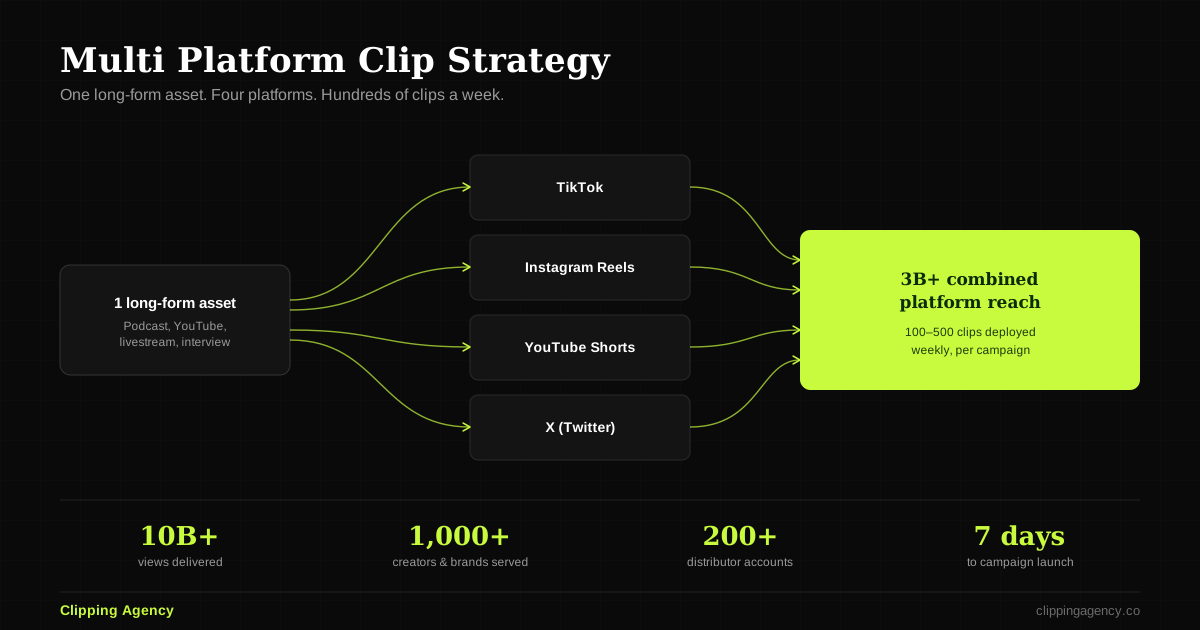
Reposting the same clip unchanged across platforms. TikTok, Instagram Reels, and YouTube Shorts have different feed behavior and audience expectations. At minimum, adjust the caption framing and hook structure per platform.
Shorts vs. Long-Form: How to Use Both
Shorts are a discovery tool, not a monetization tool. YouTube’s revenue per thousand views on Shorts is substantially lower than on long-form. A Shorts-only channel builds reach without the subscriber depth needed for sponsorships, memberships, or high CPM ad revenue.
The model that works financially:
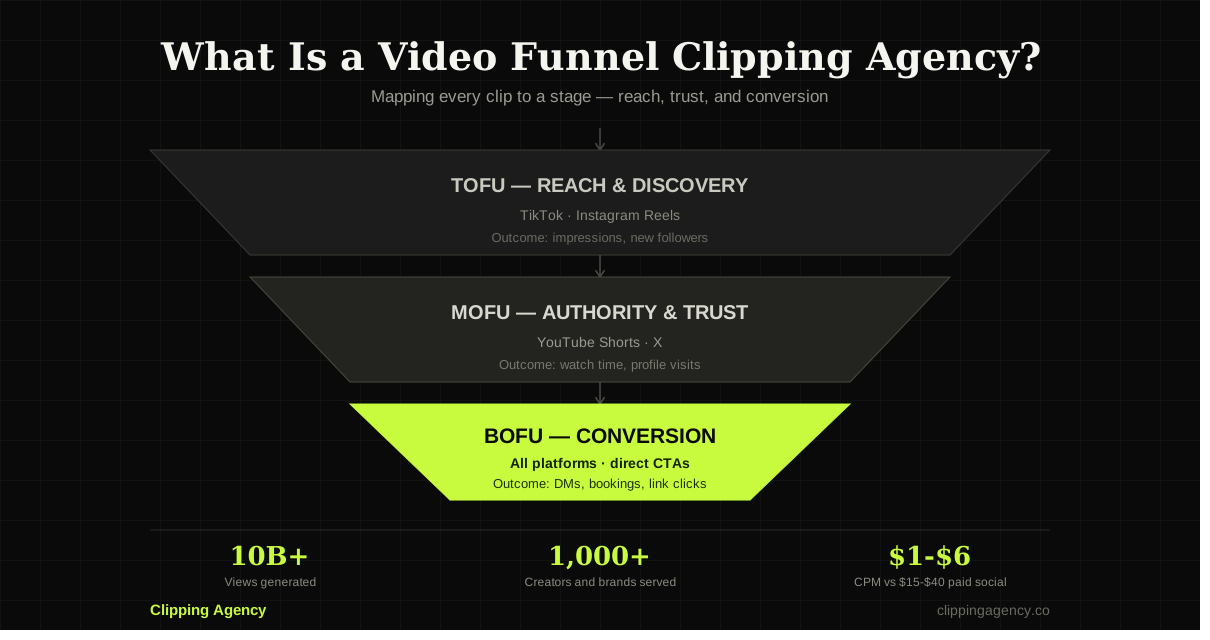
- Shorts bring in viewers who have never heard of the channel
- A portion visit the channel and watch long-form videos
- Long-form generates ad revenue and enables sponsorship deals
- A growing subscriber base improves long-form reach
- Better long-form produces higher-quality source material for clipping
Shorts and long-form are not competing strategies, they are two stages of the same funnel. Read more about how to structure this as a scaling Shorts distribution strategy when you are ready to move beyond a single channel.
How Long Growth Actually Takes
Weeks 1–3: Low impression volume while the algorithm builds an audience model. Do not adjust strategy based on numbers from this window.
Weeks 4–8: First meaningful signal. Click-through rates consistently below 4% means the hook copy needs work. Watch-through averages below 55% means clip selection or pacing needs adjustment.
Month 3 onward: Channels that maintained volume and made data-driven adjustments see compounding reach. Channels that paused or pivoted in this window typically reset their progress.
The most common reason this strategy gets abandoned is comparing week-three results to channels that have been running it for six months.
FAQs
How many Shorts should I post per day?
One per day is the minimum for consistent growth. Three to five per day from a backlog tends to produce results significantly faster. Fewer than three per week is too slow to generate useful performance data.
Do YouTube Shorts actually grow subscribers?
Yes, but indirectly. Shorts bring viewers to your channel page, where long-form content converts them into regular subscribers. The Shorts-to-subscriber conversion rate is lower than long-form — the real value is top-of-funnel reach.
Can Shorts replace long-form entirely?
No. Shorts revenue per thousand views is substantially lower than long-form. Use Shorts to grow the top of your funnel. Let long-form convert that attention into an audience worth monetizing.
How long should a YouTube Short be?
30 to 90 seconds for most categories. Watch-through rate matters more than length. A 35-second Short with 80% completion outperforms a 60-second Short with 50% completion in the algorithm.
What actually makes a Short go viral?
Low swipe-away rate in the first five seconds combined with high watch-through to the end. Both come from the same place: a hook that creates a reason to keep watching and a payoff that delivers on it.
Does this work for new channels?
Yes and it is particularly effective for new channels because it solves the volume problem without daily original recording. A backlog of 10 long videos can sustain consistent daily posting for months, which is long enough for the algorithm to start distributing more aggressively.
Every Day You Wait, A Competitor Gets the View
We recruit, train, and manage a clipping army that distributes your content across 50–500 accounts on TikTok, Reels, and Shorts simultaneously. One upload becomes hundreds of posts. Every single day.
Trusted by 1,000+ creators · 10 Billion+ views generated