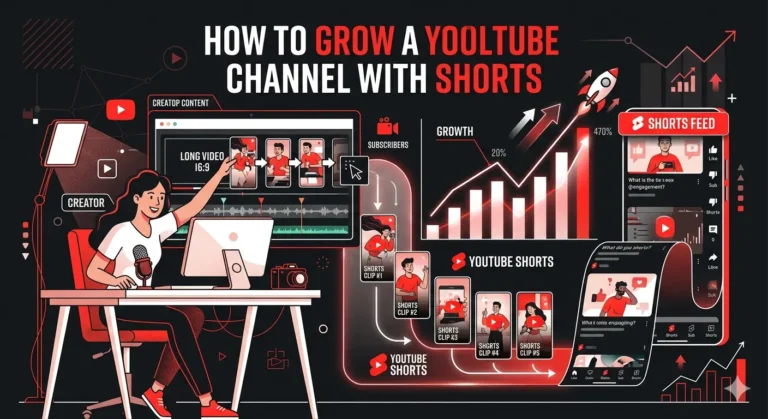

Short-form video has become the largest growth channel on the internet.
- YouTube Shorts generates 70+ billion daily views
- TikTok users watch over 1 billion videos every day
- Instagram Reels reaches more than 2 billion users monthly
Because of this massive reach, creators are turning long-form content into short clips to attract new audiences.
That’s where AI tools like Opus Clip come in.
They promise something simple:
Upload a long video → instantly generate multiple viral clips.
It sounds like the perfect system.
But many creators eventually start asking the same question:
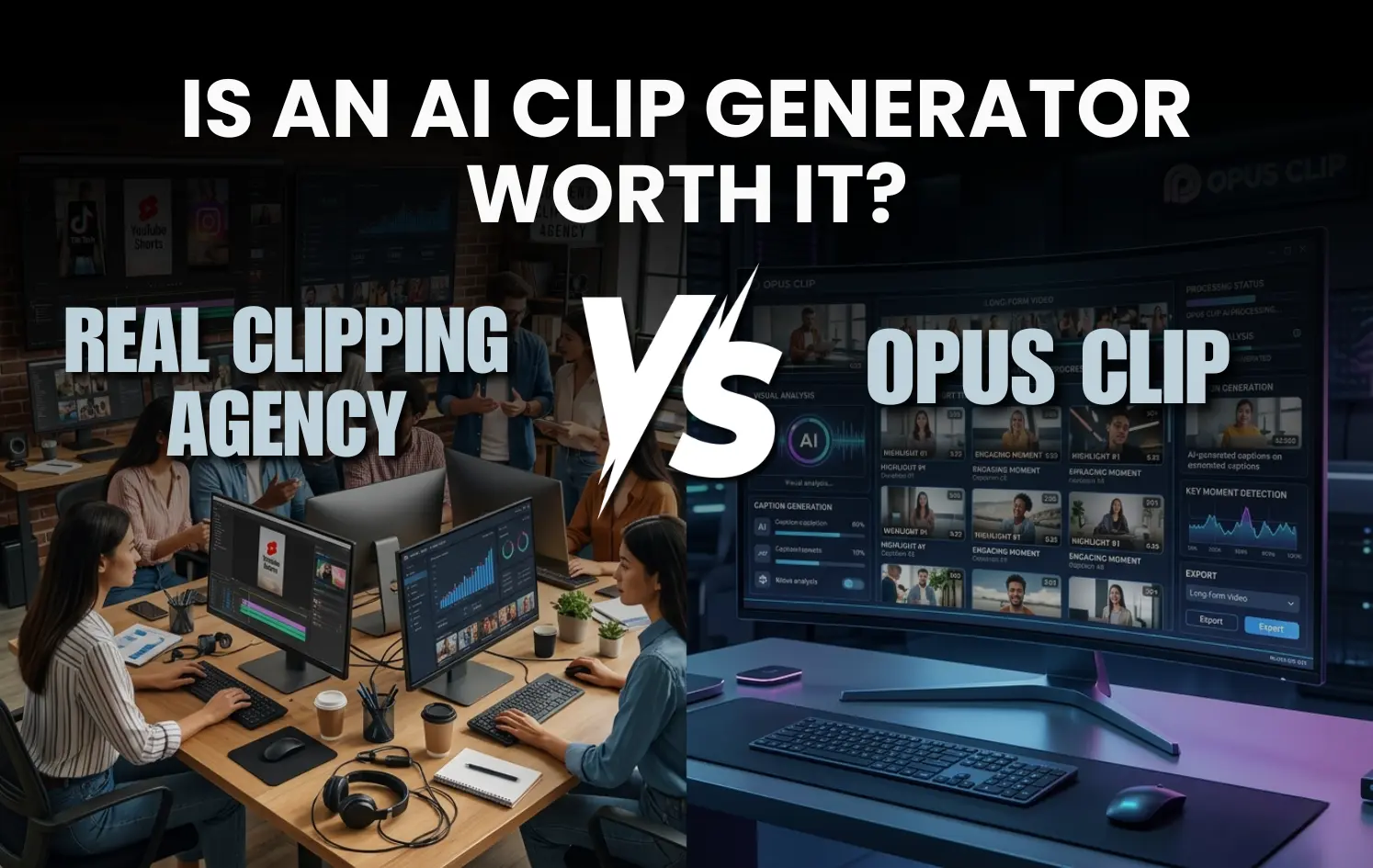
Is an AI clip generator actually worth it?
Or can a real clipping agency grow a channel faster?
Let’s break it down.
The Short-Form Content Explosion
Short-form video is not just a trend anymore. It’s a distribution strategy.
According to HubSpot’s video marketing research:
- Short-form video delivers the highest ROI of any content format
- Videos under 60 seconds generate 2.5× more engagement
- Creators who post multiple clips per day grow audiences significantly faster
This is why podcast hosts, coaches, founders, and YouTubers now build entire content strategies around video clipping.
Instead of relying on one long video, creators distribute their ideas through dozens of short clips.
But creating high-performing clips consistently is harder than it looks.
Quick Question for You
Before reading further, ask yourself:
- Do your clips stop viewers from scrolling?
- Do people watch past the first five seconds?
- Do some clips explode while others get almost no views?
If this sounds familiar, you’re dealing with the short-form retention challenge.
And this is where the difference between AI clipping and strategic clipping becomes clear.
What Is an AI Clip Generator?
An AI clip generator is software that automatically converts long videos into short-form clips.
Tools like Opus Clip analyze video transcripts and identify potential highlight moments.
The process usually works like this:
- Upload a long video or podcast episode
- AI scans the transcript for interesting segments
- Clips are cut automatically
- The video is converted to vertical format
- Subtitles and captions are generated
Within minutes, creators receive several short clips ready for posting.
For creators who publish podcasts or long-form content regularly, this saves a lot of time.
But automation also introduces some limitations.
Example: AI Generated Vertical Clip
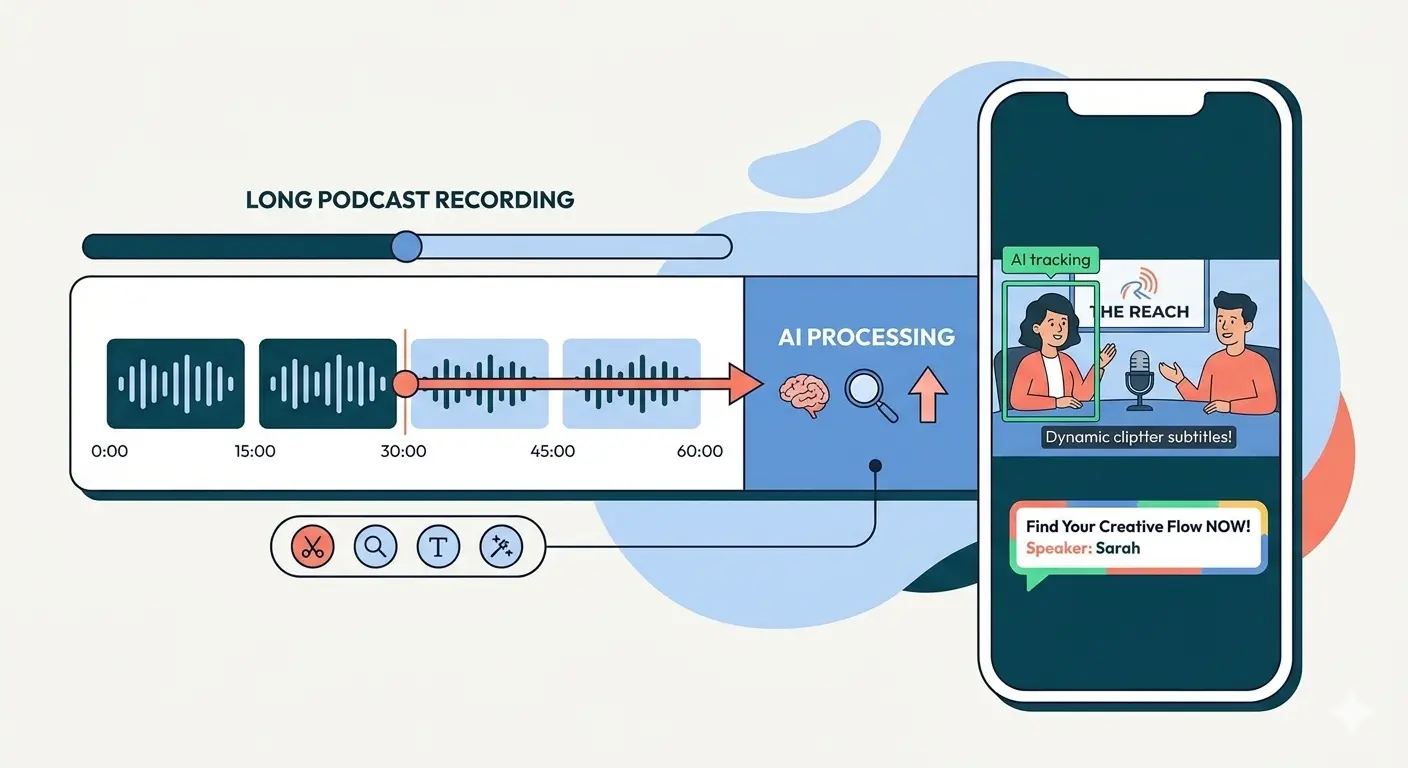
Typical AI clips include:
- automated captions
- speaker tracking
- basic zoom edits
- automatic highlight detection
For quick repurposing, this works well.
However, many creators notice something interesting.
Most AI clips look very similar.
Is an AI Clip Generator Worth It?
The honest answer is:
Yes, but only for speed.
AI clip generators are useful for:
- quickly repurposing podcasts
- testing short-form content ideas
- generating many clips at once
- reducing editing workload
For beginners, they are a great starting point.
But when the goal shifts from producing clips to growing a channel, automation alone often falls short.
Because viral clips rely on something AI still struggles with: storytelling structure.
Why Many AI Clips Don’t Perform Well
AI tools detect activity signals, not storytelling.
They analyze things like:
- loud moments
- speaker changes
- laughter
- emotional speech
But high-performing clips usually follow a specific structure.
1. Hook (0–2 seconds)
A statement that stops scrolling.
Example:
“Most creators fail on TikTok because they miss this one thing.”
2. Context (2–10 seconds)
A quick explanation that builds curiosity.
3. Payoff (10–25 seconds)
The insight or punchline that rewards the viewer.
AI tools often cut clips mid-conversation, which removes the hook.
Without a strong hook, viewers scroll.
And when viewers scroll, the algorithm stops pushing the video.
Example: Weak AI Clip Hook
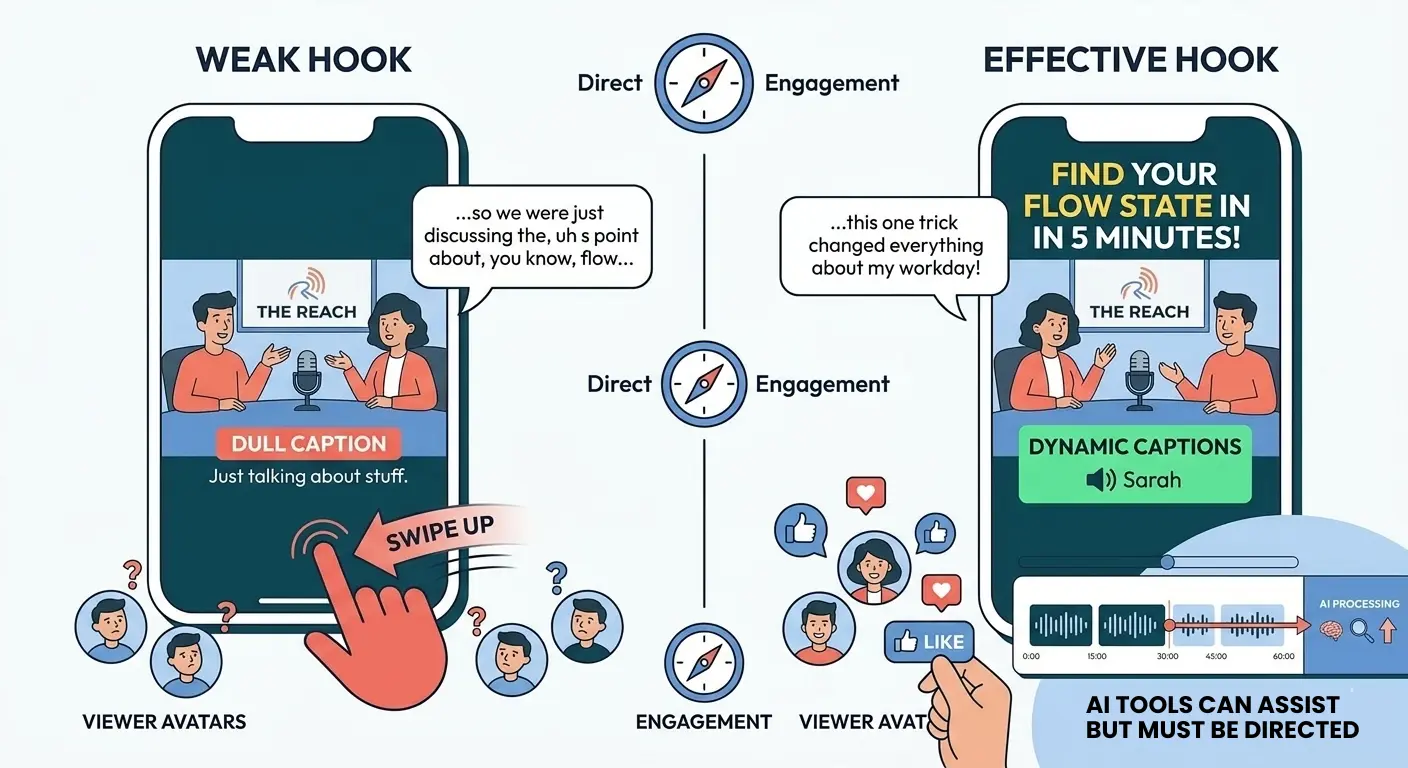
This is why many creators experience inconsistent results with automated clipping tools.
Opus Clip vs a Real Clipping Agency
Let’s compare them directly.
| Feature | AI Clip Generators (Opus Clip) | Professional Clipping Agency |
| Editing speed | Very fast | Moderate |
| Cost | Low | Higher |
| Storytelling structure | Limited | Strong |
| Hook optimization | Automated guess | Human strategy |
| Retention editing | Basic | Advanced |
| Clip uniqueness | Often repetitive | Custom editing |
| Growth strategy | None | Content distribution strategy |
| Long-term scalability | Limited | High |
AI tools win when it comes to speed and automation.
Clipping agencies win when it comes to performance and growth strategy.
The Real Metric That Matters: Retention
Short-form platforms prioritize viewer retention.
Algorithms measure:
- watch time
- completion rate
- engagement
- rewatches
Industry data shows:
- Clips with 80%+ completion rate are far more likely to go viral
- Strong hooks increase retention by 30–40%
- Dynamic editing can increase watch time by 20% or more
Achieving these metrics requires intentional editing decisions.
That’s why many creators eventually work with professional clipping teams.
If you want your content turned into high-performing short clips, explore our clipping services.
How Real Clipping Agencies Grow Channels
A professional clipping agency doesn’t just cut videos.
They build short-form distribution systems.
Their workflow usually includes:
- Content analysis
- Hook engineering
- Story-driven editing
- Retention optimization
- Multi-platform distribution
Instead of producing random clips, agencies create clips designed to maximize watch time and reach.
See how creators scale short-form distribution with structured clipping campaigns
Example: Strategically Edited Clip
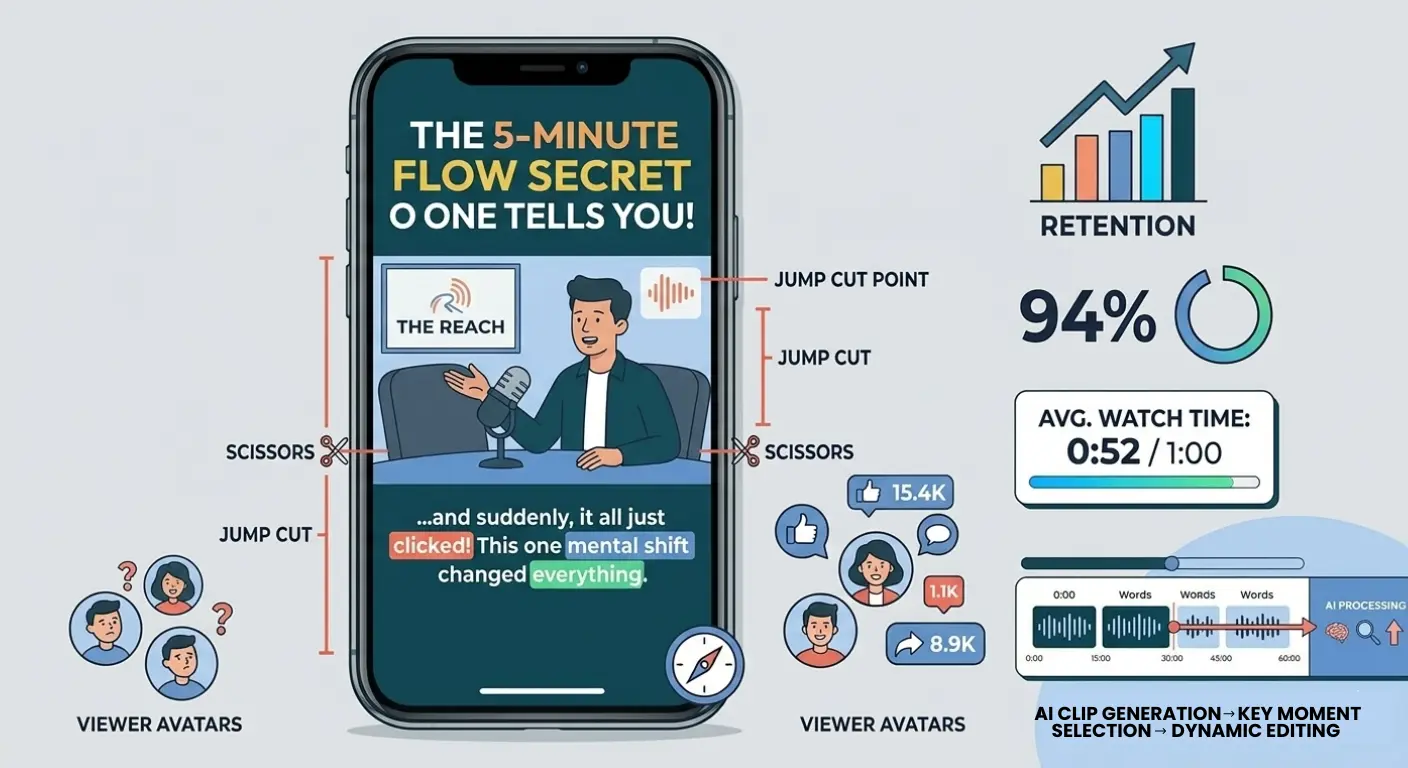
Notice how the clip starts with a clear idea.
That structure increases the chance of viewers watching the entire video.
The Hybrid Strategy Used by Top Creators
Interestingly, many successful creators combine AI tools and human editing.
In this workflow:
AI helps with:
- transcript scanning
- highlight detection
- initial clip drafts
Human editors improve:
- hook placement
- pacing
- storytelling
- visual engagement
This hybrid model provides both speed and performance.
Many podcasts and creators use a podcast clipping agency to turn every episode into dozens of optimized clips.
Learn how a dedicated podcast clipping agency turns long content into viral short videos
When an AI Clip Generator Actually Makes Sense
AI clipping tools are still extremely useful.
They make sense if you want to:
- test new content formats
- quickly repurpose long videos
- produce high clip volume
- create draft clips for editing
For many creators, they are the first step into short-form video.
But as channels grow, creators realize that automation alone rarely builds sustainable growth.
Strategy does.
Final Verdict: AI Clip Generator vs Clipping Agency
AI clip generators like Opus Clip make short-form content easier to produce.
They reduce editing time and help creators experiment quickly.
But growing a channel requires more than automation.
It requires:
- storytelling
- strong hooks
- retention-focused editing
- consistent distribution
That’s why many creators eventually move from pure AI clipping to strategic clipping workflows.
Because the goal is not just to produce clips.
The goal is to create clips that people actually watch.
And when viewers watch longer, platforms push your content to larger audiences.
Discover how clipping marketing strategies turn short videos into consistent growth engines
Ready to Turn Your Content Into Viral Clips?
AI tools can generate clips quickly.
But strategic editing turns clips into millions of views.
If you want:
- higher retention
- stronger hooks
- consistent posting systems
- viral-ready short videos
Work with a professional team through our clipping services
Frequently Asked Questions About AI Clip Generators
Is an AI clip generator worth it for creators?
AI clip generators can be useful for quickly turning long videos into short clips. They save time by automatically identifying highlight moments and adding captions. However, many creators find that automated clips lack strong hooks and storytelling structure, which are important for viewer retention. For creators focused on long-term growth, combining AI tools with strategic editing usually produces better results.
Do AI clip generators help videos go viral?
AI tools can help generate a large number of clips quickly, but virality depends on several other factors. Successful short-form videos typically include a strong opening hook, clear storytelling, and optimized pacing. These elements often require human editing decisions, which is why many creators rely on professional clipping services to improve clip performance.
What is the best AI clip generator?
Several AI clipping tools exist today, including Opus Clip and other automated editing platforms. These tools are designed to detect highlights from long videos and convert them into vertical clips for platforms like TikTok, YouTube Shorts, and Instagram Reels. The best tool depends on your workflow, editing needs, and content strategy.
Can AI replace video editors for clipping?
AI can automate parts of the clipping process, such as detecting highlights and generating subtitles. However, it still struggles with storytelling, pacing, and emotional timing. For high-performing short-form content, many creators combine AI tools with human editors who refine clips for retention and engagement.
How do creators turn podcasts into viral clips?
Successful creators usually follow a structured clipping strategy. Instead of posting random highlights, they design clips around strong hooks, clear ideas, and engaging storytelling. Many podcasts work with dedicated clipping teams that turn each episode into dozens of optimized clips for TikTok, Instagram Reels, and YouTube Shorts.
Every Day You Wait, A Competitor Gets the View
We recruit, train, and manage a clipping army that distributes your content across 50–500 accounts on TikTok, Reels, and Shorts simultaneously. One upload becomes hundreds of posts. Every single day.
Trusted by 1,000+ creators · 10 Billion+ views generated