
You’ve already done the hard part. You recorded the video. You edited it. You published it. And then — nothing much happened.
That’s not a content quality problem. That’s a distribution problem. And a YouTube Shorts clipping campaign is specifically how you fix it.
This guide breaks down exactly what a YouTube Shorts clipping campaign is, how the system works, what separates a campaign that generates millions of views from one that flatlines at 300, and why the creators who are scaling fastest right now aren’t creating more content — they’re distributing what they already have more aggressively.
What Is a YouTube Shorts Clipping Campaign?
A YouTube Shorts clipping campaign is a structured, repeatable distribution system where your existing long-form YouTube videos are converted into short-form vertical clips and published across multiple accounts simultaneously — every single day.
It is not:
- Hiring a freelancer to send you clips once a month
- Uploading a few Shorts yourself and hoping one goes viral
- Running paid YouTube ads against your Shorts
It is:
- A managed pipeline where trained clippers identify high-retention moments from your long-form videos
- A community-driven distribution network that posts those Shorts across dozens or hundreds of real accounts
- A performance-tracked operation with submissions, quality review, and payout systems running behind the scenes
The goal of a YouTube Shorts clipping campaign isn’t just views on a single Short. It’s algorithmic momentum — the kind that compounds over weeks and months and starts pulling your long-form content into recommendation feeds it would never reach through a single-account upload strategy.
Why YouTube Shorts Specifically — And Why the Timing Is Now
YouTube Shorts crossed 70 billion daily views in 2024. That number has continued climbing. But the more important stat isn’t the raw viewership — it’s how the YouTube algorithm treats Shorts performance in relation to the rest of your channel.
A Short that performs well tells YouTube’s recommendation engine that your content resonates. That signal doesn’t stay siloed inside the Shorts tab. It feeds into how often your long-form content gets surfaced to new audiences in the “Up next” queue, in Browse features, and in Home feed recommendations.
This is the structural advantage that no other short-form platform offers: YouTube Shorts and YouTube long-form are the same ecosystem. When the short wins, the channel wins.
YouTube Shorts vs. Other Short-Form Platforms: What Actually Matters for YouTubers
| Platform | Cross-format benefit | Monetisation path | Algorithmic compounding |
|---|---|---|---|
| YouTube Shorts | ✅ Directly boosts long-form visibility | ✅ AdSense + Shorts Fund | ✅ Strong — same channel |
| TikTok | ❌ No long-form crossover | Limited | Moderate |
| Instagram Reels | ❌ No YouTube benefit | Limited | Moderate |
| X (Twitter) | ❌ No long-form crossover | Very limited | Low |
For a YouTuber specifically, a Shorts clipping campaign is the highest-ROI distribution move available. You’re not just getting views on a Short — you’re accelerating the entire channel’s growth trajectory.
The Scale Problem: Why Single-Account Posting Doesn’t Work
Here’s the math that most YouTubers never run.
You post one Short. That Short gets shown by the algorithm to a small initial batch of viewers — maybe a few hundred to a few thousand, depending on your channel’s existing authority. If the watch-through rate is strong, it expands. If it’s average, it doesn’t. You had one shot.
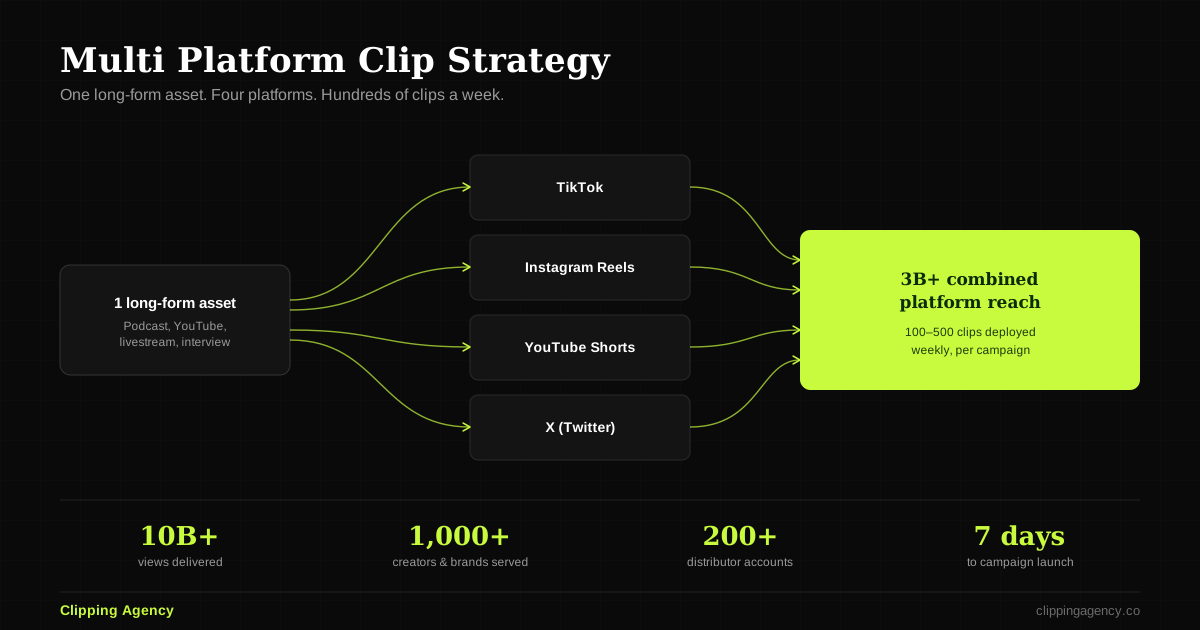
Now imagine 100 different accounts post the same Short on the same day, or different clips from the same video. The algorithm is receiving 100 independent distribution signals. Some of those accounts reach different demographic segments. Some land in different geographic feeds. The content is appearing in more places, to more people, without any single account needing to go “viral” for the campaign to succeed.
This is the volume-and-velocity model that clipping campaigns operate on. And it’s why the performance gap between a managed campaign and a solo upload strategy widens every single month.
The Numbers That Make This Concrete
| Strategy | Daily Shorts Posted | Monthly Reach Potential | Cost per 1,000 Views |
|---|---|---|---|
| Solo creator posting manually | 1–2 | 10,000–50,000 | Unpredictable |
| Small clipping team (5–10 clippers) | 10–30 | 200,000–800,000 | ~$0.005–$0.01 |
| Full managed clipping campaign | 50–200+ | 1M–5M+ | ~$0.002–$0.003 |
| YouTube paid ads | N/A | Budget-dependent | $10–$14 |
The cost-per-view difference between a paid ad campaign and a managed clipping campaign isn’t marginal — it’s 3,000–5,000× cheaper. That’s not a rounding error. That’s a fundamentally different business model for audience growth.
How a YouTube Shorts Clipping Campaign Actually Works
Understanding the operational mechanics is important — because this is where most DIY attempts break down.
Phase 1: Content Audit and Clip Identification
Before a single Short gets published, the campaign starts with a content audit. An experienced clipper or campaign manager reviews your existing long-form library and identifies:
- Hook moments — the first 2–3 seconds that make someone stop scrolling
- High-tension exchanges — arguments, debates, surprising admissions
- Quotable insight windows — 30–60 second segments where a strong idea is clearly stated
- Emotional peaks — moments of laughter, frustration, revelation, or genuine surprise
The average hour-long YouTube video contains 8–15 viable Shorts moments. A 3-hour podcast episode might contain 20–40. Most creators have months or years of backlog content that has never been touched for clipping.
Phase 2: Clip Production and Formatting
Each identified moment gets formatted for YouTube Shorts:
- 9:16 vertical crop — YouTube Shorts requires vertical framing; horizontal footage gets reformatted with dynamic cropping or background fill
- Subtitles/captions — 80%+ of Shorts are watched without sound; burned-in captions are not optional
- Hook text overlay — first-frame text that reinforces why the viewer should keep watching
- Clip duration — YouTube Shorts performs best between 30–90 seconds; the sweet spot for most niches is 45–60 seconds
Phase 3: Community Distribution at Scale
This is the part that separates a clipping campaign from a clipping service. Finished clips are published through a managed network of real accounts — the campaign’s clipper community. Each clipper posts your content to their own account or to managed accounts set up for distribution.
The result: the same piece of content is appearing across dozens or hundreds of different channels simultaneously. Different audiences. Different recommendation pools. Different geographic feeds. The algorithm treats each as an independent signal.
Phase 4: Performance Tracking and Optimisation
A properly run YouTube Shorts clipping campaign doesn’t just post and forget. It tracks:
- View counts and watch-through rates per clip
- Which clip styles (hooks, formats, lengths) are performing above benchmark
- Which source content categories are generating the most Shorts traction
- Payout management for clipper contributions
This data gets fed back into Phase 1. The campaign becomes more efficient over time, not just consistent.
What Makes a Shorts Clip Actually Perform? The Anatomy of a High-Retention YouTube Short
Not all clips are equal. The difference between a Short that gets 500 views and one that gets 500,000 views often comes down to three things.
1. The first three seconds. YouTube’s algorithm measures skip rate at the 3-second mark. If a viewer swipes before three seconds, that’s a hard negative signal. If they stay past three seconds, the algorithm considers them “retained.” Every high-performing Short starts with a statement, a visual, or a question that makes swiping feel like missing something important.
2. Watch-through percentage. YouTube weights average view duration heavily in Shorts ranking. A 45-second Short with 85% watch-through will always outperform a 90-second Short with 40% watch-through. Shorter clips that hold attention beat longer clips that lose it.
3. Re-watch rate. Unlike long-form video, Shorts loop automatically. A clip that gets watched twice or three times per session tells the algorithm this content is compelling enough to re-consume. This is why cliffhangers, unresolved questions, or extremely dense information tend to outperform clips that give everything away in the first half.
How Many Shorts Per Video? A Framework for Long-Form Content
This is one of the most common questions from YouTubers starting a clipping campaign. The answer depends on your content format.
| Content Type | Avg Video Length | Typical Shorts Yield | Distribution Potential/Month |
|---|---|---|---|
| Interview / Podcast | 45–120 min | 15–40 clips | 3M–8M views |
| Educational / Tutorial | 10–30 min | 5–12 clips | 800K–2.5M views |
| Vlog / Documentary | 15–45 min | 8–20 clips | 1M–4M views |
| Live Stream | 60–240 min | 20–60 clips | 5M–15M views |
| Commentary / Reaction | 10–20 min | 4–10 clips | 500K–1.5M views |
Estimates based on a managed campaign with 50–150 active clippers and daily posting cadence.
The Compound Effect: Why Clipping Campaigns Get Better Over Time
Month one of a YouTube Shorts clipping campaign rarely shows the campaign’s full potential. This is where many creators make a costly mistake — they evaluate a campaign’s performance at 30 days and decide it isn’t working.
Here’s what’s actually happening:
Month 1: Clipper community is onboarded. Posting volume ramps up. Algorithm begins receiving fresh signals from new accounts. Initial view data starts flowing in.
Month 2: High-performing clip formats are identified. Clipper quality improves. The YouTube algorithm starts associating your channel with consistent Shorts engagement. Long-form recommendation frequency begins to increase.
Month 3+: Compounding kicks in. The channel’s algorithmic authority builds. Each new Short gets an expanded initial distribution pool because the algorithm has learned your content retains viewers. Monthly views start climbing at a rate that has nothing to do with how many new videos you’ve published.
This is the fundamental difference between a one-time content push and a content distribution system. One is an event. The other is infrastructure.
Common Mistakes YouTubers Make When Running a Shorts Clipping Campaign
Mistake 1: Treating it like a content strategy, not a distribution strategy
A YouTube Shorts clipping campaign does not require you to make more content. It requires you to distribute what you already have more aggressively. The creators who stall out are the ones who treat clipping as a content creation task.
Mistake 2: Using AI clipping tools as a substitute for human judgment
AI clipping tools can identify moments based on audio patterns and transcription data. They cannot reliably identify why a moment will resonate with a specific audience. Hook quality, emotional timing, and cultural relevance require human judgment. AI clipping vs human clipping isn’t a debate about efficiency — it’s a debate about campaign performance at scale.
Mistake 3: Underestimating the operations layer
The hardest part of a clipping campaign isn’t the clips. It’s the operations. Recruting clippers, reviewing submissions, enforcing quality standards, processing payouts, replacing underperforming clippers — this is a full-time management job. Most YouTubers who try to run this in-house burn out within 60 days.
Mistake 4: Evaluating performance too early
As covered above — the compound effect doesn’t show up in month one. Cutting a campaign before the compounding begins is one of the most expensive decisions a creator can make.
Mistake 5: Ignoring the long-form feedback loop
The entire point of a YouTube Shorts clipping campaign for a YouTuber is not just Shorts views. It’s the channel-wide lift that comes from Shorts performance feeding into long-form recommendation. Creators who track only Shorts metrics are missing half the data that matters.
YouTube Shorts Clipping Campaign vs. Other Growth Strategies
| Strategy | Cost | Scalability | Organic reach | Channel-wide impact | Stops when you stop? |
|---|---|---|---|---|---|
| YouTube Shorts clipping campaign | Low ($0.002–0.003/view) | High | ✅ Yes | ✅ Yes | ❌ No — compounds |
| Paid YouTube ads | High ($10–14/1K views) | High | ❌ No | Limited | ✅ Yes |
| SEO / search optimisation | Medium (time investment) | Medium | ✅ Yes | ✅ Yes | ❌ No |
| Influencer sponsorships | High | Low | Partial | Limited | ✅ Yes |
| UGC content creation | Medium-High | Medium | Partial | Limited | ✅ Yes |
For a full breakdown of how UGC ads compare to clipping as a growth strategy, that comparison is worth reading before committing budget to either.
What Results Can a YouTuber Realistically Expect?
These are the benchmarks Clipping Agency clients typically see across the first 90 days of a managed YouTube Shorts clipping campaign:
30 days:
- 10× increase in Shorts output from existing content
- 1–3 million additional monthly views across distribution accounts
- Initial channel-wide algorithmic lift begins
60 days:
- High-performing clip formats identified and scaled
- Long-form view velocity starts increasing
- Subscriber acquisition rate from Shorts begins compounding
90 days:
- Full compound effect underway
- 3–8 million monthly views from Shorts distribution
- Long-form recommendation frequency measurably increased
- Some clients begin seeing individual Shorts break into 10M+ territory
These aren’t projections from a pitch deck. They’re outcomes from a system that has generated over 2 billion views for creators and brands globally.
How to Start a YouTube Shorts Clipping Campaign
There are three realistic paths:
Option 1: Build it yourself Recruit clippers, set up a Whop community, create submission guidelines, review clips daily, process payouts, track performance, replace underperformers. Possible — but this becomes your part-time job, and most creators who attempt it underestimate the time cost by 5–10×.
Option 2: Hire individual freelancers You get clips. You don’t get a distribution network. Better than nothing, but the ceiling is low.
Option 3: Work with a managed clipping campaign agency The entire system is built, managed, and optimised for you. You provide source content. The agency handles everything from community recruitment through to payout. You track the views and subscribers.
This is what Clipping Agency does — and it’s why the time from strategy call to live campaign is typically 24–48 hours.
Frequently Asked Questions
What is a YouTube Shorts clipping campaign? A YouTube Shorts clipping campaign is a managed distribution system where your existing long-form YouTube videos are converted into vertical short-form clips and published across multiple accounts simultaneously on a daily basis. The goal is to generate algorithmic momentum on YouTube Shorts that compounds into channel-wide growth — more Shorts views, more long-form recommendations, and faster subscriber acquisition — without requiring you to create additional content.
How many Shorts can I get from a single YouTube video? The number varies by content type and length. A standard 45-minute interview or podcast episode typically yields 12–25 viable Shorts clips. A 2-hour live stream can produce 30–60. An educational tutorial of 15–20 minutes might yield 6–12 clips. The key metric isn’t volume — it’s the quality of hook moments identified within each piece of content.
Does a YouTube Shorts clipping campaign help my main channel grow? Yes — and this is the structural advantage that makes YouTube Shorts different from other short-form platforms. When your Shorts perform well (strong watch-through, engagement, re-watch rate), YouTube’s algorithm applies those positive signals to your channel as a whole. This increases how often your long-form content is recommended to new viewers in Browse features and the “Up next” queue. Shorts growth and long-form channel growth are directly connected on YouTube.
How long does it take to see results from a YouTube Shorts clipping campaign? Initial view activity begins within the first week as distribution ramps up. The compounding effect — where each month’s performance builds on the previous month’s — typically becomes visible between weeks 6 and 12. Most Clipping Agency clients see 1–3 million additional monthly views by the end of month one, with that number growing each subsequent month.
Can I run a YouTube Shorts clipping campaign on old videos? Absolutely. Backlog content is often where the best clipping opportunity sits. Most YouTubers have 12–48 months of archived long-form videos that have never been repurposed for Shorts. This content can be onboarded immediately into a clipping campaign without waiting for new uploads.
What kind of YouTubers benefit most from a Shorts clipping campaign? The highest-performing clipping campaigns are typically for creators in high-engagement niches: interview-based content, commentary, business and finance, fitness, gaming, podcasting, and education. Any creator producing long-form content with high-value spoken moments — opinions, insights, debates, revelations — has strong raw material for a Shorts clipping campaign.
How is a clipping campaign different from hiring a video editor? A video editor delivers clips. A clipping campaign delivers distribution. The difference is scale: a single editor might produce 5–15 clips per week for one account. A managed clipping campaign produces 50–200+ clips per week distributed across dozens or hundreds of accounts simultaneously. The output isn’t just more clips — it’s dramatically more reach.
How much does a YouTube Shorts clipping campaign cost? Campaign costs vary based on the scale of distribution and the volume of source content. The more relevant comparison is cost-per-view: a managed clipping campaign typically delivers views at $0.002–$0.003 per view, compared to $10–$14 per 1,000 views on YouTube paid ads. For a full breakdown of scope and pricing, the best starting point is a strategy call where your specific content library and growth targets can be assessed.
The Bottom Line: Why Clipping Agency Is the Right Partner for Your YouTube Shorts Campaign
You already have the content. The question is whether it’s being used.
Every week that passes without a systematic YouTube Shorts distribution strategy is a week your competitors are compounding. The creators who are scaling right now aren’t necessarily better at making content than you. They’re better at distributing it.
Here’s what working with Clipping Agency actually means:
We’ve generated over 2 billion views for creators and brands globally. That’s not a projection. That’s a track record.
We handle 100% of the operations. Community recruitment, clipper vetting, quality review, payout processing, performance tracking — none of it lands on your desk. You make content. We make sure it reaches the people who should be seeing it.
Our campaigns go live fast. From your first strategy call to active distribution is typically 24–48 hours. There’s no months-long onboarding or agency bureaucracy.
We understand the YouTube algorithm specifically. A clipping campaign built for TikTok and a clipping campaign built to drive YouTube Shorts performance that compounds into long-form channel growth are two different animals. We build for both — and we optimise for the channel-wide lift, not just the Short.
Trusted by 1,000+ creators. From YouTubers just past 10K subscribers to established channels with millions of followers — the system works at every stage of growth because the algorithm rewards volume, velocity, and retention regardless of channel size.
If you’re serious about turning your existing YouTube content into a compounding distribution engine, book a strategy call. The call is free. The compounding starts day one.
Every Day You Wait, A Competitor Gets the View
We recruit, train, and manage a clipping army that distributes your content across 50–500 accounts on TikTok, Reels, and Shorts simultaneously. One upload becomes hundreds of posts. Every single day.
Trusted by 1,000+ creators · 10 Billion+ views generated