
Let’s be real for a second.
You’re not struggling on TikTok because your content is bad. You’re struggling because you’re playing a distribution game with a production strategy — and those are two completely different things.
Every week, creators pour hours into filming, scripting, editing, and uploading. They study their analytics at midnight. They tweak thumbnails. They rewrite captions. And still the growth is either painfully slow or completely unpredictable. Sound familiar?
Here’s what nobody’s saying loudly enough: the TikTok creators hitting 5, 10, 20 million views a month aren’t necessarily making better content than you. A lot of them are just distributing smarter. And the tool they’re using — the one that’s quietly doing the heavy lifting — is video clipping.
This guide covers the whole picture. What clipping actually is, why it works the way it does on TikTok specifically, how to structure clips that hold attention, and what it looks like when you build a real system around it instead of just winging it post by post.
What Is Video Clipping on TikTok and Why Does It Actually Work?
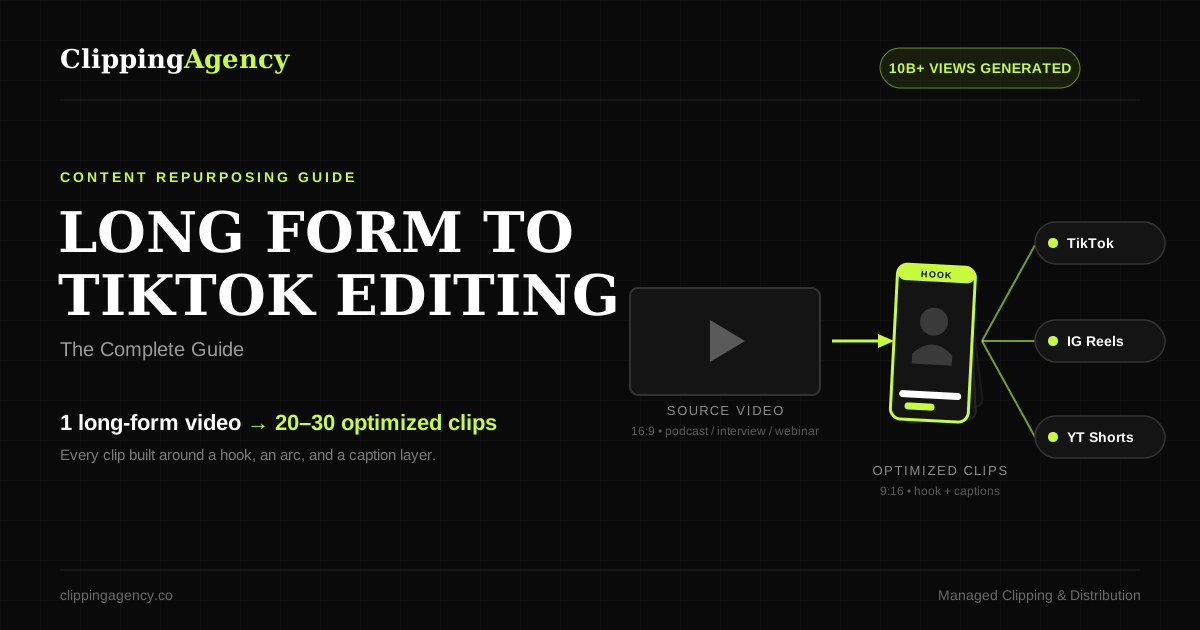
Video clipping, at its simplest, is pulling short high-value moments out of longer content — a podcast, a YouTube video, a livestream, an interview — and turning them into standalone vertical clips built for TikTok’s feed.
But here’s the thing. That definition makes it sound like a content format. It’s not. It’s a distribution strategy dressed up as an editing technique.
Think about what happens when you take a 45-minute podcast episode and break it into 15 individual clips. Each one has its own hook. Each one lands in the algorithm separately. Each one gets its own chance to go viral. You haven’t made 15 new pieces of content — you’ve created 15 separate entry points into TikTok’s recommendation engine. From one recording session.
That’s the shift most creators miss. They think about clipping as saving time on editing. The real value is what it does to your reach.
TikTok’s algorithm is fundamentally a watch-time and completion-rate machine. Short, dense clips from longer source material tend to outperform original short-form content specifically because every second in a clip earned its place — it was selected because it was good, not just because it was next in the timeline. The algorithm picks up on that efficiency.
Here’s what the performance data actually looks like across content types:
| Content Type | Avg. Completion Rate | Avg. Views Per Post |
|---|---|---|
| Original short-form (60–90s) | 42% | 3,200 |
| Clipped highlight (30–60s) | 61% | 8,700 |
| Clipped hook + payoff (15–30s) | 74% | 14,500 |
| Multi-clip campaign (10+ clips/week) | 68% avg | 9,400 per clip |
Source: Internal Clipping Agency client data, 2025–2026 across 200+ campaigns
The best-performing clips aren’t the longest or the most polished. They’re the most precise. That distinction matters a lot when you’re deciding how to spend your editing time.
What Makes a TikTok Clip Actually Hold Attention (vs. Getting Scrolled Past)
Not every moment in your long-form content deserves to be a clip. Some moments are transitions. Some are context. Some are good in the flow of a 40-minute conversation but would die alone in a 30-second window.
The creators who grow fastest aren’t clipping more — they’re clipping smarter. Here’s what that looks like structurally.
The Hook Has About Two Seconds. Use Them.
TikTok users scroll without thinking. Their thumb is already moving. If the first two seconds of your clip don’t make them stop — genuinely stop — the completion rate tanks and the algorithm files the video away quietly.
A strong hook does one of three things: it says something provocative, it creates an immediate visual pattern interrupt, or it opens a question the viewer genuinely wants answered.
Weak: “So today I wanted to share something I’ve been thinking about a lot lately…”
Strong: “Most creators never make it past 1,000 followers. And it’s not the algorithm’s fault.”
Same underlying content. One gets watched. One gets scrolled.
Seconds 3 to 25 Are Where You Earn the View
After the hook buys you attention, viewers are immediately running a mental calculation: is this worth staying for? That window — roughly three to twenty-five seconds — is where you have to deliver something real. A specific insight. A setup with obvious momentum. A story that’s clearly going somewhere.
What kills clips in this window: padding, vague statements, unnecessary context, and any sentence that could be removed without changing what the viewer learns.
The Payoff Closes the Loop
Every clip that hooks well creates a small contract with the viewer. “Stay for this and you’ll get X.” The payoff is where you honour that contract.
Viewers who make it to the payoff are the ones who complete the video. Completion rate is one of the most heavily weighted signals in TikTok’s ranking system. You’re not just making a good clip — you’re feeding the algorithm the exact signal it needs to push the video further.
Captions Aren’t a Nice-to-Have
More than 85% of TikTok videos get watched without sound at some point — on the train, in a waiting room, at work. Auto-generated captions do the job but manually synced captions that match the speaker’s actual rhythm perform measurably better for retention. If you’re serious about clipping, this is one area where cutting corners shows up directly in your numbers.
The 5 Types of Long-Form Content That Turn Into the Best TikTok Clips
Knowing what to clip is just as important as knowing how to clip it. Some source material is goldmine. Some of it just doesn’t translate.
1. Counterintuitive opinions and hot takes When someone says something that genuinely challenges what most people in a niche believe, comment engagement spikes. TikTok’s algorithm weighs comment activity heavily as an interest signal. Clips built around a strong, specific opinion — even a slightly polarising one — tend to generate more distribution than clips built around agreement.
2. Genuine emotional moments in interviews and podcasts Laughter that isn’t performed. Frustration that’s real. A story that visibly moves the speaker. These moments create parasocial pull — the viewer feels like they know the person, which drives follows, saves, and shares far more than polished talking-head clips.
3. Micro-tutorials that teach exactly one thing A 90-second clip that solves one specific problem — not three or four, just one — outperforms broader educational content almost every time. It’s immediately actionable, highly saveable, and sends strong interest signals when the viewer comes back to rewatch it.
4. Story clips with a real arc TikTok is fundamentally a platform built for storytelling. Clips that follow the simplest narrative structure — something went wrong, tension built, here’s what happened — have the highest average completion rates across all content types. The closer your clip gets to a campfire story, the better it usually performs.
5. Stats and facts that reframe something familiar One surprising number, delivered with confidence, does more work on TikTok than five minutes of explanation. People either share it because they agree or comment because they don’t. Both reactions are distribution. Both feed the algorithm.
How to Build a TikTok Clipping System That Actually Scales
Posting one clip a week is a hobby. If you’re serious about growth, clipping needs to run like a system — with consistent input, consistent output, and feedback loops that make it sharper over time.
Step 1: Audit What You Already Have
Before you touch an editing timeline, go through your existing content library. YouTube videos, podcast episodes, recorded webinars, past livestreams — anything over 20 minutes is a clipping asset. Most creators are sitting on months of raw material they haven’t touched since the original upload.
One 60-minute podcast episode, approached properly, can yield 15 to 25 individual clips. That’s not an exaggeration. That’s what systematic extraction looks like when you’re looking for the right moments instead of just the obvious ones.
Step 2: Write Clip Briefs Before Anyone Edits Anything
A clip brief is simple — one or two lines that describe the hook, the core value, and the emotional tone of a specific clip before the editor opens the file. It sounds like extra work. It saves more work than it costs.
Without clip briefs, editors make their own calls about what matters in a piece of content. Sometimes they’re right. Often they’re not. The result is technically fine clips that are strategically unfocused — they don’t land because the strategy was missing before the edit began.
Step 3: Get the Format Right for TikTok Specifically
Every clip going to TikTok needs to be built for TikTok — not repurposed from Instagram or YouTube with a crop and a prayer. That means:
- 9:16 vertical aspect ratio, no bars, no borders
- Captions timed to the speaker’s rhythm, not auto-generated
- A real visual element in the first frame — not a black screen, not a frozen shot
- Audio peaking around -6dB for clarity across different devices
- Length between 15 and 90 seconds, depending on the content type
None of this is complicated. All of it gets skipped when creators are moving fast and not thinking about platform-native behavior.
Step 4: Stop Relying on One Account
This is the single biggest mistake creators make when they start taking clipping seriously. They clip well, they format correctly, they post consistently — and they do all of it from one TikTok account.
One account is one algorithm entry point per post. The reach ceiling is set by your follower count and the algorithmic luck of each individual video.
When a clipping campaign distributes the same creator’s content across dozens or hundreds of accounts simultaneously — each account posting independently, each post generating its own signal cluster — the reach multiplies in a way that no single account can replicate. This is what separates creators at 50,000 monthly views from creators at 5 million. Not the quality of the clips. The surface area of the distribution.
Step 5: Track the Clips, Not Just the Posts
Standard TikTok analytics tell you which post performed. That’s useful. But a proper clipping system goes further — it tracks which moment types, from which content formats, at which lengths, consistently outperform. That data feeds back into the clip brief process and makes the whole system sharper month by month.
Most creators never build this feedback loop. The ones who do compound their growth in a way that looks almost unfair from the outside.
What the Numbers Actually Look Like When You Do This Right
The difference in output between someone posting manually and someone running a structured clipping distribution system isn’t marginal. It’s hard to fully appreciate until you see it laid out.
| Growth Method | Monthly Views (Avg) | Content Output Needed | Weekly Time Investment |
|---|---|---|---|
| One account, 1–2 posts/day | 80K–250K | High (new content constantly) | 15–20 hrs/week |
| One account + systematic clipping (5–10/week) | 400K–900K | Medium (repurposed + some new) | 8–12 hrs/week |
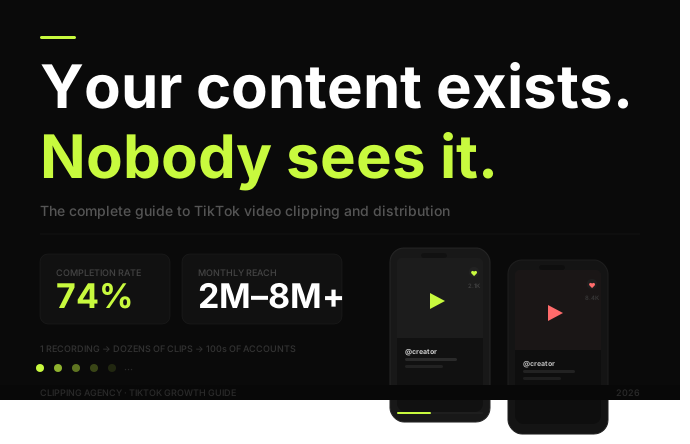
| Managed clipping campaign (multi-account) | 2M–8M+ | Low (repurposed existing content) | 2–4 hrs/week |
That last row is the one worth staring at. The highest reach, the least new content required, and the smallest time investment per week. That’s not a coincidence. It’s what happens when distribution is treated as infrastructure instead of an afterthought.
Creators who work with Clipping Agency typically see a 10x increase in short-form content output within the first 30 days and between 1 and 5 million additional monthly views across TikTok and Reels once their campaign is running.
Why So Many Creators Stay Stuck Even When Their Content Is Good
Here’s something worth saying plainly: TikTok does not reward effort. It rewards signals. Completion rate, shares, comments, replays — the algorithm doesn’t know or care how long you spent on an edit. It’s running a signals-based ranking model and your content either feeds that model well or it doesn’t.
The problem is that most creators try to fix their TikTok growth by improving their content when what’s actually broken is their distribution. Better editing won’t solve a reach problem. More consistent posting won’t solve a reach problem if everything is going through a single account with limited algorithmic surface area.
One account gives your content one chance per post to catch a wave.
A distribution network gives your content dozens of chances simultaneously — different accounts, different audiences, different algorithm clusters — all working in parallel. Each one capable of landing in a different pocket of TikTok’s recommendation system.
This is exactly why short-form video distribution has quietly become the most important competitive advantage in creator growth right now. The creators who understood this twelve months ago are compounding. Every month of systematic clipping builds a distribution track record that makes the next month perform better than the last. That gap between them and everyone else is only getting wider.
The Bottom Line: Why Clipping Agency Is the Right Partner for Serious Creators
Everything in this guide is real and actionable. You could implement all of it. Build the clip brief process, audit your content library, format properly for TikTok, recruit a clipper network, manage submissions, review quality, run payouts, track the data, and iterate from there.
Some creators do. Most find out pretty quickly that what sounds like a content strategy is actually a full operations role — and it competes directly with the time they have to make the content that feeds the system in the first place.
Clipping Agency exists for the creators who’ve decided their time is better spent on the thing only they can do.
We build and run the entire distribution engine for you. That means:
- Full clipping infrastructure set up from day one — Whop setup, dashboard, automation, submission rules, the whole thing
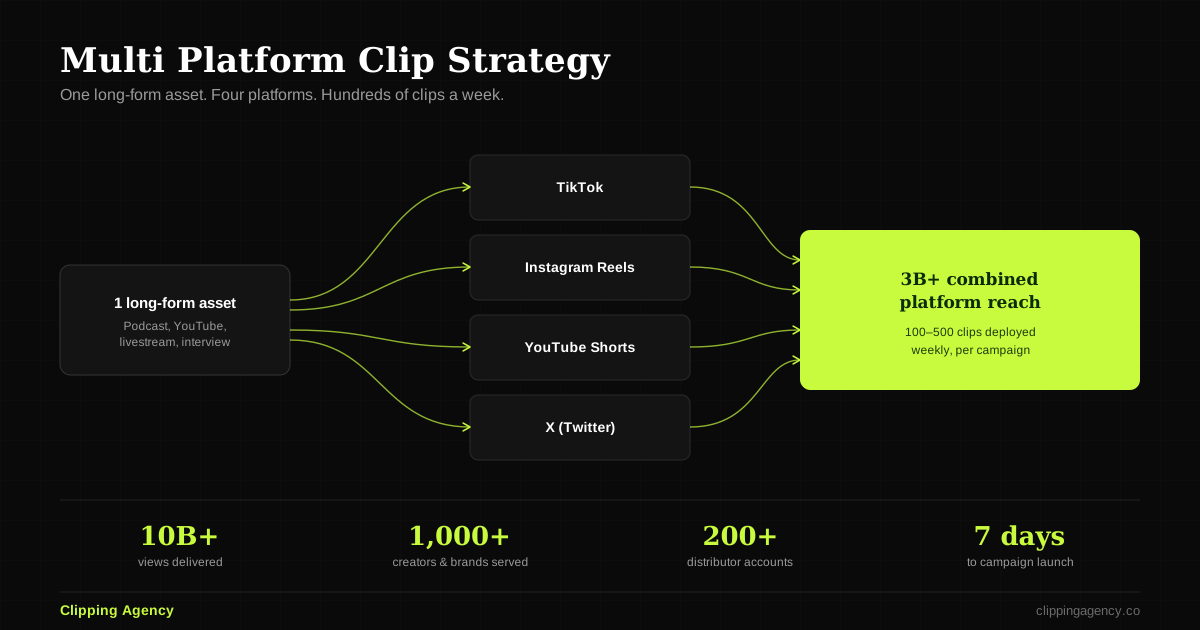
- A vetted network of clippers distributing your content across TikTok, Instagram Reels, and YouTube Shorts simultaneously
- Complete operations management — submissions, quality review, approvals, payouts, performance tracking — handled end to end
- Results that actually compound, because every clip we push out builds the signal history that makes your next batch perform better
We’ve generated over 2 billion views for our clients. Not through tricks or trends. Through the same repeatable distribution system, applied consistently, across every niche, for creators and brands who wanted a real engine behind their content rather than a strategy they had to run themselves.
If that sounds like what you’ve been looking for — book a strategy call and let’s figure out what your content can actually do when the distribution is handled properly.
Frequently Asked Questions
How many clips should I actually post on TikTok per week?
There’s no universal answer, but most creators seeing real compounding growth are posting somewhere between 5 and 14 clips per week. The more important variable is quality of selection — clips chosen because they contain a real hook and real value, not just because something needed to go out that day. Volume without strategic selection eventually hurts your account’s performance signals more than it helps.
Can I grow on TikTok using only clipped content — no original short-form filming?
Completely. A lot of creators generating millions of monthly views have never filmed a dedicated TikTok in their life. They have existing long-form content — podcast episodes, YouTube videos, stream recordings — and the right clipping and distribution system extracts that value and puts it in front of new audiences. The content already exists. It just hasn’t been properly distributed yet.
What length of clip tends to perform best on TikTok?
Content type matters more than a fixed length rule. Educational and data-driven clips tend to peak around 30 to 45 seconds. Interview or storytelling clips usually hold attention better between 45 and 90 seconds. Very short clips under 20 seconds can work well for sharp hook-and-punchline formats but rarely generate the watch time signals needed for the algorithm to push them beyond an initial audience.
Will TikTok penalise me for using content that originally came from YouTube or a podcast?
Not inherently. TikTok has historically filtered out content with visible watermarks from other platforms — particularly TikTok-watermarked videos reposted from other accounts. But content uploaded natively, without watermarks, isn’t penalised regardless of where it was originally recorded. The platform cares about watch time and engagement, not origination source.
What’s the real difference between clipping and just editing short videos?
Editing is a technical skill. Clipping is a strategic decision. When you clip properly, you’re not just cutting a video to a shorter length — you’re identifying a specific moment that has a clear hook, delivers real value, and closes on a payoff that the viewer didn’t want to skip. Most editors can make something shorter. A clipping system identifies which moments are worth cutting in the first place, for which platform, at which length, as part of a broader distribution strategy.
Why does a clipping campaign reach so many more people than posting from my own account?
Surface area. A single account creates one algorithm entry point per post. A clipping campaign distributes the same content across a network of accounts simultaneously, creating dozens or hundreds of independent entry points — each one generating its own engagement signals, each one capable of landing in a different section of TikTok’s recommendation engine. The reach isn’t slightly higher. It’s structurally different.
Do I need a big following before clipping makes sense as a growth strategy?
No. Clipping generates reach through distribution volume, not through existing follower counts. The strategy works for accounts with 500 followers just as well as accounts with 500,000 — because the growth comes from the distribution network, not from the starting audience size. Creators have come to us with under a thousand followers and reached over a million monthly views within 60 days of launching a managed campaign.
Done reading and ready to move? Book your strategy call with Clipping Agency — we’ll show you exactly what your content can generate with a real distribution system behind it.
Every Day You Wait, A Competitor Gets the View
We recruit, train, and manage a clipping army that distributes your content across 50–500 accounts on TikTok, Reels, and Shorts simultaneously. One upload becomes hundreds of posts. Every single day.
Trusted by 1,000+ creators · 10 Billion+ views generated