
You hit record. You talked for an hour — maybe more. The conversation was good. Real insights, real back-and-forth, the kind of thing a listener would send to a friend.
And then you uploaded it. Dropped it on Spotify. Maybe YouTube.
And it just… sat there.
Not because the content was bad. Because nobody outside your existing audience had any reason to find it. That’s not a content problem. That’s a distribution problem — and it’s the exact problem a podcast repurposing service is built to fix.
Here’s what most podcasters don’t realize: the episode you just recorded isn’t one piece of content. It’s fifty. It just needs the right system to pull them out, format them correctly, and get them in front of the people who’d actually stop scrolling to watch.
That’s what Clipping Agency does. This article explains how — every format, every step, no fluff.
What Does It Actually Mean to Repurpose a Podcast Episode?
Let’s be specific, because “repurposing” gets thrown around like it means anything.
Podcast repurposing is the process of taking one long-form audio or video recording — an interview, a solo episode, a roundtable — and transforming it into multiple shorter, platform-native content formats. Each format is built for a different audience behavior on a different platform.
Think about what lives inside a 60-minute episode. There’s at least one take your guest says that would make someone stop mid-scroll. There’s a framework that sounds obvious once you hear it but that nobody’s ever explained that cleanly. There’s a personal story with a real emotional beat. There’s a stat that contradicts something most people believe.
None of that needs to be recorded again. It already exists. The repurposing system Clipping Agency runs extracts it, shapes it, and gives it its own distribution life — completely separate from the episode itself.
The core idea that actually matters: one recording session should produce multiple distribution events, across multiple platforms, reaching audiences who will never open a podcast app.
The 5 Formats Clipping Agency Uses to Repurpose Podcast Episodes
1. Short-Form Video Clips — The Format That Actually Grows Your Audience
Everything else in the repurposing stack supports this one. Short-form video is where real audience growth happens — and it’s the format Clipping Agency has built its entire distribution infrastructure around.
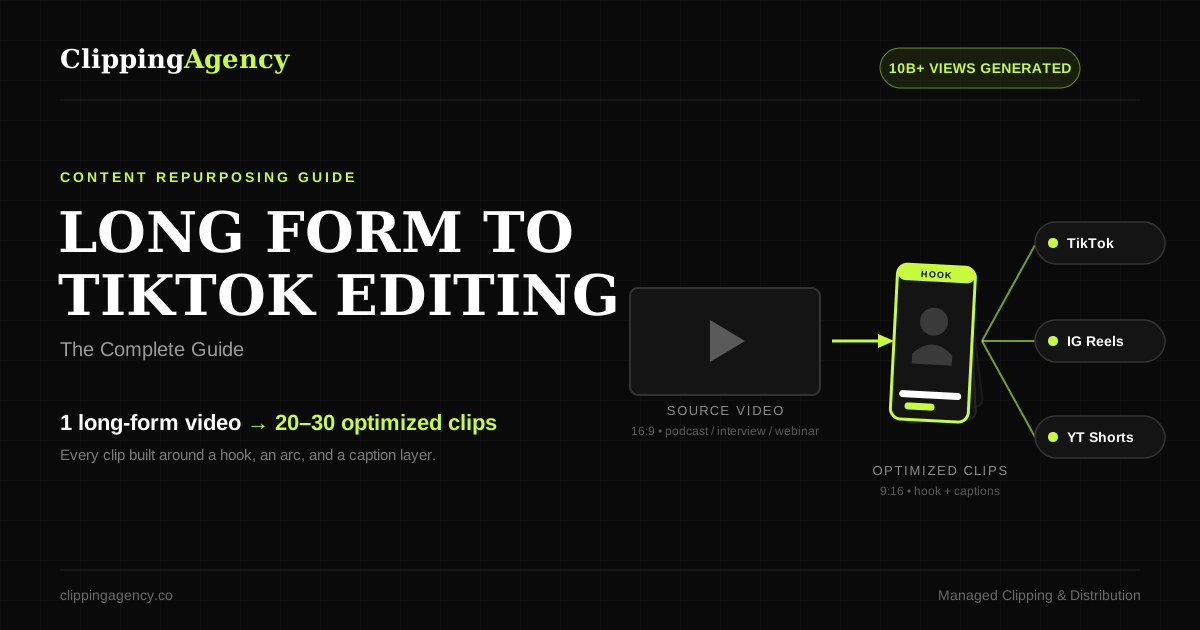
The process starts with a content audit. Clipping Agency’s editors — called clippers — go through your full episode looking for the moments that can stand alone. The 30 to 90 seconds where something genuinely lands. A sharp opinion. A story that builds to a real point. A question the host asks that the guest clearly wasn’t expecting. Those moments get cut, captioned, formatted to vertical 9:16 for TikTok, Instagram Reels, and YouTube Shorts, and sent into distribution.
Here’s where most podcasters get it wrong, though. They think the value is in the editing. It’s not. The value is in what happens after the edit.
When you hire a freelance editor to clip your episode and post to your own TikTok account, you’re feeding your existing audience. The people who already follow you see another piece of content. That’s fine — but it doesn’t grow anything. You’re not reaching new people.
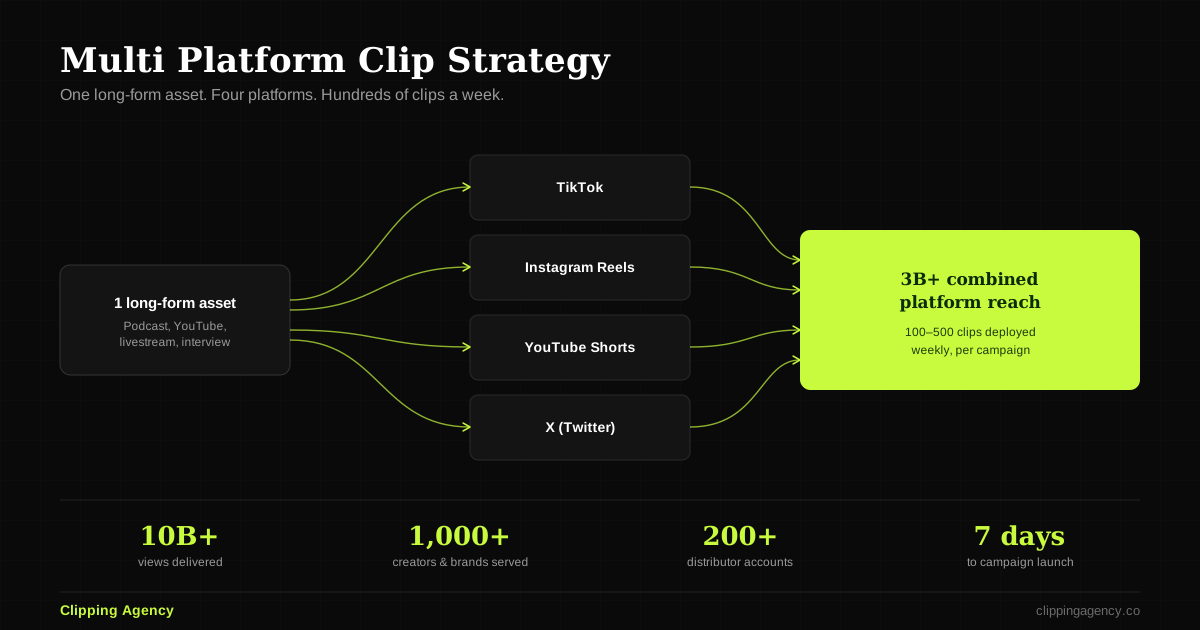
When Clipping Agency runs your clips through a network of 50 to 100 distribution accounts, something completely different happens. Each account is its own separate algorithmic exposure event. The clip isn’t going to your followers — it’s going to TikTok’s algorithm on 50 different accounts simultaneously. People who have never heard your name find a 60-second clip that hits something they care about. They follow. They listen. They become real subscribers.
That’s not a minor difference. That’s the entire model.
By the numbers — what one episode actually produces:
| Format | Output Per Episode | Platforms | Who It Reaches |
|---|---|---|---|
| Short-form clips (your account only) | 3–5 | TikTok, Reels, Shorts | Your existing followers |
| Short-form clips (Clipping Agency network) | 20–40 | TikTok, Reels, Shorts | New audiences across 50–100 accounts |
| Audiograms | 5–10 | LinkedIn, Twitter/X | Limited algorithmic reach |
| Blog post extractions | 2–4 articles | Google Search | Search-intent traffic |
| Email newsletter segments | 1–2 | Direct inbox | Your subscriber list |
A 60-minute episode run through Clipping Agency’s podcast clipping service typically produces 20 to 40 clips. A two-hour interview episode produces 40 to 80 — from a single recording session, without you touching anything.
2. Audiograms — What Happens If You Don’t Record on Camera
A lot of strong podcasts are audio-only. No camera setup, no lighting rig, no video production. Just microphones and a good conversation.
That used to mean you couldn’t do short-form video. It doesn’t anymore.
Clipping Agency produces audiograms for audio-first podcasters — short video files that combine a clip from your audio with an animated waveform visual, your show’s branding, and auto-generated captions. The result behaves exactly like a native video on TikTok, Reels, and LinkedIn. The algorithm treats it like one. Viewers watch it like one.
Where audiograms genuinely perform well is LinkedIn and Twitter/X. Both platforms reward professional, polished content — and a clean audiogram with a strong quote from a business, finance, or leadership conversation fits naturally into both feeds without feeling out of place.
On TikTok and Reels, full-motion video clips — especially with faces, expressions, and genuine on-camera energy — outperform audiograms in most niches. But “outperform” doesn’t mean audiograms don’t work. For audio-first creators who aren’t ready to switch to video, they still generate real views. Think of them as the bridge, not the final destination.
What Clipping Agency handles end-to-end for audiograms:
- Transcript generation directly from your raw audio file
- Clip selection based on standalone value — moments that work without surrounding context
- Waveform animation built to your brand colors and fonts
- Caption styling optimized for mobile viewing behavior
- Platform-specific export dimensions and quality settings
- Quality review before anything goes live
You send the episode. Clipping Agency sends back a content calendar’s worth of ready-to-post video files.
3. Blog Post Extraction — The Format That Compounds Over Time
Here’s something most podcasters don’t think about: their episodes are sitting on thousands of words of SEO-ready content that Google has never seen.
A 60-minute podcast episode, fully transcribed, produces somewhere between 8,000 and 12,000 words of spoken content. Inside that transcript are multiple self-contained ideas — each a potential article, each potentially ranking for a search query your audience is already typing into Google.
What Clipping Agency’s blog extraction workflow does: it pulls those arguments out of the transcript, strips the filler language that sounds natural when spoken but reads terribly in writing, restructures everything into proper article format with clear headers, and optimizes each piece for a specific search query.
Here’s a concrete example of what that looks like in practice.
Say you run a business podcast and you do an episode about hiring your first full-time employee. In that 60-minute conversation, your guest covers how they knew they were ready to hire, a mistake on their first hire that cost them $40,000 to undo, and the exact questions they now use in every interview. That’s three standalone articles — “Signs you’re ready to hire your first employee,” “First hiring mistakes and how to avoid them,” “Best interview questions for early-stage founders” — each with genuine search demand, each extracted from one conversation that already happened.
The timing difference between this format and clips is what makes them complementary rather than competing. A clip stops generating views in 72 hours on most platforms. A blog post targeting a clear search query keeps driving traffic for months. Sometimes years. Clipping Agency runs both formats in parallel so your episode works short-term and long-term at the same time.
What one episode yields in blog content:
- 2 to 4 standalone articles, each targeting a different search query
- Each article linking back to the full episode for listeners who want more
- An SEO footprint that grows episode by episode, compounding over time
4. Email Newsletter Segments — Turning New Views Into People Who Actually Stay
Short-form clips introduce you to strangers. Email turns strangers into subscribers — people who asked you to show up in their inbox, not people who stumbled across you in a feed they’ll forget about by tomorrow.
The way Clipping Agency handles newsletter repurposing: one key insight gets extracted from each episode and packaged as a short, standalone written segment. Not a summary. Not a transcript excerpt. A genuine piece of value that works on its own, with a natural reason to go listen to the full episode if it lands for you.
Why does this matter so much? Because algorithm reach is borrowed. You don’t own TikTok’s distribution. You don’t own Instagram’s. The moment their algorithm deprioritizes your content — and it will, at some point — your reach drops and there’s nothing you can do about it.
Your email list is different. Every person on it opted in directly. They gave you their address because they wanted to hear from you. That relationship doesn’t disappear when an algorithm changes overnight.
The sequence Clipping Agency builds is intentional: clips bring in the new audience, the newsletter captures the ones who want to go deeper. You can’t skip to the newsletter — you need something bringing in new people first. The clip distribution network handles that. Once views are coming in and people are discovering the show, the newsletter segment converts the most engaged listeners into owned subscribers.
The clips are the reach. The newsletter is the relationship.
5. Quote Cards and Platform Posts — The Glue Between Everything Else
Quote cards are the lightest-touch format in the repurposing stack. A single line from the episode — something sharp, counterintuitive, or emotionally resonant — goes over a clean branded visual and gets posted to Instagram, LinkedIn, or Pinterest.
Low production cost. Quick to make. Easy to schedule. And honestly, not a primary growth channel — Clipping Agency will tell you that directly rather than oversell it.
Here’s what quote cards actually do well: they keep your brand visible between the bigger distribution pushes. Someone who discovered you through a clip on TikTok last week sees a quote card on Instagram today. It’s a recall moment. It reminds them you exist. A well-written quote gets saved by someone who recognizes the insight as worth keeping — and that save signals quality to Instagram’s algorithm, which extends the post’s reach slightly.
Clipping Agency produces these in batches: five to ten per episode, formatted to each platform’s spec, scheduled across the week so there’s always something live while the clips are doing the heavy lifting.
What Clipping Agency Does That a Freelance Editor Simply Can’t
This distinction matters more than most podcasters realize before they’ve tried both.
A freelance video editor is a skilled professional who cuts your content and delivers files. Genuinely useful. But it’s one piece of a much larger operation that the editor was never built to run.
What you get with a freelance editor: The editor watches your episode, cuts the clips you brief them on, captions them, and sends back the files. You decide which to post, when to post, what platform, which account, and how to track what’s working. You manage the strategy, the schedule, and the distribution. You do all of it.
What you get with Clipping Agency: Clipping Agency reviews every episode across every format — not just clips, but blog moments, newsletter segments, quote candidates, audiogram windows. Every piece gets formatted to each platform’s native specs without you specifying anything. Clips go out through a network of distribution accounts, not just yours. Clipper payouts, submission quality, content review — all managed internally. Performance data comes back into the system and shapes how the next episode gets approached. You don’t manage any part of this.
The editor does the creative work. Clipping Agency runs the infrastructure that makes the creative work reach people who’ve never heard of you.
That’s the real difference. Not editing quality. Distribution scale and operational infrastructure.
A content distribution system built by Clipping Agency removes the entire operational layer so you focus on one thing: being a good podcaster.
Key Facts and Figures: What Podcast Repurposing Actually Produces
These numbers matter because they change how you think about what a single episode is actually worth:
- There are over 4 million active podcasts globally — but fewer than 20% publish consistently past episode 10. The ones that disappear don’t have bad content. They never solved distribution.
- Podcasters using Clipping Agency’s network-based clip distribution system typically see 1 to 5 million additional monthly views within the first 30 days of going live.
- A structured clipping system produces a 10× increase in short-form content output without any increase in recording time or production budget.
- Short-form video now drives more new podcast listener discovery than search recommendations on Spotify and Apple Podcasts combined.
- A single 60-minute episode, fully processed across all repurposing formats, can produce more than 50 individual pieces of content — clips, posts, articles, newsletter segments — from one recording session.
How the Full Clipping Agency Workflow Runs: Episode to Distribution
Here’s what actually happens when you hand an episode to Clipping Agency. Day by day, start to finish.
Day 1 — Episode Submission You upload the raw recording or Clipping Agency pulls it automatically through your RSS feed. No chasing required. The episode enters the workflow on publish day.
Days 1–2 — Content Audit Clippers go through the full episode and timestamp every moment worth using — strong takes for short-form video, clear frameworks for blog extraction, memorable lines for newsletter segments and quote cards. This isn’t random selection. Experienced clippers know what hooks, what builds correctly, and what data points make someone stop scrolling.
Days 2–3 — Production Clips get cut and captioned. Audiograms get formatted. Blog outlines get drafted from the transcript. Newsletter copy gets written. Quote cards get designed in your brand style. Everything produced in parallel, not one format waiting on another.
Days 3–4 — Quality Review Nothing goes live without a review pass. Clips are checked for hook strength, caption accuracy, and correct aspect ratio for each platform. Blog drafts are checked for structure and search intent match. This is where most solo workflows fall apart — Clipping Agency has a review layer built into the system because nothing gets posted that isn’t ready.
Days 4–7 — Distribution Clips go live across the distribution network. Blog posts get published. The newsletter segment goes out. Quote cards schedule across the week. One episode, active across five formats, on dozens of accounts, all within a week of recording.
Ongoing — Performance Tracking and Optimization View counts, saves, shares, and follower attribution data feed back into the system. Clipping Agency uses it to refine which moment types, hook styles, and posting patterns perform best for your specific show and audience. Every episode makes the next campaign smarter.
The Bottom Line: Why Clipping Agency Is the Right Partner for Podcast Repurposing
Let’s talk about what actually happens when podcasters try to handle this themselves.
They hire a good editor. The editor makes clips. The podcaster posts them to their own account. A couple of clips get decent traction. Most don’t land the way they hoped. Three months in, the numbers haven’t moved in any meaningful direction. The conclusion most people reach: “Clipping doesn’t work for my niche.”
It wasn’t the niche. It was never the niche.
The content was good. The editing was fine. The problem was that posting clips to your own account is talking to the people who already follow you. You’re maintaining, not growing. You’re putting effort into a channel that has a ceiling defined by your existing audience size.
Clipping Agency removes that ceiling.
We don’t just produce your clips — we build the engine that pushes them out to new audiences at scale. A vetted network of clippers and distribution accounts takes your episode from raw recording to hundreds of simultaneous posts across TikTok, Instagram Reels, and YouTube Shorts. Every single week. Without you managing a single part of the operation.
Over 2 billion views generated for creators and brands. More than 1,000 podcasters, founders, streamers, and media companies served. Clipper recruitment, quality review, payout processing, performance reporting — all handled end-to-end by Clipping Agency.
You record. We distribute. Your audience grows.
Every episode you publish without a real distribution system behind it is reaching maybe 1% of the people who’d genuinely care about it. That’s not a content failure. That’s a missing infrastructure problem — and it’s exactly what Clipping Agency was built to solve.
Book a free strategy call with Clipping Agency and we’ll audit your existing episodes, show you which moments should have been clips months ago, and map out what a full distribution engine looks like for your specific show. The call is free. The results aren’t something you’ll want to undo.
Frequently Asked Questions About How Agencies Repurpose Podcast Content
What is a podcast repurposing service?
A podcast repurposing service is a managed system — like the one Clipping Agency operates — that takes long-form podcast episodes and transforms them into multiple shorter content formats: short-form video clips, audiograms, blog posts, email newsletter segments, and quote cards. Each format gets distributed to the platform where it performs best. The goal is to maximize the reach and lifespan of every episode without the podcaster needing to create additional content or manage the distribution themselves.
How many clips can Clipping Agency produce from one podcast episode?
Clipping Agency typically produces 20 to 40 short-form clips from a 60-minute episode. A two-hour episode can yield 40 to 80. Interview-format shows get clipped on two separate tracks — one for the host, one for the guest — which often doubles total output from a single recording and gives the guest shareable content that introduces your show to their audience at no extra cost or effort.
What’s the difference between hiring an editor and working with Clipping Agency?
A freelance editor produces clip files and hands them back to you. Clipping Agency builds and operates the full distribution infrastructure around those clips — including a multi-account network, quality review systems, clipper management, payout processing, and performance tracking. The editor does the creative work. Clipping Agency makes sure that work reaches new audiences at a scale no individual editor or single account can match.
Do I need to record video to work with Clipping Agency?
No. Audio-only episodes are repurposed as audiograms — short video files that pair your audio with an animated waveform, branded visuals, and auto-generated captions. These perform on TikTok, Instagram Reels, LinkedIn, and YouTube Shorts without you ever appearing on camera. Some of the most-clipped podcasts in business and finance are fully audio-only. You don’t need to rebuild your recording setup to get into distribution.
How quickly does Clipping Agency’s podcast repurposing service produce results?
Podcasters using Clipping Agency’s network-based short-form video distribution typically see measurable increases in content output and monthly views within the first 30 days. Blog and SEO repurposing compounds more slowly — three to six months before organic search traffic builds consistently. Email newsletter repurposing generates immediate engagement from existing subscribers and grows steadily alongside the clip distribution over time.
Which podcast episode types benefit most from Clipping Agency’s repurposing system?
Interview-format episodes, debate or strong-opinion episodes, and long-form solo content all produce excellent clip windows. Episodes built around clear frameworks, surprising data, emotional storytelling, or contrarian takes generate the most clippable moments. Episodes under 20 minutes produce fewer clips but can be batched with other episodes to maintain volume. Any episode 30 minutes or longer has enough material for a full repurposing workflow across all five formats.
Can Clipping Agency handle multiple podcast episodes per week?
Yes — and high-volume podcasters benefit the most from this. Whether you publish one episode a week or five, Clipping Agency’s system processes each one at the same turnaround, typically within 48 hours of upload. Every episode that enters the distribution network adds to a growing footprint across TikTok, Reels, and Shorts that compounds episode by episode. The more consistently you publish, the more distribution events you’re generating simultaneously.
Where can I learn more about how Clipping Agency works for podcasters specifically?
The Podcast Clipping Agency service page covers the full system — including the dual-track host and guest clipping model that doubles output from interview episodes. For a broader look at repurposing strategy across all creator types, the Best Content Repurposing Strategies for Creators guide goes deep on every format. To understand how distribution campaigns are built and measured, explore Clipping Campaigns.
Published on the Clipping Agency Blog — the distribution playbook for creators who want their content seen.
Every Day You Wait, A Competitor Gets the View
We recruit, train, and manage a clipping army that distributes your content across 50–500 accounts on TikTok, Reels, and Shorts simultaneously. One upload becomes hundreds of posts. Every single day.
Trusted by 1,000+ creators · 10 Billion+ views generated