
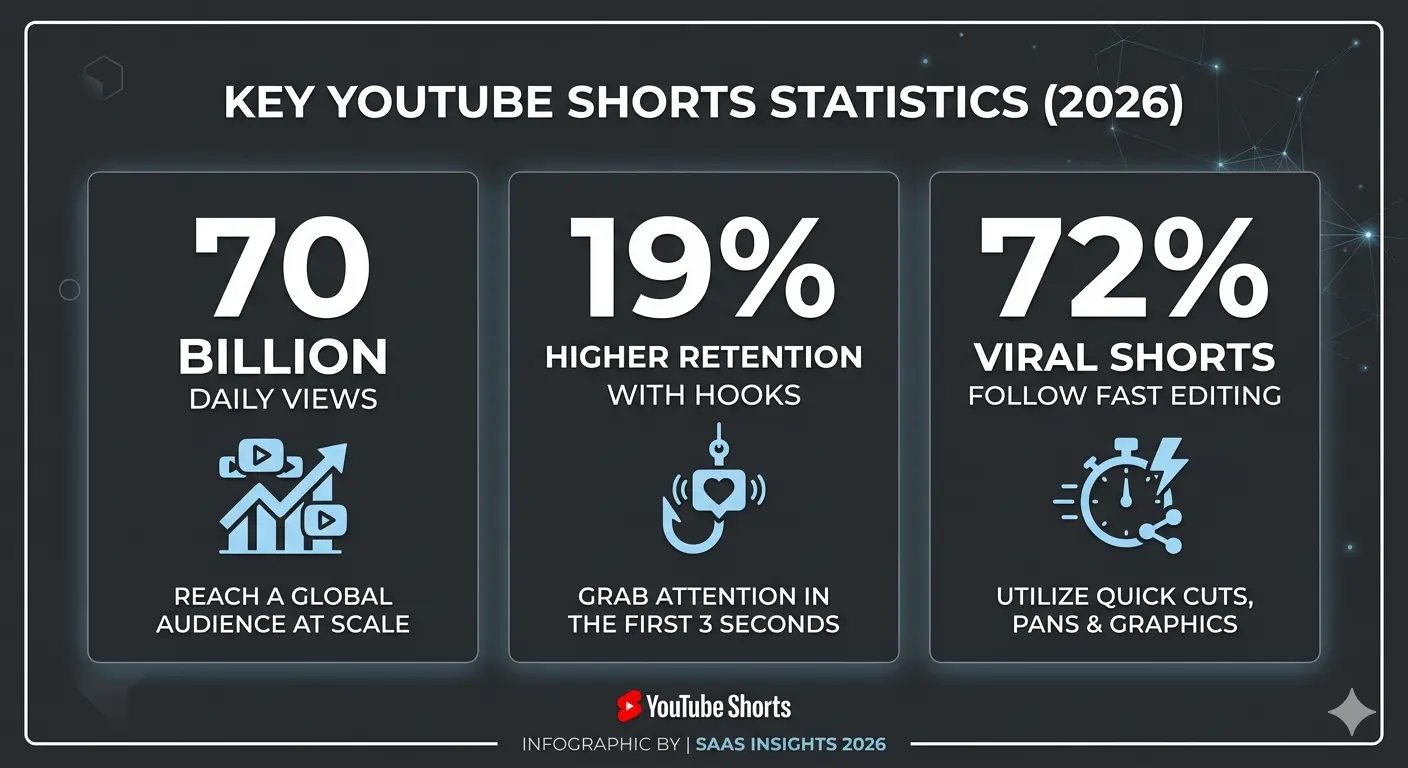
YouTube Shorts generates 70 billion views per day. A large share of that comes from TV show clips. Not original content. Not trends. Edited scenes from shows that aired years ago, still pulling millions of views in 2026.
So, what are the most clipped TV shows on YouTube Shorts right now, and why do they keep outperforming original content?
TV show clips outperform original Shorts because they compress professional storytelling into seconds. A clipper’s job is finding the 30-second window where all of it lands.
This guide covers which shows dominate, why each one works differently, and what separates clippers who grow channels from those who post randomly.
If you are a brand or marketing team, the principles are the same. Webinars, interviews, product demos, and event recordings contain the same structural elements that make these clips perform. The shows below are the benchmark. Your content can follow the same system.
What Are the Most Clipped TV Shows on YouTube Shorts
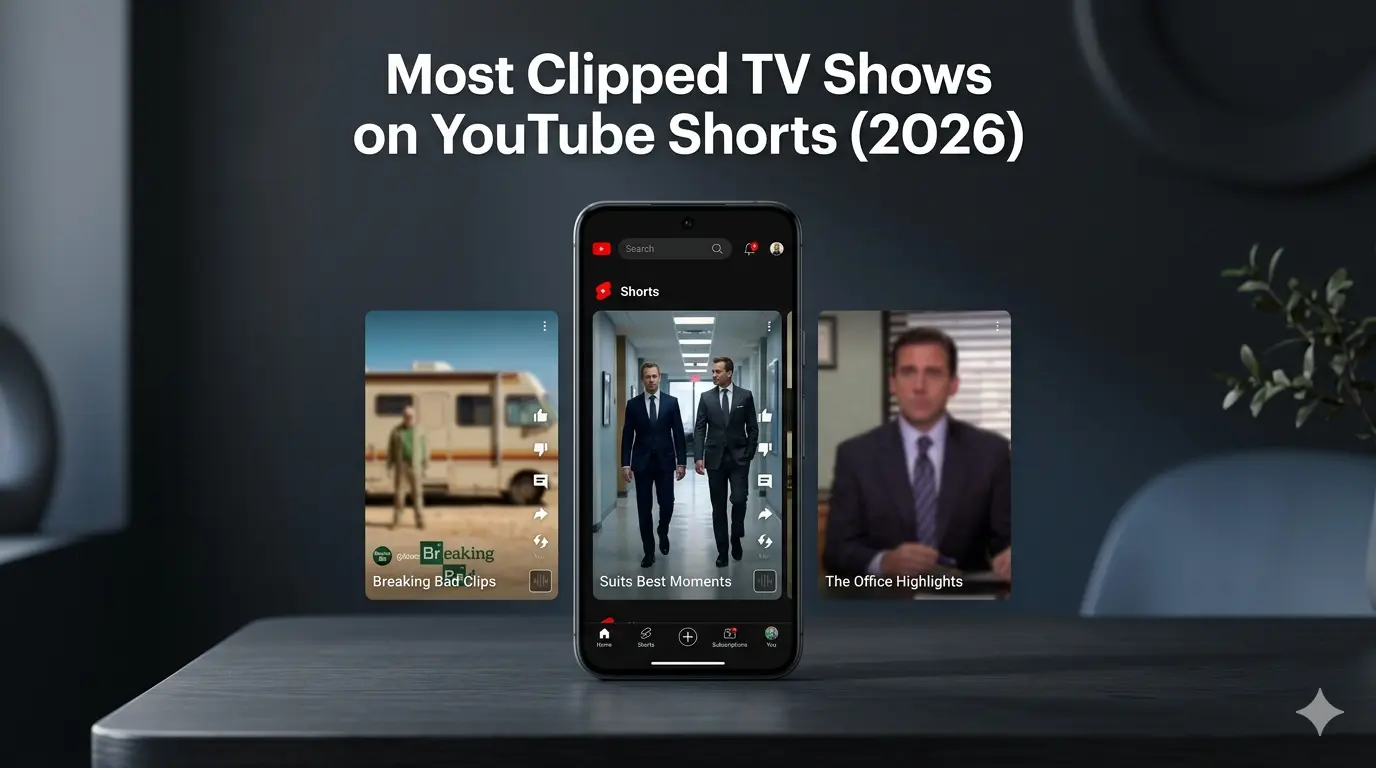
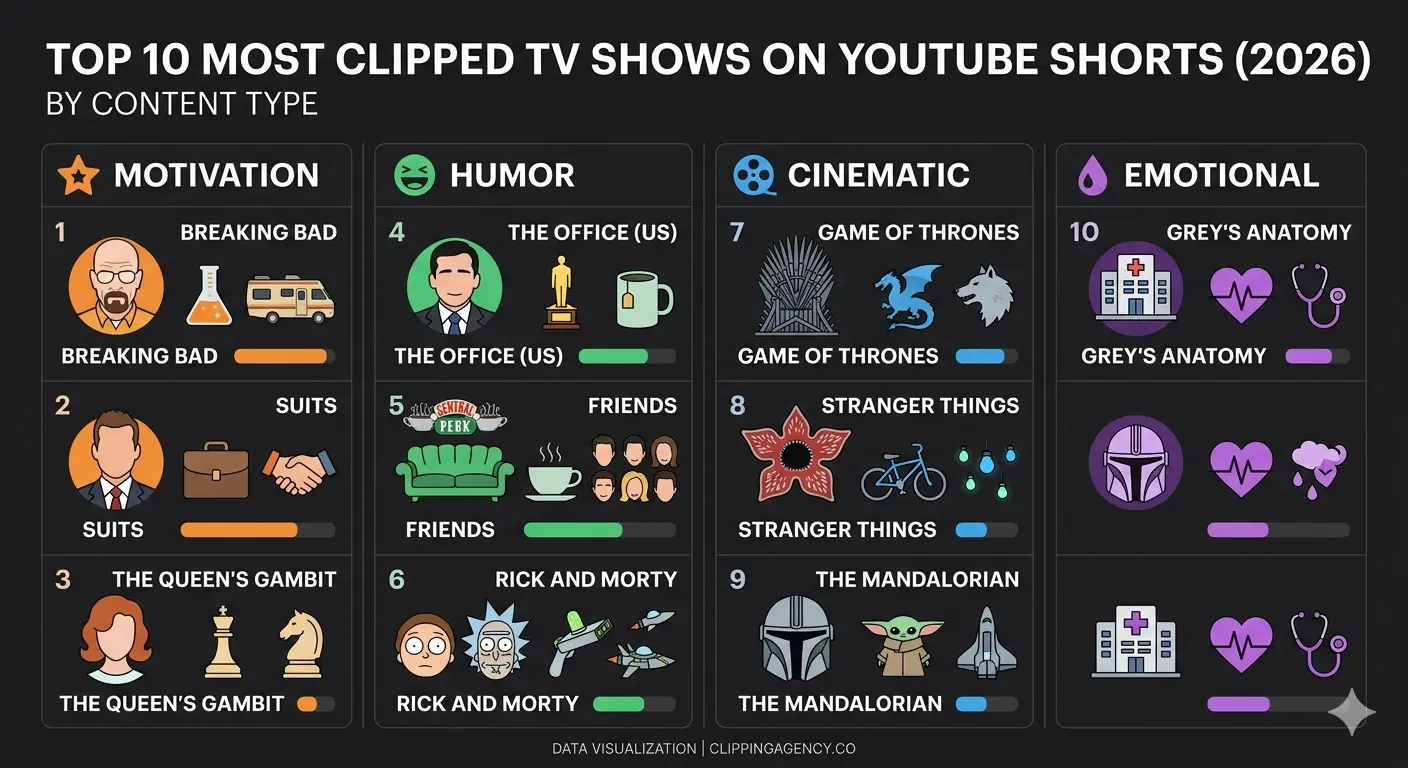
The most clipped TV shows on YouTube Shorts in 2026 are Breaking Bad, Suits, The Office, Friends, Peaky Blinders, Game of Thrones, Euphoria, Family Guy, The Simpsons, and Stranger Things.
Breaking Bad and Suits dominate motivational and dialogue clips. The Office and Friends lead humor and reaction formats. Peaky Blinders owns cinematic edits.
Why TV Shows Win on Shorts
Three data points explain it:
- Shorts with a hook in the first 2 seconds retain 19% more viewers
- Clips with subtitles get 18% more watch time
- 72% of viral Shorts (over 1M views) follow fast-paced editing with minimal dead air
TV scenes are professionally written and directed to create tension fast. That is a structural advantage no original creator can replicate from scratch. The raw material is already close to what the algorithm rewards.
What Makes a Show Clippable
Not every show works. The ones that dominate share four traits.
Dialogue that lands alone. “I am the one who knocks” needs no context. Neither does “I don’t have dreams, I have goals.” Lines that only make sense after three episodes of setup do not clip well.
Emotional peak within 5 seconds. Many viral Shorts have over 100% average percentage viewed, meaning viewers watch them more than once. That only happens when the emotional peak hits fast and hard.
Scenes that stand alone. Jim’s camera looks on The Office need zero context. Mid-season Game of Thrones political scenes need several episodes of setup. One works. One does not.
Meme or archetype potential. Clips that map onto shared experiences get shared beyond the show’s existing audience. Ambition, comebacks, betrayal. That cross-audience reach separates a clip with 50K views from one with 5 million.
The 10 Most Clipped Shows (2026 Breakdown)
1. Breaking Bad
Category: Motivation, transformation, power
Breaking Bad ranked number one on IMDb’s Top 250 TV Shows in 2025. On Shorts, it owns transformation content. Walter White’s arc from chemistry teacher to drug lord maps onto every power and ambition narrative that performs on short-form.
The dialogue is written as declarations, not conversations. Declarations clip cleanly. “I am the danger.” “Say my name.” The Skyler monologue. All land in under 25 seconds with zero setup.
Best format: 18–25 seconds, subtitles, zoom on Cranston’s face at peak intensity. No music needed. Silence between lines does the work.
Copyright risk: Low. AMC is one of the least aggressive studios for enforcement.
2. Suits
Category: Comebacks, confidence, power dynamics
Harvey Specter became the face of a content category that did not exist when the show aired. The cold, calculated, unbothered professional. That archetype drives strong engagement with male audiences aged 18–35.
Suits has 9 seasons and 130+ episodes. A channel built around it can post daily for years without repeating content. No other show on this list offers that library depth.
Best format: Challenge. Harvey responds in one line. Silence. Under 30 seconds. Clear beginning, middle, and end.
Copyright risk: Low.
3. The Office (US)
Category: Humor, reactions, relatable workplace moments
The mockumentary format was built for clipping. Scenes are short. Characters break the fourth wall. Each interaction is self-contained.
Jim’s reaction shots are the most efficient clips on this list. A character does something absurd. Jim looks at the camera. Clip ends. 8 to 15 seconds. Near 100% completion rate. A 10-second clip watched fully beats a 45-second clip watched halfway every time. The algorithm knows the difference.
Best format: Situation. Jim reaction. Cut. Viewers share these because they are sending a message, not just sharing a video.
Copyright risk: Low. NBCUniversal typically monetizes rather than removes clips.
4. Friends
Category: Evergreen humor, shareability
Friends scenes are written in three-act micro-structures. Setup, escalation, punchline. That maps onto the hook-reaction-payoff formula Shorts rewards.
The humor is not topical. Chandler’s sarcasm, Ross’s over-explaining, Joey’s misunderstandings. None of these require cultural context from 1998. They are character-based and universal. New audiences who have never seen the show still find the clips funny.
Best format: The three-line exchange. 15 to 22 seconds. Complete in itself.
Copyright risk: Low.
5. Peaky Blinders
Category: Cinematic motivation, aesthetic edits
Peaky Blinders was shot like a film. Dramatic lighting, close-ups on eyes, silence as a storytelling tool. These visual qualities translate to Shorts better than standard TV production values.
Tommy Shelby walking into a room. People react. He says one line. Scene cuts. No narration needed. This format works on alpha mindset pages, entrepreneurship accounts, and aesthetic edit channels. Clips from this show often get repurposed with text overlays and music, turning the source material into something new.
Best format: 20 to 30 seconds, cinematic pacing, minimal captions needed.
Copyright risk: Medium.
6. Game of Thrones
Category: Epic speeches, battle moments
The clips that work require no context. Battle speeches and power statements are universal. Courage and sacrifice land without knowing the characters. Cersei’s “when you play the game of thrones, you win or you die” works standalone.
Best format: 25 to 40 seconds, speech-driven, subtitles critical.
Copyright risk: High. HBO (Warner Bros. Discovery) is the most aggressive enforcer on this list. Clips without significant transformation get claimed fast.
7. Euphoria
Category: Emotional, relationship-driven, aesthetic
Euphoria’s visual style makes clips recognizable from a thumbnail alone. Glitter, slow motion, dramatic color grading. The show drives strong engagement with audiences aged 16 to 25.
Rue’s confrontations, Maddy and Cassie’s scenes, Fezco’s moments. They deal with betrayal, loyalty, and self-destruction through characters who are highly watchable. These clips cross-post well. The same clip on Shorts, TikTok, and Reels often performs on all three.
Copyright risk: High. HBO enforces aggressively.
8. Family Guy
Category: Meme clips, fast humor
Family Guy cutaway gags are pre-built Shorts. Setup in one sentence. Unrelated visual joke (10 to 20 seconds). Return to scene. No editing required beyond cropping to vertical.
A clipper working Family Guy produces 20 to 30 usable clips per episode. No other show on this list matches that output rate.
Copyright risk: High. Fox claims aggressively and collects the ad revenue. Clips get views. The creator does not get paid.
9. The Simpsons
Category: Meme content, social sharing
35 seasons. No library is deeper. The clips that perform best combine a scene with a text overlay mapping it to a real-world situation. The original scene gives the visual. The text gives the share motivation.
Simpsons clips get lower per-clip views than Breaking Bad or Suits. But comment and share rates are far higher. Viewers use them as social communication tools, not just content.
Copyright risk: High. Fox enforces and claims revenue.
10. Stranger Things
Category: Fan-driven clips, seasonal spikes
Stranger Things clips follow a predictable pattern. Season announcement. Release. Post-season discussion. Each phase drives views. Season four clips posted in 2022 resurfaced at the season five announcement in 2024, then again at release in 2025.
Evergreen clips from earlier seasons compound over time when relevance spikes return. This makes it one of the best shows for building a long-term clip library.
Copyright risk: Medium.
Performance Summary
| Show | Category | Best Length | Copyright Risk | Best Platform |
| Breaking Bad | Motivation | 18–25s | Low | Shorts |
| Suits | Comebacks | 20–30s | Low | Shorts |
| The Office | Reaction | 8–20s | Low | Shorts |
| Friends | Humor | 15–22s | Low | Shorts |
| Peaky Blinders | Cinematic | 20–30s | Medium | Reels |
| Game of Thrones | Speeches | 25–40s | High | Shorts |
| Euphoria | Emotional | 20–30s | High | TikTok |
| Family Guy | Meme | 10–20s | High | Shorts |
| The Simpsons | Meme | 10–20s | High | Shorts |
| Stranger Things | Fan clips | 20–30s | Medium | Shorts |
The Copyright Reality in 2026
Most creators get this wrong. Here is what actually matters.
Content ID claim vs. copyright strike. Not the same thing. A claim means the rights holder chose an action: run ads on your clip and collect the revenue, track views, or block in certain regions. A strike is a manual DMCA takedown. Three strikes means channel termination. Most TV clips receive claims, not strikes. The clip stays up. The studio collects the money instead of you.
YouTube updated its Partner Program rules on July 15, 2025 to target “inauthentic content,” including clips without clear transformation or added value. Raw clips re-uploaded without editing now face higher demonetization risk even without a formal claim.
What reduces risk: Adding commentary, a reaction, or significant editing. Never let a clip run more than 5 to 8 seconds without a cut, transition, or text overlay. This helps retention and makes the content more defensible if claimed.
Want to understand the full clipping and distribution system? See how clipping campaigns work
Why Most Clipping Channels Stall
The shows, the moments, the editing principles are all learnable. The system that runs them at scale is where most clippers stop.
Posting 5 or more clips per week across platforms drives three to five times more growth than posting once or twice. That pace requires sourcing, editing, captioning, and distributing across multiple platforms daily. For one person, it becomes a second full-time job before the channel gains any real momentum.
Most creators stop here. Not because they do not know what to clip. Because they cannot keep up with the volume, the editing, and the distribution at the same time. That is where growth stalls.
The channels that compound treat the show as a brand, the clip format as a product, and distribution as the business. See what a clipping system looks like in practice
What This Means for Brands and Marketing Teams
The ten shows above dominate because their content is built to create fast emotional impact, work without context, and map onto experiences people want to share.
Your brand content can do the same thing.
A 45-minute webinar contains 8 to 15 moments that work as standalone 30-second clips. A customer case study interview contains 4 to 6 quotes that land without the full video. A product demo contains specific feature moments that answer the exact questions buyers are searching for on YouTube and LinkedIn.
70% of B2B buyers use video in their purchase decisions. 59% of senior executives prefer video over text when evaluating solutions. They are not watching long-form recordings. They are finding short clips on YouTube Shorts and LinkedIn and forming opinions before a sales conversation happens.
The same clipping principles that make Breaking Bad clips go viral apply to your content:
Dialogue that lands alone. Pull the sharpest line from your founder’s keynote. Does it work in 20 seconds without the 40 minutes before it? If yes, it clips.
Emotional or intellectual peak first. Start with the strongest moment, not the intro. Most webinar recordings become usable clips only when the first 90 seconds are cut entirely.
Scenes that stand alone. A customer saying “we cut our onboarding time in half” needs no context. A detailed walkthrough of your product architecture does. Know the difference.
Shareability. A clip that makes a buyer think “that is exactly our problem” gets forwarded to three colleagues. That is the B2B equivalent of a meme going viral.
The gap most B2B brands have is not content. It is extraction and distribution. The recordings exist. The system to turn them into daily short-form output does not. See how B2B brands run consistent clip distribution
Scale It Without Doing It Alone
Whether you are building a clipping channel around TV shows or turning your brand’s long-form recordings into daily short-form output, the operational problem is the same. The source material exists. The system to distribute it consistently does not.
At Clipping Agency, we run the distribution system for both. Creators get daily clip output from their streams and content. Brands get their webinars, interviews, and event recordings turned into platform-ready clips for LinkedIn and YouTube Shorts.
Most agencies edit clips. We build systems that generate daily views. See how it works for your use case
Frequently Asked Questions
What are the most clipped TV shows on YouTube Shorts?
Breaking Bad and Suits generate the highest volume of clips for motivation and confidence content. The Office and Friends lead in humor and reaction formats. All four are low copyright risk, which makes them the safest starting point for a clipping channel.
Can you monetize YouTube Shorts using TV show clips?
Most clips receive Content ID claims rather than strikes. The studio collects ad revenue instead of the creator. Adding commentary or significant transformation improves both the copyright position and the monetization outcome.
Which TV shows are safest to clip?
AMC shows (Breaking Bad, Better Call Saul) and NBC shows (The Office, Parks and Recreation) have the least aggressive enforcement. HBO and Fox are the most aggressive. Start with AMC and NBC if building a monetizable channel.
How long should TV show clips be for Shorts?
18 to 35 seconds performs best. 42% of Shorts viewers watch the full video when it is under 20 seconds. Shorter clips with high completion rates get distributed harder by the algorithm than longer clips with average retention.
Is clipping TV shows legal?
Raw clips without transformation are unlikely to qualify as fair use and will receive Content ID claims. Clips with added commentary, reaction footage, or significant editing have a stronger position. Fair use is decided by courts, not YouTube’s automated systems. When in doubt, add transformation.
What is the difference between a Content ID claim and a copyright strike?
A Content ID claim is automated. The rights holder monetizes or tracks your clip. It does not affect your channel standing. A copyright strike is a manual DMCA takedown that removes the video and damages your channel. Three strikes results in termination. Most TV clips trigger claims, not strikes.
Every Day You Wait, A Competitor Gets the View
We recruit, train, and manage a clipping army that distributes your content across 50–500 accounts on TikTok, Reels, and Shorts simultaneously. One upload becomes hundreds of posts. Every single day.
Trusted by 1,000+ creators · 10 Billion+ views generated