

A content scaling system helps you create, distribute, and amplify content consistently across multiple channels.
It never starts with a viral post. It starts with something smaller. A spark. A single idea that tries to stretch itself across channels, audiences, and formats. And somewhere in that stretch, things break. Not because the idea is weak, but because the system behind it isn’t built to carry the weight. That’s where the real work begins.
Scaling content isn’t about posting faster or shouting louder. It’s about shaping a flow that keeps moving even when you’re not watching it. A rhythm. A pattern. A content scaling system that turns one strong piece into many, without losing its essence.
But let’s be honest—most teams don’t struggle with ideas. They struggle with the distance between creation and reach. Between hitting publish and actually being seen. And that gap grows wider when you try to do everything manually.
So this guide takes you inside the engine. The workflows, the platforms, the little moments of structure that turn scattered efforts into something steady. Something that grows. Because when the system clicks, every piece of content travels farther than you expect.
What a Content Scaling System Actually Is

Most people hear the phrase and imagine something complicated. Rows of tools. Dashboards. Maybe a team of specialists pressing buttons in perfect sync. But a real content scaling system isn’t some giant machine humming in the background. It’s simpler. It’s the way ideas move from rough thoughts to finished pieces—again and again—without falling apart in the middle.
More Flow Than Force
Think of it like a small river. It doesn’t push. It moves. Steadily. Predictably. Every piece of content enters the stream and follows a path. First the idea. Then the creation. Then the repurposing. And finally the distribution. Nothing dramatic. Nothing chaotic. Just a smooth current carrying your message forward.
Yet most brands work against the flow. They treat every piece like a new project. Fresh planning, brainstorming and stress. That’s why things feel heavy. But when you build a system, the weight lifts. You don’t start from zero each time. You simply follow the path you’ve already shaped.
Not About One-Off Wins
Great content isn’t rare. What’s rare is consistency. The kind that shows up week after week, even when you’re busy, tired, or distracted. A content scaling system protects that consistency. It makes sure ideas don’t get stuck in drafts or lost in email threads. Instead, they move forward—maybe repurposed, maybe shortened, maybe turned into something new—but always moving.
And this approach matters because the internet rewards repetition dressed in new angles. A long video becomes a dozen clips. A single blog becomes social posts, email snippets, and scripts. A podcast becomes quotes, carousels, hooks. Suddenly, your “one idea” becomes twenty. And that’s the point. The value multiplies because the system multiplies it.
A Mix of Structure And Freedom
Some people worry systems kill creativity. But it’s the opposite. A system removes the small decisions so your mind stays on the big ones. Instead of wasting energy figuring out where to publish or how to format, you spend your energy on what to say. You get space to think. Space to refine. Space to actually create instead of constantly organizing chaos.
And the freedom shows. You write better, repurpose smarter, and stay consistent without burnout. Meanwhile, the structure quietly holds everything together.
Built For Real Teams, Not Perfect Teams
You don’t need a huge crew. You don’t need fancy tech. Even the Clipping Agency uses simple, predictable workflows that turn long-form content into dozens of ready-to-publish assets every day. It’s not magic. It’s momentum. A small team with a stable system will always outperform a big team with scattered habits.
Because at the end of the day, a content scaling system isn’t about automation or volume. It’s about movement. It’s the engine that keeps your ideas alive long after you hit publish. It makes sure nothing dies in the drafts. It gives every piece a second life.
And when the system works, you feel it. Things move faster. Ideas stretch farther. And content finally stops being a struggle—and starts becoming a cycle you can trust.
The Foundation: Building Repeatable Content Workflows
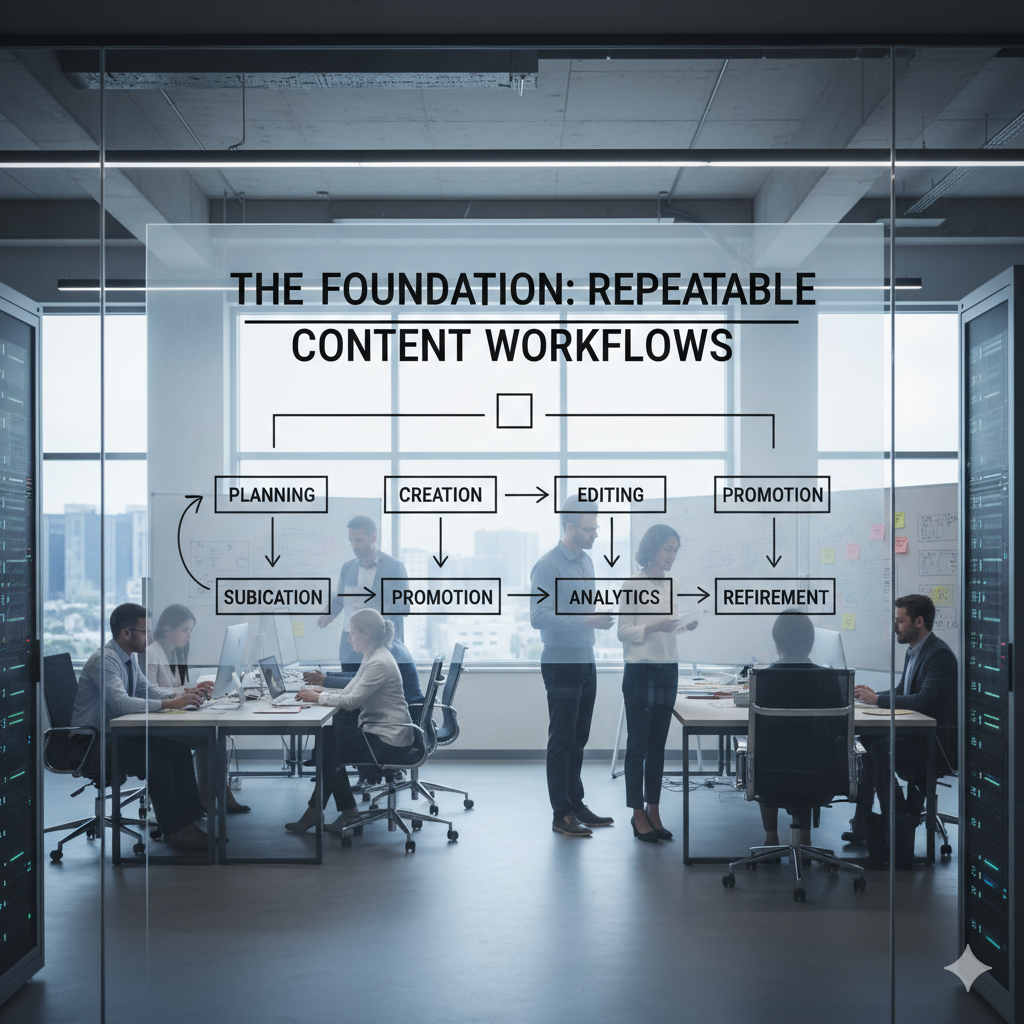
Most teams chase creativity like it’s a lightning strike. Quick. Rare. Unpredictable. But real growth happens somewhere else—in the quiet, behind-the-scenes structure that guides every piece of content from idea to publish. That’s the part people ignore because it feels boring. Yet it’s the backbone of any strong content scaling system.
Where Ideas Stop Getting Lost
Ideas come fast. They show up while scrolling, during calls, or in the middle of a random conversation. And just as quickly, they disappear. A repeatable workflow stops that from happening. It gives every idea a place to land. A simple note. A board. A list. Something that keeps thoughts from slipping through the cracks.
Then, instead of asking, “What should we make this week?” the question becomes, “Which idea in the queue is ready to move?” That shift alone removes half the stress.
From Rough Thought to Polished Content
Once an idea enters the workflow, it follows a path. Not a rigid one. Just a clear one. Your content workflow may involve outlining, scripting, designing, or moving straight into editing, depending on your process and goals. But the steps stay the same. You’re not reinventing the process each time. You’re just moving the piece forward.
And because the steps repeat, everything feels lighter. You know what happens next. The team knows what happens next. Even the content knows where it’s going.
Modular Beats Messy
Repeatable workflows thrive on small, modular tasks. Break big content into smaller blocks. A blog becomes sections. A video becomes segments. A podcast becomes timestamps. Modular pieces are easier to repurpose, easier to edit, and easier to scale.
Plus, when something changes—an angle, a headline, a stat—you don’t rebuild the whole piece. You just adjust the part that needs it.
Removing Friction, Not Creativity
Some creators fear that workflows crush their originality. But the opposite happens. When the routine tasks are predictable, your mind stays clear. You think better, write cleaner, and stay in flow longer with the right content systems supporting you. Creativity breathes because the workflow holds the heavy parts.
It’s like having rails on a track. You’re still driving the train. You’re just not derailing every five minutes.
Where Teams Finally Sync
A repeatable workflow doesn’t just help individuals—it aligns the whole team. Writers know when editors step in. Editors know when designers take over. Designers know when it’s ready for distribution. Everyone moves in rhythm.
Even small teams feel bigger because the system carries half the load. And big teams feel calmer because chaos stops running the show.
The Quiet Advantage
The truth is, your competitors are likely creating content. But they’re doing it in messy, unpredictable bursts. This is why creators burn out, why their content quality becomes inconsistent, and why their online presence fades whenever life or work gets busy.
But when your workflow repeats, your presence doesn’t slip. Your quality doesn’t wobble. Your momentum doesn’t die. Everything stays steady.
And that’s the foundation. Repeatable workflows turn scattered efforts into something strong. Something consistent. Something you can scale—again and again—without losing your mind or your message.
Content Distribution Platforms: The Backbone of Scale

You can create the smartest content in the world, but if it sits in a folder or waits in a draft, it’s just potential—nothing more. That’s where content distribution platforms change everything. They turn still ideas into moving ones. They push your work out into the world, consistently, even when you’re deep in another project. And when you’re building a strong content scaling system, this is the part that quietly carries most of the weight.
Where Content Starts to Travel
Think of distribution like wind. You can’t always see it, but you can feel its impact. Once your content lands inside a platform—any platform designed to send it across channels—it doesn’t just sit. It moves. It gets scheduled. Published. Reposted. Shared. All without you manually dragging it everywhere.
This movement matters because visibility is rarely about one big post. It’s about lots of small touches across different places. A platform makes that possible.
One Home For Everything
Most teams scatter their publishing tasks. A reel here. A newsletter there. A tweet scheduled somewhere else. It’s messy. And it drains energy you could’ve used to create.
A distribution platform fixes that by giving everything one home. One dashboard. One calendar. One timeline that shows exactly where each piece is going next. Suddenly, the chaos becomes a pattern. You see the whole picture instead of juggling ten tabs.
And when the picture is clear, decisions get easier. You start planning better. You start posting smarter.
The Difference Between Distribution and Amplification
People mix the two all the time. But they’re not the same. Distribution is the “send.” Amplification is the “spread.” One ensures your content goes out. The other ensures it gets noticed. A solid system needs both, but content distribution platforms handle the first part beautifully.
They post while you sleep, publish while you’re in meetings, and keep your online presence consistent so you can stay focused on creating your next big idea. And that consistency is what algorithms respect.
A Partner, Not A Replacement
Some worry distribution tools make everything robotic. But that’s not true. The human touch still decides the message, the tone, the timing, the angle. The platform just takes over the repetitive lifting.
Think of it like having an assistant who never forgets a deadline. You still drive the strategy. The tool just keeps things moving.
Why A Platform Multiplies Your Reach
Once your workflow feeds into a distribution system, the whole engine starts humming. You repurpose content faster, publish across more platforms, and effortlessly experiment with new formats because posting no longer feels like a chore.
And slowly, something shifts. Your reach grows. Your content shows up in more feeds, more inboxes, more conversations. People start recognizing your voice. Not because you posted more, but because you posted consistently.
A content scaling system only works when the output moves smoothly. Without distribution, everything stalls. With it, even small teams can look—and perform—like giants.
And that’s the backbone of scale: not louder work, but work that travels farther, effortlessly, day after day.
Scalable Content Marketing

Most teams think growth comes from creating more. More posts, videos and ideas. But real scalable content marketing doesn’t start with volume. It starts with transformation. It’s the skill of taking one strong piece and turning it into many—each one shaped for a different moment, a different platform, a different audience. And when this works, it feels less like grinding and more like multiplying.
One Idea, Many Lives
The magic begins with a single core asset. A podcast. A long video. A blog. Something with depth. From there, you start slicing. A clip becomes short. A paragraph becomes a carousel. A quote becomes a tweet. A single insight becomes a hook for a reel.
Suddenly, one idea isn’t just one thing anymore. It’s the source. The well. And that shift changes everything because you’re no longer chasing content—you’re expanding it.
The Power Of Repurposing
Repurposing isn’t recycling. It’s reframing. You take the same message and give it a different shape. Make it shorter, punchier, and more visually striking. The core stays the same, but the packaging changes so it fits the platform it lands on.
And this process isn’t just efficient. It deepens your message. People don’t remember something after one exposure. They remember it after many, delivered in fresh angles that hit from different directions.
A System That Compounds
When your repurposing process links with your content scaling system, the compounding effect kicks in. You produce one piece, but the system creates momentum. Everything feeds into everything else.
A script leads to blog sections. Blog sections lead to social posts. Social posts lead to micro videos. Micro videos lead to email content. And on it goes.
You’re not doing more work; you’re getting more outcomes from the same work.
Built for the Modern Attention Span
People scroll fast. They skim. They glance. That’s why scalable content marketing works so well. You create assets that meet them where they are. Long when they have time. Short when they don’t. Visual when they’re tired. Text when they want depth.
Multiple formats. Multiple touchpoints. Same idea, just translated.
Consistency Without Burnout
Here’s the quiet truth: most creators burn out not because they create too much, but because they create from scratch every time. A scalable approach stops that. It gives you rhythm. It gives you breathing room.
Instead of staring at an empty page, you’re shaping pieces from a full one. You’re refining, trimming, adjusting—not starting over.
And in that space, your voice grows stronger because you get to focus on quality, not quantity.
The Real Advantage
In a world overflowing with content, attention goes to the ones who show up often and consistently—without losing their tone or message. Scalable content marketing makes that possible. Consistency keeps you visible, relevant, and always moving forward online.
And when paired with a solid content scaling system, everything accelerates. Your content stretches, spreads, multiplies. One piece turns into twenty. Twenty turn into conversations. And those conversations turn into reach.
That’s the quiet power of scale—small pieces adding up to something much bigger than you expected.
Multi-Channel Content Amplification

You can publish the best piece of content in the world, but if it only lives on one platform, it’s like whispering in a crowded room. Someone might hear it, but most won’t. That’s where multi-channel content amplification steps in. It takes your message and sends it outward, in every direction, through every doorway your audience might walk through.
One Message, Many Stages
Think of your content like a performer. Your content doesn’t stay on one platform — it travels, appearing on TikTok as a short, high-impact clip that amplifies your reach. Then it shifts into a carousel on Instagram. Then it becomes a thread on X, a snippet on LinkedIn, a paragraph in your email newsletter, and maybe even a short reel on YouTube. Same message. New shape, stage. New moment to be seen.
And that movement matters because people don’t all gather in one place anymore. They scatter across platforms. Multi-channel content amplification brings your content to where they already are.
Small Ripples That Stack
Amplification doesn’t always feel dramatic. Sometimes it’s just a post shared twice. A clip reposted next week. A quote reused in a different way. But those small ripples stack. They create familiarity. Recognition. Memory.
Because the truth is simple—visibility doesn’t come from shouting once. It comes from showing up often, in subtle but steady waves.
Where Timing Becomes Your Quiet Advantage
Every platform has its own rhythm. Mornings on LinkedIn. Evenings on TikTok. Midday on Instagram. Late-night browsing on X. When you amplify across channels, you naturally stretch your visibility across different times, moods, and attention levels.
And suddenly, your content doesn’t feel like a one-time event. It feels alive throughout the day.
The Hidden Lift Inside Your Content Scaling System
Amplification links directly back to your content scaling system. While the system ensures you have enough content in motion, amplification ensures that content doesn’t fade after its first appearance. Instead, it gets a second wind. And a third. Sometimes a fourth.
This synergy turns each piece into a long-term asset, not a single-use post.
Meeting People Where They Scroll
- Every platform has its own language.
- Short and sharp for X.
- Polished and structured for LinkedIn.
- Fast and visual for TikTok.
- Warm and conversational for email.
Amplification means translating your message into each of these languages without changing the meaning behind it. It’s like telling the same story in different tones depending on who’s listening.
And when your content speaks their language, people pay attention.
The Real Growth Comes Later
Most amplification doesn’t create immediate explosions. It builds something slower—momentum. The more your content appears across channels, the more people start recognizing the name, the voice, the message. It becomes familiar.
And familiarity is what creates trust. Trust is what brings engagement. Engagement is what drives real reach.
In the end, multi-channel content amplification isn’t about being everywhere for the sake of it. It’s about giving your ideas the room they deserve to travel. It’s about showing up, again and again, in ways that feel natural.
And when that rhythm kicks in, your content stops feeling isolated. It starts feeling amplified—louder, stronger, and far more alive than it did on its own.
The Role of AI and Automation

People talk about AI like it’s here to take over everything. But in reality, it’s more like a quiet assistant—always working, rarely seen, and surprisingly good at handling the parts we tend to avoid. And inside a strong content scaling system, AI isn’t the star. It’s the engine that keeps things moving when human energy dips.
Automating the Heavy Lifting
Most creators love the creative part. The brainstorming. The scripting. The storytelling. But the repetitive tasks? Formatting. Scheduling. Tagging. Drafting variations. Those can drain momentum fast.
This is where automation steps in. It does the boring work without complaining. It keeps things organized even when your mind is already onto the next idea.
And because those small tasks disappear, you get time back—time to think, refine, polish, and create.
A Tool for Flow, Not Replacement
Some people worry automation will steal the human feel from their content. But automation doesn’t write your voice. It doesn’t choose your message. It simply clears the path so you can focus on the parts only you can do.
Think of it like this: you set the direction. AI just keeps the wheels turning.
Faster Decisions, Clearer Insights
AI sees patterns long before humans do. It notices which formats work, which headlines land, which platforms respond better at certain times. And these insights aren’t meant to replace intuition—they strengthen it.
You still trust your gut. AI just gives your gut better data.
Repurposing Made Easier
One of the biggest advantages of AI is how fast it can break content into smaller pieces. A video can become ten clips. A blog can become five captions. A podcast can become quote cards and carousel ideas.
Not because AI is “creative,” but because it’s fast. It pulls out the raw material so you can shape it in your own style.
This synergy makes repurposing feel less like a chore and more like a natural extension of your workflow.
Keeping Consistency When Life Gets Messy
Humans slow down. We get tired. We get busy. But automation doesn’t. It keeps posting, distributing, and scheduling your content automatically—whether you’re in a meeting or halfway across the world.
And that consistency is the quiet superpower behind scale. Not bursts of effort, but steady movement.
Removing Friction From Every Stage
When AI handles the micro-tasks, everything gets smoother. Ideas move faster. Teams sync better. Deadlines feel lighter. Bottlenecks shrink. It’s not that AI does the job for you—it simply stops slowing you down.
And when paired efficiently with automation, your workflow starts to feel like a clean, well-lit hallway instead of a maze.
The Real Benefit
AI doesn’t replace creativity. It protects your creativity by giving you space and returning the hours you lose every day to repetitive, manual tasks. And with those hours, your ideas grow sharper and more consistent.
Inside a content scaling system, AI isn’t the hero. It’s the steady hand making sure the system keeps running—quietly, reliably, and without interruption.
Common Mistakes That Kill Content Scale

Scaling content sounds simple on paper. You produce more, publish more and grow more. But in reality, many brands hit a ceiling long before they see real momentum. They work harder, but the results stay flat. And often, the reason is not lack of effort—it’s a few avoidable mistakes that quietly slow everything down. When you recognize these traps early, your content scaling system becomes smoother, faster, and far more predictable.
Focusing on Volume Instead of Value
One of the biggest mistakes is thinking scale is only about numbers. More posts, more videos. More everything. But when the quality drops, so does engagement. People can tell when something feels rushed or generic. And once your audience stops paying attention, your entire engine loses power.
Instead, scale the process, not the shortcuts. Keep a consistent voice. Maintain clear viewpoints. Make every piece useful. Quantity matters, but value keeps your audience coming back. And when that trust grows, scale becomes easier and more sustainable.
Ignoring the Customer Journey
Another issue shows up when content teams flood the internet with random pieces that don’t align with what people actually need. Without mapping your customer journey, you end up with gaps in awareness, confusion in consideration, and silence during decision-making.
A strong system connects the dots. Each article, clip, or graphic moves someone forward. Each channel supports the next. And because everything aligns with real customer behaviour, the content doesn’t just fill space—it pushes growth. When your content knows where it’s going, your results follow.
No Clear Distribution Strategy
Many brands invest heavily in production and almost nothing in distribution. They assume publishing is enough. It isn’t. If your content goes live without a plan behind it, it will disappear into the noise.
You must prepare a path for every asset. That includes repurposing, reposting, and reshaping content to fit each platform. It also means knowing when and where your audience spends time. When distribution becomes part of your workflow rather than an afterthought, scale stops feeling like guesswork and starts working like a real system.
Doing Everything Manually
Manual processes drain time. They slow momentum. And they limit how far you can grow. When teams refuse automation because “we’ve always done it this way,” they end up stuck at the same level forever.
Automation doesn’t remove creativity—it protects it. By automating the repetitive parts, your team can think bigger, move faster, and create with more clarity. It also reduces errors and keeps your entire machine running smoothly.
Lack of Documentation and Workflow Systems
If your process lives in someone’s head, your scale is fragile. One person leaving or taking a break can stop the entire pipeline. Without workflows, templates, and SOPs, content becomes inconsistent, slow, and difficult to track.
Strong documentation creates stability. It builds clarity. And it gives you a reliable structure you can grow on. When everyone knows how things move from idea to distribution, your engine becomes stable enough to scale.
Scaling Without Data
Finally, many brands scale blind. They publish without knowing what’s working. They repeat formats that perform poorly and ignore the ones people love. And because they guess instead of measure, their efforts produce minimal return.
Data gives you direction. It helps you shift resources, reveals your strengths. It also prevents you from wasting time on content that won’t help you grow. When you use data to guide your moves, your scale becomes intentional—never accidental.
Conclusion
Scaling content doesn’t just happen. It’s more like building a machine that keeps moving on its own. A content scaling system gives every idea a path, every team member a rhythm, and every post a reason to exist.
It’s not about posting more. It’s about stretching one idea into many. A blog becomes snippets, clips, emails, carousels. A video travels across platforms. Each piece works harder, without you burning out.
Mistakes happen. Gaps appear. But systems fix that. They keep things steady, let creativity breathe and make sure nothing dies in drafts.
And slowly, the magic shows. Content moves, reaches, connects. It grows. Not because you worked more, but because your system works smarter. That’s the real win—a flow that keeps going, long after you hit publish.